Halloween season has reached the point where a bright-orange unicorn can become the most suspicious creature in a Universal Studios Hollywood parking lot.
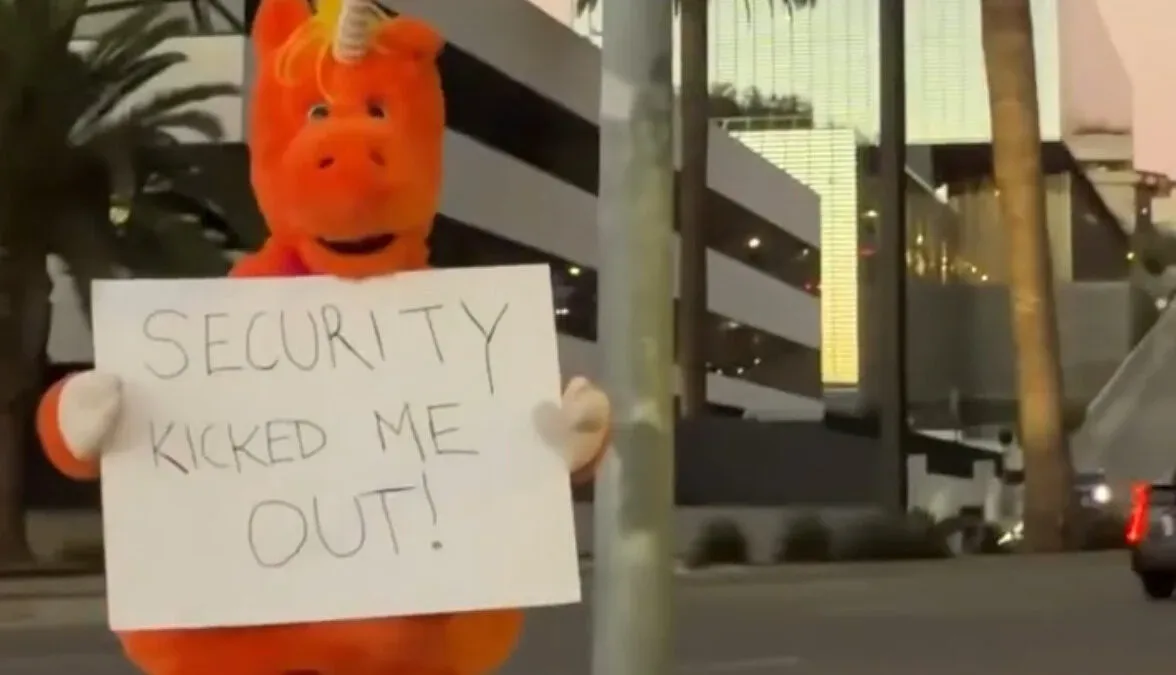
A brief video circulating around the start of September shows Buddy the Unicorn, the oversized mascot tied to a new horror film, hanging around outside Halloween Horror Nights. Buddy poses for photographs with people in the lot before staff members approach and escort the character away from the area. The bit has the polished, knowing feel of a possible promotional stunt, but it also plays on a very real part of the event experience: guests generally are not permitted to arrive in costume for Halloween Horror Nights.
That makes the gag unusually effective. Buddy is not a guest in a witch hat or a casual vampire cape. The character is a giant, unmistakably branded orange unicorn attempting to enter one of the biggest seasonal horror destinations in the country. In the logic of the clip, the park has met a walking advertisement for a monster movie and decided it has enough monsters already.
Universal Studios Hollywood has not been short on them. Its Halloween Horror Nights program for the season includes haunted-house attractions connected to Hellraiser, Sinners, Stranger Things, and Killer Klowns From Outer Space. The wider event has also made room for horror figures outside the traditional maze format, including walkabout appearances by Art the Clown from Terrifier and “Freaky” Nikki from Obsession.
So Buddy’s removal lands as a tiny piece of spooky-season theater: an interloper arriving at a party already packed with established nightmares, only to learn that the velvet rope applies even to supernatural plush animals.
A cheerful mascot with an ominous premise
Buddy is the featured costume character in a new film from Casper Kelly, who is known for the viral Adult Swim segment Too Many Cooks. The movie’s setup takes a familiar piece of children’s entertainment—a colorful show built around a large, friendly mascot—and twists it toward eldritch horror. Buddy’s soft, child-friendly exterior conceals something far more threatening.
That contrast is central to why the character works as an attention-grabbing image. A mascot is designed to be simple, colorful, highly visible, and inviting from a distance. Horror has repeatedly used those same traits to make viewers uneasy. The visual language of children’s television is supposed to communicate safety and routine; placing an ancient or unknowable menace inside it turns reassurance into a warning label.
The film stars Cristin Milioti, Keegan-Michael Key, Patton Oswalt, and Michael Shannon. It has also reportedly outpaced its projected box-office expectations by several million dollars despite a modest budget. That result fits a broader 2026 pattern in which lower-cost horror releases have drawn audiences in numbers that can look especially strong beside much larger blockbuster campaigns.
Related coverage includes Buddy the Unicorn Removed From Universal Studios Hollywood's Halloween Horror Nights.
Buddy’s parking-lot appearance is therefore more than a random mascot sighting. It is a compact example of modern horror promotion: put a distinctive character in a public place, let people take pictures, and make the character’s behavior part of the joke. A unicorn being refused entry to Halloween Horror Nights is inherently shareable because the setting gives the gag its punchline. This is the place that welcomes killers, demons, and creatures—just not necessarily a character selling a different studio’s film.
Why the apparent stunt still follows the rules
The available video suggests a staged or at least heavily choreographed scenario, and it should be treated with that uncertainty in mind. The interaction is short, Buddy is visibly drawing attention and photos, and the outcome is almost too perfectly tailored to the premise. There is no need to assume that every element happened spontaneously for the story to make sense.
Still, the underlying restriction is plausible. Halloween Horror Nights is built around carefully managed costuming, performers, themed spaces, and guest safety. Allowing visitors to wear elaborate outfits could make it harder to distinguish official performers from members of the public, complicate crowd management, and create unwanted confusion around characters who appear frightening or gory. A full mascot suit is exactly the sort of thing likely to attract extra scrutiny.
There is also the straightforward branding issue. Halloween Horror Nights routinely partners with major horror properties, but its attractions are part of Universal’s own event presentation. A conspicuous character connected to another movie is not merely a guest wearing a costume; Buddy functions as a highly visible promotional object. Whether the removal was planned or genuine, the scene understands that an event can be enthusiastic about horror while still controlling which horror brands are represented within its gates.
That distinction is worth remembering for fans tempted to show up in an elaborate getup. The event’s atmosphere can invite people to dress for the season, but its themed scares work differently from a conventional costume party or an open cosplay convention. The performers, mazes, and roaming figures are part of an organized production. Guests are there to experience the illusion, not join the cast.
Halloween Horror Nights keeps expanding beyond the maze
For years, licensed horror attractions have been an essential draw for Halloween Horror Nights, with a recognizable film or television property often serving as the hook for a dedicated haunted house. This season’s lineup illustrates the range of that strategy, moving from supernatural horror in Hellraiser to the contemporary cultural footprint of Stranger Things, alongside Sinners and the cult-chaos energy of Killer Klowns From Outer Space.
But the event is no longer limited to the idea that every major character must stay behind the entrance of a maze. Art the Clown and “Freaky” Nikki being added as walkabout characters shows the value of turning the paths between attractions into part of the show. A roaming character can create a quick fright, a photo opportunity, or a viral clip without requiring guests to queue for an entire house.
That approach resembles the broader entertainment logic behind live-service games and seasonal events. The attraction is not only the large, scheduled activity; it is also the possibility that something memorable happens while moving between activities. A well-placed character encounter turns transit time into content. In Buddy’s case, the trick was to make the encounter happen just outside the event rather than inside it.
The seasonal footprint has grown in other directions as well. Halloween Horror Nights has continued extending its operating season, while a year-round Halloween Horror Nights attraction opened in Las Vegas last year. Together, those developments reflect an appetite for horror that no longer needs to wait strictly for the final weeks of October. The genre can function as a full calendar of experiences, merchandise, screenings, themed food, and in-person events.
For people interested in the overlap between pop culture and interactive entertainment, the enduring appeal is easy to recognize. Like games, haunted attractions ask participants to enter a designed space with rules, audiovisual cues, and moments of controlled surprise. They turn familiar properties into places people can move through, react to, and talk about afterward. The latest game news may be about world maps and new systems—such as the planned Atomic Age and nuclear diplomacy additions planned for Civilization 7—but seasonal attractions operate on a similar urge to revisit known worlds in a new, participatory form.
Buddy’s ban is the joke, not the setback
There is a practical lesson in the episode: a horror mascot does not need to get inside Halloween Horror Nights to benefit from being associated with it. The refusal is the entire premise. Buddy standing in a parking lot, being photographed, then getting escorted off creates a miniature story with a beginning, middle, and punchline. It communicates the character’s odd visual identity while borrowing the cultural force of a major horror event.
It also arrives at a moment when compact horror concepts have particular visibility. A simple but unsettling image—a cheerful orange unicorn whose costume hides an eldritch threat—can travel quickly because the premise is understood instantly. That does not guarantee a film’s success, but it gives audiences an easy reason to be curious, especially when a character can be placed beside familiar horror icons without disappearing into the crowd.
For now, Buddy appears to have been left outside while Universal Studios Hollywood fills its own Halloween Horror Nights spaces with officially invited nightmares. The orange unicorn may not have secured access to the event, and the video may well be a purposeful bit of promotion. Either way, the character got what a mascot in a horror campaign wants most: a crowd, cameras, and one memorable reason to be talked about.