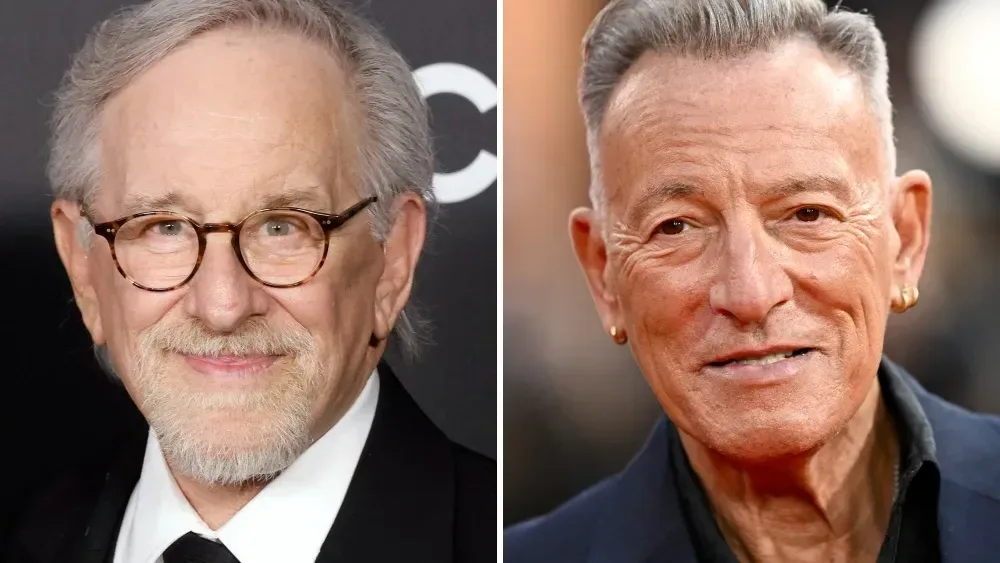

Bruce Springsteen arrived at a Museum of Modern Art tribute to Steven Spielberg with an accusation that has apparently been waiting almost 50 years to surface: Jaws ruined skinny dipping.
Honoring Spielberg at MoMA and Chanel’s 18th Annual Film Benefit, Springsteen looked back to the Jersey Shore of 1975 and the appeal of swimming at night. Then came Spielberg’s shark thriller, and, in Springsteen’s comic accounting, the water became a much less inviting place. His central charge was blunt, affectionate and not especially subtle: Spielberg had thoroughly messed it up.
The joke works because Jaws is not merely a famous movie about a shark. It is a cultural warning siren with a fin. Its premise has long outlived any individual scene: the ocean is enormous, opaque and potentially occupied by something that does not care about your plans. Springsteen’s riff made a familiar cultural effect into a mock personal grievance, with night swimming as the collateral damage.
A friendship with a very large boat-shaped loophole
Springsteen and Spielberg have been friends for around 30 years, so the speech was delivered from a place of real familiarity rather than hostile waters. Springsteen said he had joined Spielberg aboard the director’s boat on several occasions and used that experience to advance the case.
Spielberg, Springsteen said, owns a vessel far grander than the larger boat needed in Jaws. Yet, despite being surrounded by the sea, Springsteen said he had not seen Spielberg get into the ocean. The director, he added, does not use the boat’s swimming pool either.
That observation gave Springsteen’s bit its ideal comic reversal. The filmmaker responsible for cinema’s most enduring sea-going anxiety was portrayed as a man who has chosen a firm no-contact policy with water. Springsteen’s proposed explanation for the global decline of carefree nighttime dips was therefore not that audiences were irrationally frightened by a highly effective thriller. It was that Spielberg himself is scared of the water.
It is difficult to improve on the architecture of that joke: make a terrifying shark film, obtain an enormous boat, avoid both ocean and pool, then receive a public indictment from the Boss.
Why this particular movie still has teeth
Jaws, released in 1975, is widely regarded as the first summer blockbuster. In film-business language, a blockbuster is a release designed and distributed as a major event, with an exceptionally broad commercial ambition. The movie helped reshape the way Hollywood handled big-budget spectacles, and its influence remains part of the reason a Spielberg celebration can invite jokes about a decades-old shark and still have every listener immediately understand the premise.
Related coverage includes Bruce Springsteen Jokes Spielberg Ruined Skinny Dipping With ‘Jaws’.
Springsteen was not delivering a literal historical analysis of beach culture. He was describing a recognizable consequence of a powerful popular image. A fictional shark became a durable mental shortcut for the dread of water one cannot see through. That is the peculiar success of a movie like Jaws: its threat is specific enough to be memorable but broad enough to follow people into entirely different contexts, including a moonlit swim far from the film’s own setting.
There is also a neat contrast in Springsteen’s choice of target. His version of the pre-Jaws shore is intimate, spontaneous and carefree. Spielberg’s movie is built around tension, uncertainty and an unseen danger. Putting those two moods side by side turns the tribute into an argument that a filmmaker did not just change movies; he changed the emotional weather around open water.
A room full of collaborators and friends
Springsteen’s routine capped an evening that brought together an unusually deep bench of Spielberg collaborators and peers. Tom Cruise, Robert De Niro, Martin Scorsese, Cate Blanchett, Drew Barrymore, Steve Martin and Stephen Colbert were among those attending the benefit.
Spielberg characterized the gathering as a family affair, saying that the people present were friends connected to him through long professional and personal relationships. That framing was reinforced by Cruise, whose opening remarks were a surprise to Spielberg himself. Cruise worked with the director on Minority Report in 2002 and War of the Worlds in 2005, and thanked him for his generosity over the years and for the opportunity to make the two films together.
Scorsese took a different route, reflecting on the fact that he and Spielberg had reached their 80s. The line is simple, but in the context of the event it underscored what was being celebrated: not a single title, but a career extending across multiple generations of filmmakers, performers and moviegoers.
The night also included Emily Blunt, who discussed Spielberg’s on-set enthusiasm following a take he likes. A scene from Disclosure Day was screened at the dinner, showing Blunt’s character discovering a mind-reading ability in the middle of a speeding-ticket encounter. Blunt described Spielberg emerging from behind the tent, cheering with his fists raised when he is excited by what has been captured.
That image of an energetic director is a useful counterpoint to Springsteen’s water-shy Spielberg. One man, two pictures: a filmmaker who continues to visibly revel in the work, and a boat owner who, in his friend’s telling, sees a pool as scenery.
Spielberg’s next project remains unsettled
Disclosure Day returned Spielberg to alien life nearly 50 years after Close Encounters of the Third Kind. It grossed $248 million worldwide during the summer, described as a modest result. The film’s alien connection is notable because it places a recent release in conversation with one of the director’s longstanding creative fascinations without suggesting he has stopped looking in other directions.
Spielberg has previously mentioned a “kick-ass” Western in development, but he did not identify it as his next project. Instead, he said he has multiple projects in development and is still working out which one he will make next.
That uncertainty is worth retaining rather than filling with guesses. “In development” means a project is being worked on before the full production phase; it does not establish that it will be made next, or at all. For now, the Western is a possibility, not a confirmed follow-up. The only solid takeaway is that Spielberg is considering several options.
The preservation work behind the party
The benefit raised the most money in the event’s history. Its proceeds help MoMA acquire and restore classic films for future generations, a mission that suits a night devoted to a director whose work has become part of the shared movie vocabulary.
Film restoration refers to the work of preserving and repairing movies so they can endure and be shown in the future. Acquisition matters too: an institution needs works in its holdings before it can preserve, study and exhibit them. The glamour of a benefit can make that work easy to overlook, but it is the practical reason the event exists.
Chanel has supported the annual benefit since 2011 and has been MoMA’s lead film sponsor since 2021. Spielberg joins a previous roster of honorees that includes Scorsese, Cate Blanchett, Tom Hanks, Sofia Coppola, Samuel L. Jackson, Guillermo del Toro, Penélope Cruz, George Clooney, Laura Dern, Julianne Moore, Alfonso Cuarón, Tilda Swinton, Quentin Tarantino, Pedro Almodóvar, Kathryn Bigelow, Tim Burton and Baz Luhrmann.
There are many ways film history persists: restored prints, studio archives, museum collections, and even the market for screen-used artifacts. That latter lane recently produced a striking example when Darth Vader’s screen-used lightsaber sold for a record $4.875 million. But MoMA’s focus is on the films themselves—the works audiences need to be able to see, not merely the objects associated with them.
For Spielberg, the gala offered praise from friends, collaborators and fellow giants of cinema. For Springsteen, it offered something equally valuable: a public venue to establish that if anyone’s reluctant to swim after dark, responsibility begins with the director of Jaws. The prosecution rests—preferably somewhere dry.