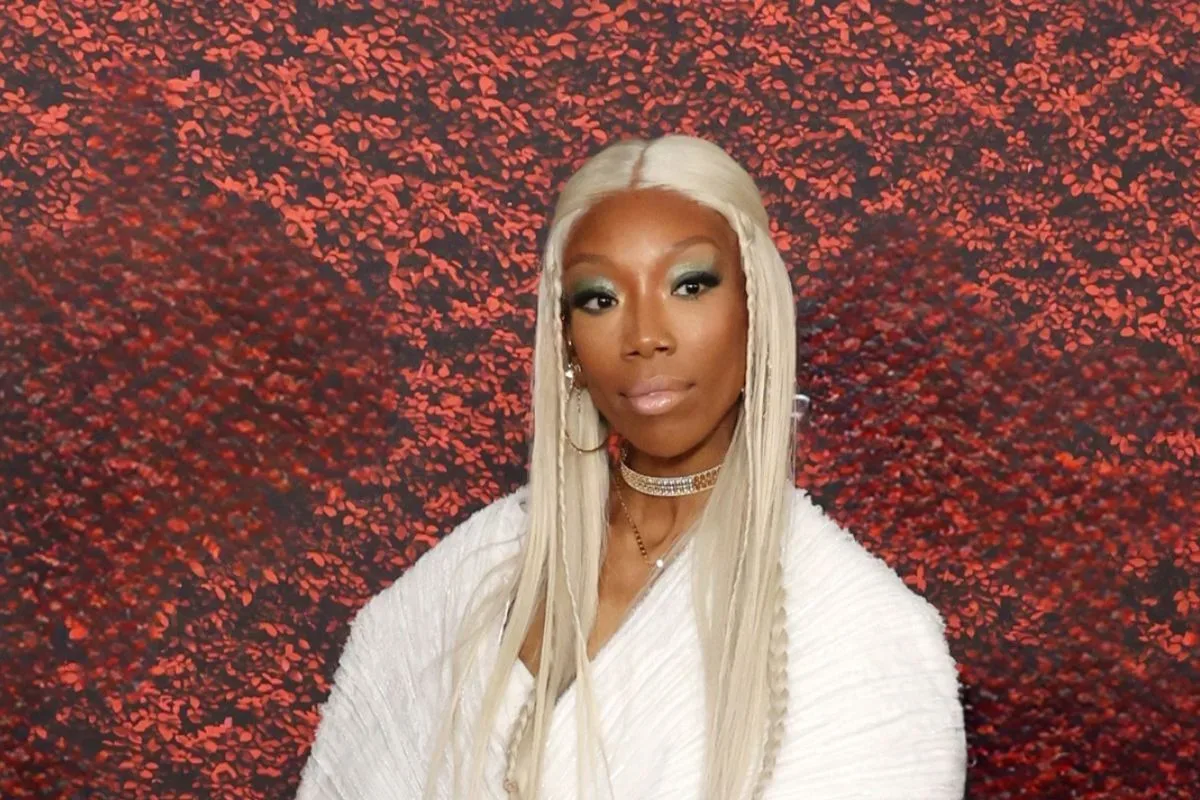
Brandy used a major career honor to make room for a message that was much more personal than ceremonial.
Accepting recognition at the Power 100 gala on November 9, the singer spoke about self-image, grief, early pressure and the long process of learning to view her own achievements without diminishing them. The event at the Hollywood Palladium in Los Angeles placed her among honorees from music, business, sports and community leadership, but Brandy’s remarks centered on an inward-looking idea: success can be difficult to accept when a person has spent years measuring themselves against outside expectations.
“Tonight I can feel the weight of what I’ve accomplished without making myself feel smaller,” Brandy said.
It is a concise line, but it captures the difference between being publicly celebrated and personally allowing that celebration to register. Awards ceremonies typically spotlight an achievement as a fixed endpoint: a room recognizes a body of work, an audience applauds, and an honoree steps to the microphone. Brandy instead framed the moment as part of an ongoing effort to see her own life and career clearly.
Coco Jones introduced Brandy and performed a tribute built around Brandy’s music, giving the evening a direct generational dimension. A younger artist honoring a veteran performer is familiar gala programming, but it also sharpened the focus of Brandy’s speech. Her work was being revisited in song while she addressed the less visible experience of living through childhood, fame and personal loss.
A speech connected to Phases
Brandy’s comments followed the March release of her memoir, Phases. The book addresses her childhood, early fame and her effort to locate her own voice beyond the demands and perceptions of other people. Those themes gave the acceptance speech useful context: the evening was not presented as a new public disclosure so much as another occasion for her to articulate ideas she has been exploring while telling her story in her own words.
A memoir is distinct from a career retrospective. A retrospective can assemble accomplishments from the outside, with eras, milestones and prominent performances arranged into a record of achievement. A memoir is personal narrative: its emphasis is the author’s perspective on what events meant, what pressures surrounded them and how those experiences changed them. In Brandy’s case, the available details about Phases make the book’s central concern less about simply cataloging success than about reclaiming a sense of self from the noise that can accompany public life.
That distinction matters when considering the quote she offered at the gala. “Feeling the weight” of an accomplishment is not merely acknowledging that it happened. It suggests accepting its importance without treating confidence as arrogance or self-recognition as something that must be apologized for. Brandy’s language identifies self-minimization as the obstacle, rather than the absence of achievements to celebrate.
Related coverage includes Brandy Reflects on Self-Worth While Accepting Power 100 Honor.
There is also a clear connection between early fame and the pressure she described. Becoming known at a young age can mean that public commentary, industry expectations and personal development occur at the same time. Brandy did not turn the gala remarks into a complete accounting of that experience, but she explicitly tied her reflections to grief, growing up under pressure and the material behind Phases.
Recognition and self-worth are not the same thing
The Power 100 setting created a useful contrast. The ceremony exists to recognize influence and achievement, and its program included people working across several fields. Public recognition can affirm a person’s impact, yet it cannot automatically resolve the private difficulties involved in believing one deserves it. Brandy’s remarks made that gap the emotional center of the moment.
That is why the speech’s focus carries beyond a conventional thank-you address. It does not reject the honor or downplay its significance. Quite the opposite: Brandy spoke about being able to receive it fully. The message was that acknowledging one’s accomplishments need not require becoming smaller, more palatable or less honest about hardship.
For audiences following artists through eras of their work, the practical takeaway is simple but meaningful: the polished public record does not show every internal negotiation behind it. An honor can mark influence; it cannot summarize a person. Brandy’s appearance kept both truths in view, recognizing the scale of her career while placing emotional well-being and self-regard within the same conversation.
That broader pop-culture conversation often rewards certainty, reinvention and perfectly packaged triumph. Brandy’s framing leaves space for another version of success—one in which reflection, grief and self-acceptance are not detours from achievement, but part of understanding it.
A year of hometown recognition and a pledge for student musicians
The gala honor arrived after Brandy’s hometown celebration in Mississippi earlier this year. During that visit, she received keys to McComb and Pike County and pledged $100,000 for new middle-school band instruments.
The pledge gives the recognition a tangible community-facing dimension. School-band equipment is a practical resource, not an abstract tribute: instruments are central to whether students can participate in an ensemble and develop musical skills together. The available information does not specify a distribution timetable, the particular instruments involved or the schools that will receive them, so those details should not be assumed. What is established is the amount of the pledge and its intended purpose: new instruments for middle-school bands.
Placed beside the Power 100 speech, the Mississippi event shows two complementary forms of legacy. One is public recognition of what Brandy has contributed across her career. The other is an investment directed toward young musicians in her home area. Neither erases the personal themes she raised in Los Angeles; together, they underscore that an artist’s accomplishments can be measured both in personal endurance and in what they help make possible for others.
An evening built around cultural leadership
Brandy shared this year’s special-honoree court with Flau’jae Johnson, Keith Lee, Lena Waithe, Byron Allen and Victor Glover. The group reflects the event’s cross-disciplinary design, bringing together figures associated with entertainment, sports, media, food and space exploration rather than confining recognition to one industry.
Tisha Campbell hosted the ceremony. The evening also noted more than 80 years of the organization’s history, while its leadership described celebrating Black leaders who are moving culture forward as central to the event’s mission. That language helps explain why the gala’s scope extended beyond chart success or entertainment credits. Cultural leadership can encompass creative work, entrepreneurship, community impact, public visibility and the ability to open doors within an industry or beyond it.
The program’s musical side included an opening appearance from Kirk Franklin, a performance drawing from Tyrese’s catalog, and Monica’s introduction for the closing speech. T.I. closed his set with “Pistol on the Dance Floor,” delivering its final verse a cappella.
Those performances provided the expected live-event energy, but Brandy’s speech supplied a quieter counterpoint. A gala can make achievement look effortless because it presents the polished result: songs performed, careers honored and applause delivered on schedule. Her comments redirected attention to what recognition can mean to someone who has had to work through grief, public pressure and a difficult relationship with self-image.
Why the moment resonates beyond the ballroom
Brandy’s central point is not that career success fixes self-worth. It is that she is learning to let herself acknowledge success without shrinking in response to it. That is a more complicated, and arguably more useful, message than a standard victory lap.
For long-time listeners, the remarks offer a lens through which to consider the personal stakes behind a public career. For people encountering the story through the memoir or the gala itself, they emphasize that self-authorship is a continuing practice. Telling one’s story in a book does not permanently settle every question raised by that story; speaking at a ceremony does not end an internal struggle. Both can be moments of articulation within a longer process.
There is room for celebration in that process. Brandy did not dismiss the night’s honor. She accepted it in front of peers and colleagues, after a musical tribute from Coco Jones, while plainly naming the work required to receive that kind of affirmation. That combination—gratitude without self-erasure—is the lasting point of the appearance.
Readers looking for another recent example of live performance and personal perspective intersecting in pop culture can also explore Jinkx Monsoon and BenDeLaCreme’s case for live art.