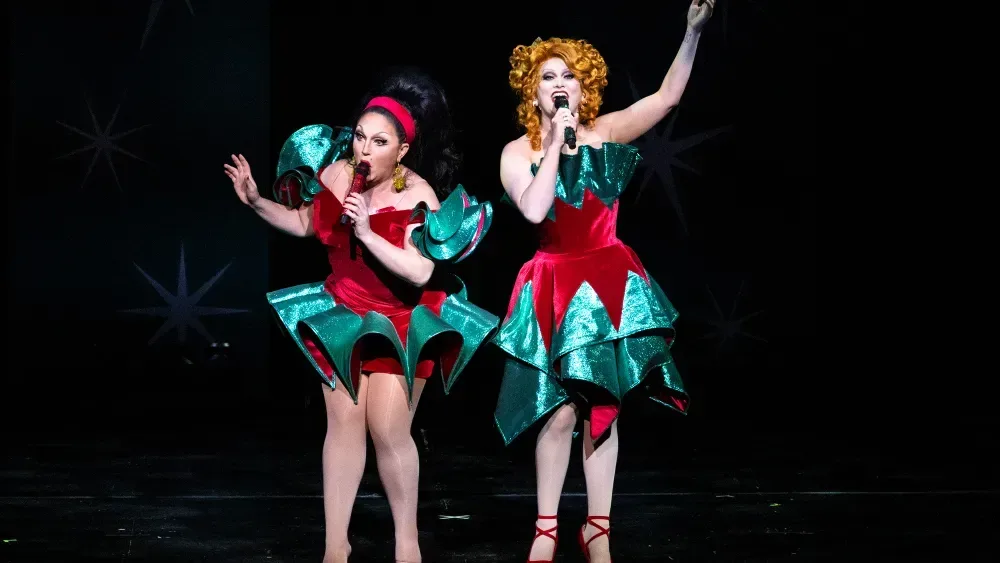
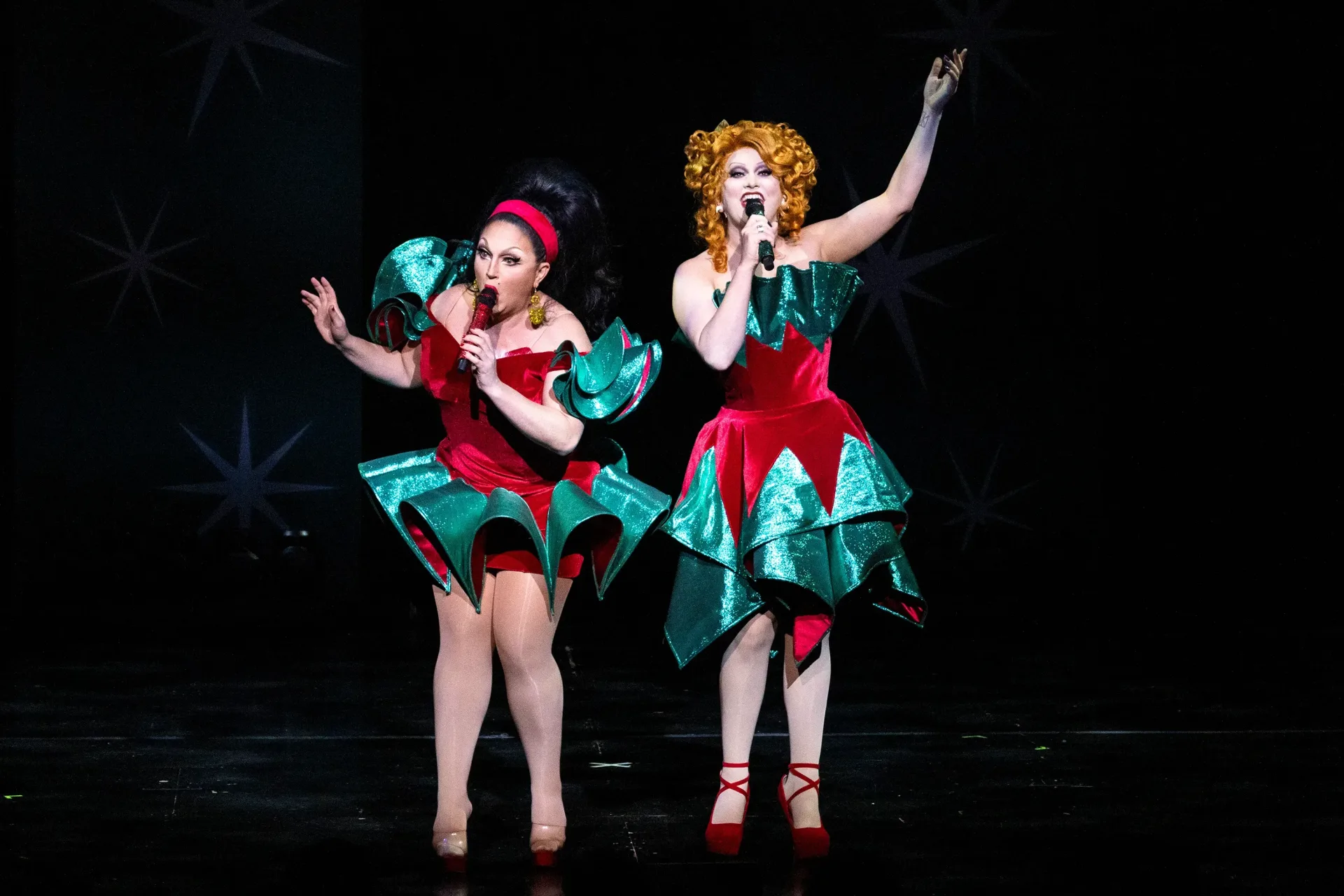
Jinkx Monsoon and BenDeLaCreme are taking The Jinkx and Dela Holiday Show back across the United States for its ninth touring year, with a new story built around a particularly seasonal villain: a billionaire Ebenezer Scrooge who buys out the holiday production.
It is a deliberately broad comic setup, but it gives the performers room to address a serious concern that runs through the new show: the uncertainty surrounding artists’ work, livelihoods and creative independence. Monsoon and BenDeLaCreme’s approach is not to separate social unease from holiday entertainment. Instead, they use familiar Christmas-fiction shorthand, songs and drag performance to make the big conversation playable onstage.
The tour is set to visit Cincinnati, New York, Cleveland, Detroit and San Francisco, alongside an Atlanta stop at The Eastern Theater. Seattle remains a holiday tradition for the production, with performances scheduled from December 21 through December 24 in the city where the pair’s friendship began.
A holiday premise with a pointed target
Scrooge is a useful comic antagonist precisely because the character is instantly legible. He represents hoarded wealth, hard-hearted calculation and the idea that a Christmas redemption arc is even possible. In this version, the character’s billionaire status brings those familiar associations into a current argument about money and culture.
That does not mean the show is being presented as a lecture with tinsel around it. Monsoon described the duo’s creative instinct as having important conversations in intentionally silly forms. Their holiday framing gives them a shared fictional vocabulary: audiences understand Scrooge, winter stories and the basic rhythm of a seasonal show before the performers begin bending those tools toward contemporary anxieties.
For readers wanting another recent pop-culture encounter with the character’s legacy, Joking Joystick has also covered a project titled “Ebenezer” connected to the Bay Theater’s reopening. The enduring utility of the Scrooge figure is that the character can be adapted without needing a long explanation: put him near a business decision, a celebration or an act of generosity, and the moral tension is already in the room.
Here, the central question appears to be less whether Scrooge will learn kindness than what happens when commercial priorities take over a space made for artistic expression. Monsoon framed that tension in practical terms. Artists need to support themselves, but they also want to remain faithful to the work they set out to create. Those are not abstract concerns for performers, writers or any creative workers whose output is often discussed first in terms of its monetary potential.
Why live performance matters to this story
The pair’s discussion of the new show also makes a case for the particular value of live entertainment. BenDeLaCreme emphasized the directness of a performer and audience sharing a physical room: viewers can see that the event is happening in front of them and experience a form of mutual presence that does not translate in quite the same way through a screen.
That distinction is important to the premise. A holiday tour is not simply content moving from city to city. Each performance depends on people gathering at a scheduled time, performers responding to the energy of a room, and an audience receiving the jokes, music and themes together. The product is the performance, but the occasion is also part of what people are buying into.
Monsoon contrasted that environment with filmed media, which she characterized as increasingly shaped by a pressure toward what is most commercially efficient rather than what makes the strongest work. That is an argument about incentives, not a claim that all screen work lacks artistic merit. The point is that a live show can preserve a visibly human scale: the performer is there, the audience is there, and neither side has to infer the other’s presence from an interface.
For a touring production led by drag artists, that immediacy also has an obvious communal dimension. Monsoon said packed houses around the country have been a reminder that queer community exists far beyond one city or one region. The tour’s itinerary matters in that sense. It creates recurring temporary spaces where people with shared concerns can assemble, laugh and recognize one another.
Hope without treating it as automatic
The show’s themes arrive in a political climate Monsoon described as difficult for queer and trans people. She recalled that a preview two years earlier fell on the night Donald Trump won a second time, a circumstance that made performing feel especially heavy.
This year’s emotional context is different for the duo. They spoke in the wake of what they called a “blue tsunami,” describing renewed hope while stressing that better outcomes do not maintain themselves. BenDeLaCreme’s formulation is central to the show’s apparent perspective: the future is unknown, it can be frightening, and inevitability is often a misleading story people tell themselves.
That makes for a more complicated seasonal message than a tidy promise that everything will be fine by the last number. Holiday entertainment often relies on resolution, reunion and the ritualized expectation of good cheer. Monsoon and BenDeLaCreme appear to be using those conventions while leaving space for vigilance. Hope is not presented as a substitute for continued effort; it is a reason to continue participating.
That balance may be why Scrooge fits the year’s material so neatly. The character traditionally embodies a world where wealth and human feeling are in conflict, but the story also insists circumstances can change. In the duo’s hands, that recognizable framework can accommodate jokes about power and commerce while still arguing that audiences, artists and communities have agency.
Tributes built into the show’s own language
The new edition will also include tributes involving Tim Curry and Dolly Parton. Monsoon said the writing process starts from a blank slate, though BenDeLaCreme typically arrives with a few creative imperatives: perhaps a current pop song, a film or another cultural reference that needs a place in the show.
For this production, the request was straightforward in principle and challenging in execution: find room for a Dolly song and a Tim Curry song, then make those moments feel native to the odd comic universe of The Jinkx and Dela Holiday Show. Monsoon said the eventual use is unlikely to be what an audience would predict in isolation, but makes sense within the production’s particular style.
That is a meaningful distinction. A tribute can be as simple as an imitation or a song selection, but it can also function as a structural choice: a way to place admired figures inside a new work without reducing them to a reference. The performers described Curry and Parton as multigenerational queer icons whose cultural presence remains strong. Their inclusion positions the show’s seasonal story in conversation with a longer, shared performance tradition.
Beyond that, the available details do not specify which songs will be used or how the numbers will be staged. Keeping those surprises intact is probably part of the point. The appeal of an annual touring production is not merely that the hosts return, but that the hosts return with a new set of connections, jokes and theatrical problems to solve.
Nine years of making the seasonal show new
A ninth year on the road brings a built-in challenge. The show must retain enough of its identity to satisfy returning audiences while giving them a reason not to regard it as a repeat visit. Monsoon and BenDeLaCreme’s stated writing method offers a clue to how they handle that: start clean, identify the cultural material that feels urgent or irresistible, and filter it through their established voice.
That voice appears to rest on contrast. The pair can use a familiar holiday figure to talk about artistic precarity, turn anxious political uncertainty into a case for collective action, and make a live variety production into a defense of being in a room with other people. The material does not deny the heaviness of its subject matter. It treats comedy as the delivery system rather than an escape hatch.
For prospective attendees, the practical takeaway is simple. This is a touring live holiday show with dates named for Atlanta, Cincinnati, New York, Cleveland, Detroit, San Francisco and Seattle, with Seattle running December 21–24. The show has been described as drawing strong ticket demand, though no ticket prices, venue details beyond Atlanta’s Eastern Theater, or additional date information are specified here.
Its larger proposition is equally straightforward: holiday shows do not have to choose between warmth and bite. In Monsoon and BenDeLaCreme’s hands, a billionaire Scrooge can carry a critique of the economics surrounding art; songs can honor artists with lasting meaning to queer audiences; and a touring room full of strangers can become evidence that community remains tangible. That is a lot to ask of seasonal entertainment, but it is also exactly the kind of high-wire mixture this duo has spent nine years refining.