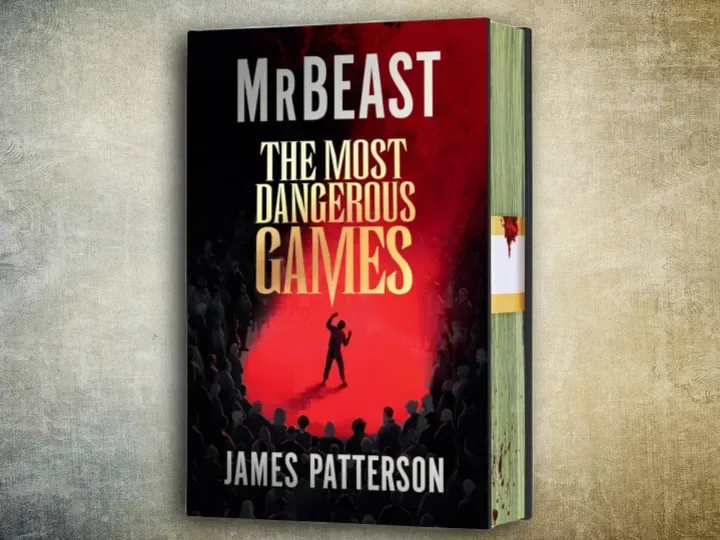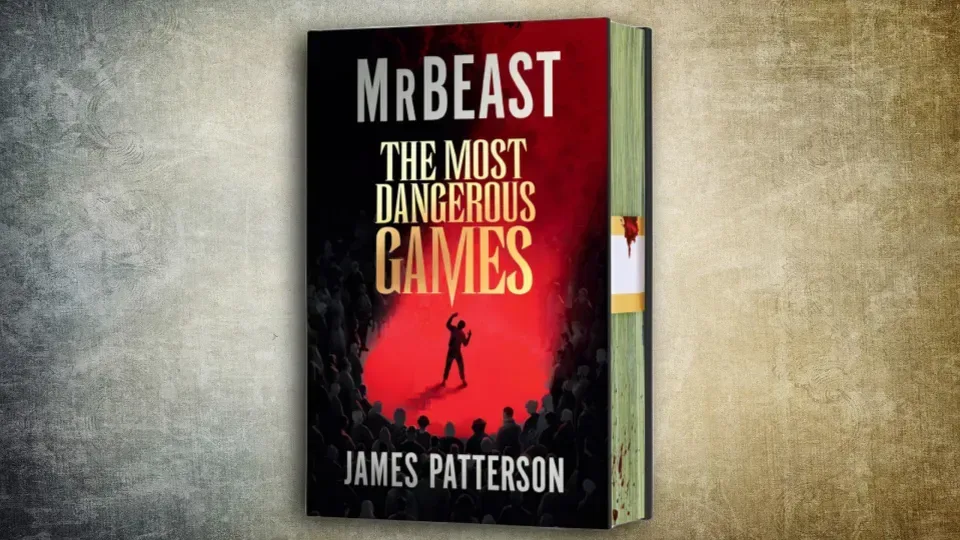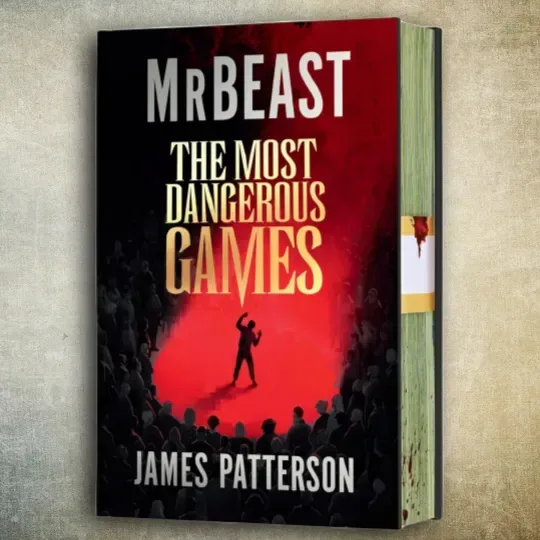
Brandon Sanderson has publicly wondered whether an uncredited writer played a substantial role in The Most Dangerous Games, the survival thriller carrying the names MrBeast and James Patterson. The important word is wondered: Sanderson did not present documentation establishing who wrote the manuscript, and he acknowledged that Patterson could have written it. His point was that the book’s credited names, its apparent feel, and his understanding of common collaboration models left him curious about the work that may sit behind the cover.
During an episode of Intentionally Blank, Sanderson said he was interested in knowing who the ghostwriter was and that he would like such a contributor to receive credit, while also recognizing why that might not happen. He framed the discussion through his own experience working with collaborators, including on Blightfall, and through his role completing Robert Jordan’s The Wheel of Time series.
The remarks have a simple hook—who wrote the MrBeast book?—but the underlying question is broader and more useful: what does a name on a book actually communicate about the labor that produced it? A cover can indicate authorship, a concept originator, an editor, a collaborator, a franchise brand, or some blend of those roles. Readers understandably use names as shorthand for creative responsibility. Yet the precise division of work is not always visible from the finished product alone.
What Sanderson is, and is not, claiming
Sanderson’s central observation is not proof of a hidden contributor. It is an inference based on the collaborative practices he described and his reaction to the book. He said the novel did not feel like a James Patterson book to him, while also calling the prospect of Patterson using an uncredited ghostwriter unusual. That tension is precisely why Sanderson found the credit arrangement notable.
It is important to keep the certainty level straight. The available information establishes that Sanderson questioned whether a ghostwriter was involved. It does not identify a ghostwriter, specify anyone’s contractual terms, establish how much MrBeast wrote, or demonstrate which person drafted particular passages. Treating Sanderson’s curiosity as a settled attribution would turn a discussion about transparency into an unsupported allegation.
Sanderson also said Patterson could have written the book. That caveat matters because authorship is not something a reader can reliably calculate from perceived style. A project may involve outlines, revisions, feedback and editorial work that meaningfully shape a book even if one person produces most of the prose. Conversely, a recognizable name does not automatically disclose the amount of drafting done by that person.
Why the Patterson credit prompts the question
Sanderson described what he understands to be the usual structure when Patterson’s name appears alongside another writer: Patterson brings an idea, the pair brainstorm and create an outline, the other writer produces the manuscript, and Patterson reads it and offers feedback. In that model, the co-writer is openly named.
That is the contrast at the heart of Sanderson’s comments. When a known collaborative approach includes a credited writing partner, the absence of one becomes conspicuous to someone who expects a similar division of labor. Sanderson did not say that this necessarily means an unnamed writer exists. He said it made the situation strange enough to question.
His comments also distinguish between a collaborator and an editor. Those labels can be used loosely in casual conversation, but they describe different jobs. A collaborator can help originate the premise, design the plot, write scenes or chapters, revise prose, or perform several of those tasks. An editor may shape the manuscript through notes, structural guidance and revisions without being the person who drafts it. In practice, the boundary can be complicated. In public-facing credits, however, the difference affects what readers think they are buying and whose work they are recognizing.
A quick guide to the terms
- Outline: A plan for the story’s plot, characters, sequence of events or structure. An outline can be highly detailed, but it is not automatically the same as writing the final manuscript.
- Drafting: Producing the prose of the book itself: scenes, narration, dialogue and transitions that readers encounter on the page.
- Editing: Reviewing and improving material that already exists. Editing can range from high-level story notes to sentence-level changes.
- Co-author: A credited creative partner. The specific split of duties can vary project by project.
- Ghostwriter: A writer who contributes writing but is not publicly credited as an author. The term describes the visibility of the credit, not a single fixed amount of work.
These distinctions are not merely semantic. If a public figure supplies a premise and a writer turns it into a novel, audiences may see that differently from a book drafted directly by the public figure. If an established novelist builds and revises a detailed outline while someone else drafts, that is another model again. All can involve real creative work; the open question is how that work is represented.
Sanderson’s own standard for visible collaboration
Sanderson used his own work to explain why he cares about the distinction. He said that when readers see someone else’s name on one of his books, the likely arrangement is that he created the outline and then acted as editor. In other words, he presented crediting as a signal to readers that another person did meaningful writing work rather than as a decorative addition to a familiar author’s brand.
That perspective carries extra weight because Sanderson has worked within an unusually visible continuation project: completing the Wheel of Time books after Robert Jordan. That kind of situation invites readers to think carefully about creative succession, authorial intent and the difference between continuing a story world and originating it. It does not make Sanderson an authority on the unpublished making of The Most Dangerous Games, but it explains why the mechanics of collaboration are central to his reaction.
The gaming audience will recognize a related issue in a different medium. Game credits can convey roles clearly, but the actual contributions behind a finished release are often distributed across many disciplines: writing, design, art, programming, production, audio and testing. A single prominent name can become a convenient public symbol for a project built by a large team. Questions about creative identity and ownership also surface when franchises change hands, such as the discussion around whether shifts at BioWare could affect Mass Effect and Dragon Age. Books and games are not the same business, but both demonstrate why visible attribution matters to audiences.
The MrBeast factor makes authorship a reader-facing issue
MrBeast is best known for a major YouTube career rather than a body of novel writing, which makes a fiction credit especially attention-grabbing. A creator’s name can tell prospective readers that a book is connected to that creator’s ideas, persona or audience. It does not, by itself, reveal the production process.
That is not a criticism of celebrity-led fiction. Collaborative creation is common, and there is no single “correct” amount of writing a named participant must do for every type of project. But it does create a practical reason for readers to pay attention to wording. “With,” “by,” “created by,” acknowledgements and co-author lines can all suggest different relationships to the work. Where those details are absent, readers may be left to infer more than the cover can actually support.
Sanderson’s preference is clear: he would rather see the writer credited. His position is about recognition, but it is also about clarity. An explicitly named collaborator gives that person professional visibility and gives readers a more direct account of the book’s creation. It reduces the pressure to guess from prose style, brand expectations or online speculation.
What is known about The Most Dangerous Games
The Most Dangerous Games has been available since September. It is presented as a survival thriller, with the official description calling it an “unputdownable” one. Reports about its commercial performance have been mixed, so there is no single source-supported takeaway on how successful it has been.
Its current discussion is therefore less about a confirmed behind-the-scenes disclosure than about the nature of credits in commercial storytelling. Sanderson’s comments place the focus on a reasonable but unanswered question: if a ghostwriter participated, should that writer’s contribution be named? His answer appears to be yes. The available facts do not resolve whether such a writer exists, and they should not be stretched to do so.
Why readers should separate interest from certainty
The most productive reading of this dispute is not to declare a verdict from the outside. It is to recognize what each claim can support. Sanderson has experience with credited collaboration and has explained a model he associates with Patterson’s work. He noticed a difference between that model and the credit presentation of The Most Dangerous Games. From there, he expressed suspicion and curiosity.
That makes the issue legitimate to discuss, particularly in an era when audience-facing brands can move across video, books and other formats. Still, a discussion of credit should preserve the difference between “an unnamed writer may have been involved” and “an unnamed writer definitely wrote the book.” Only the first reflects the uncertainty Sanderson himself left open.
For readers, the practical takeaway is straightforward: author names are meaningful, but they are not always a complete production log. Where collaboration is important to someone’s decision to read or buy a book, the most useful information comes from clear on-the-record crediting—not assumptions built from a cover, a famous name or a perceived writing style.