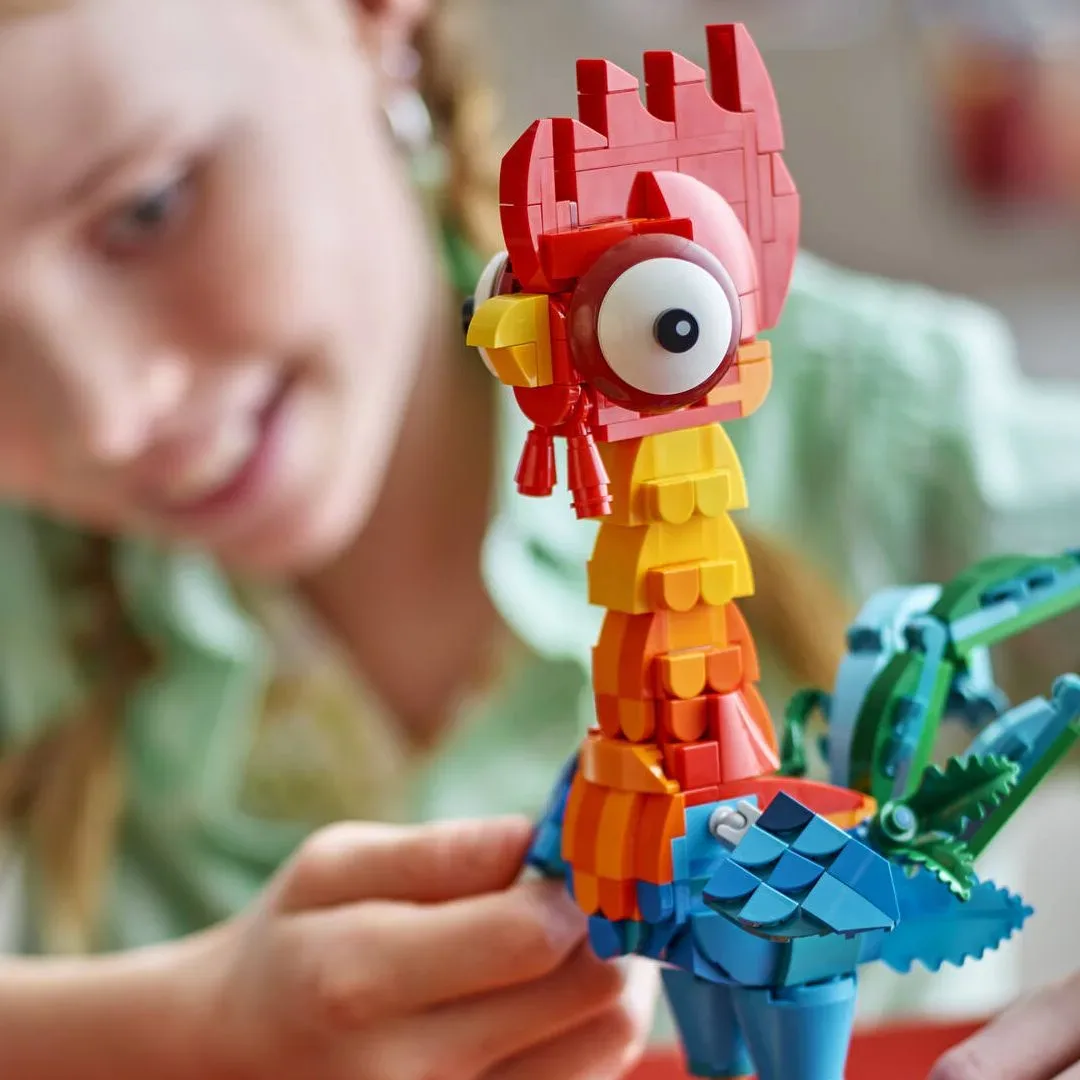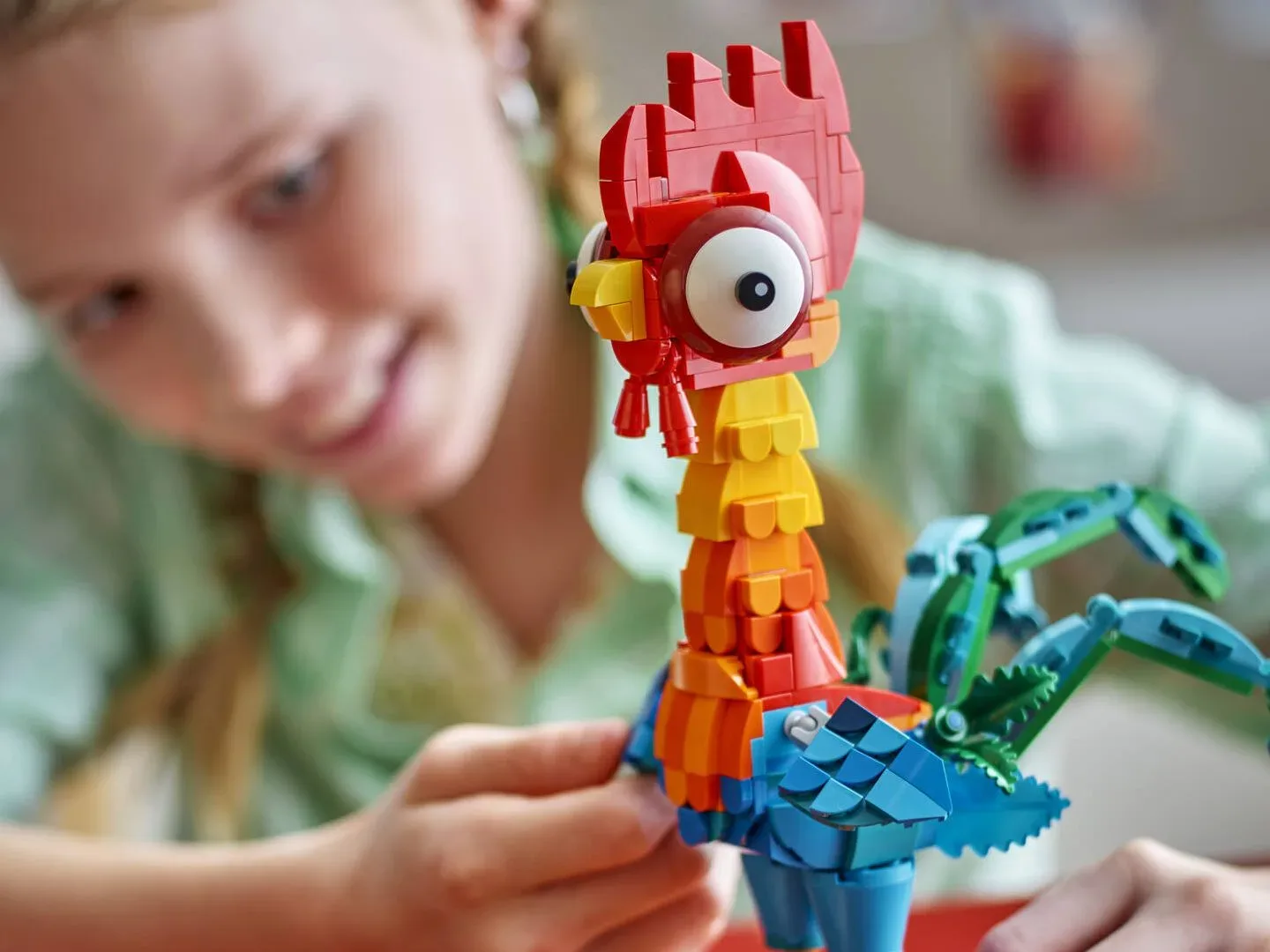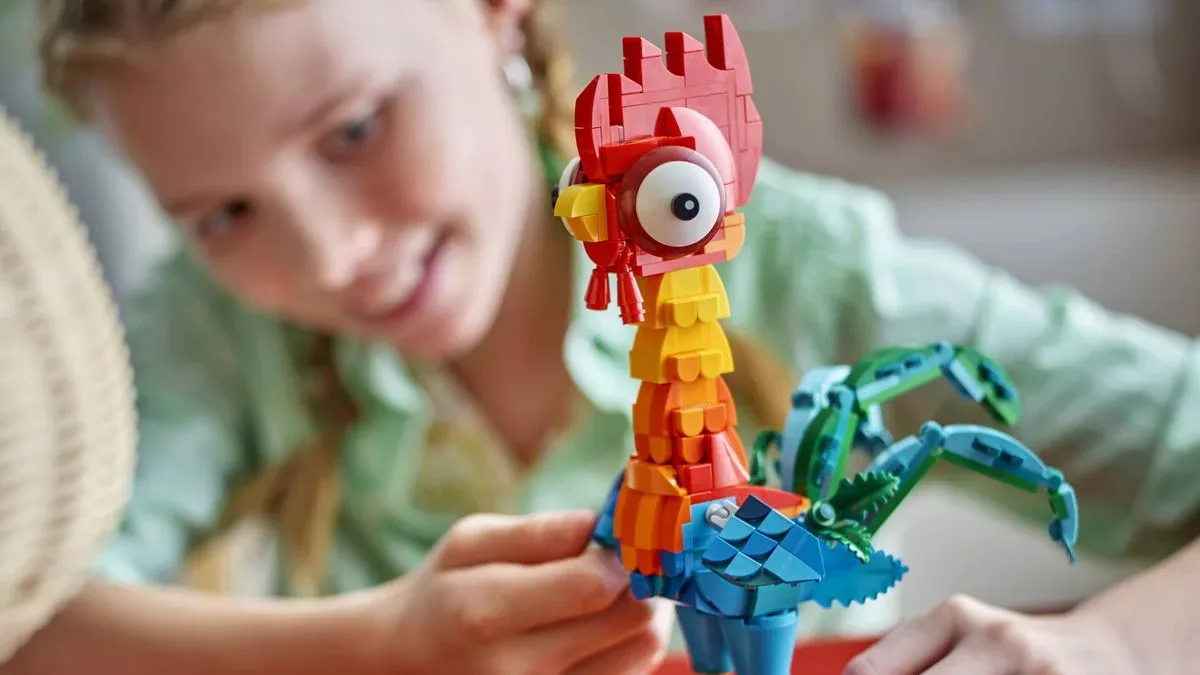
The Millennium Falcon has been rebuilt from plenty of unlikely LEGO starting points. A pumpkin has already had a turn at becoming the battered Star Wars freighter. Now, thanks to a fan posting under the name Switz399, the ship has apparently found an even stranger source material: Heihei, the wide-eyed chicken from Moana.
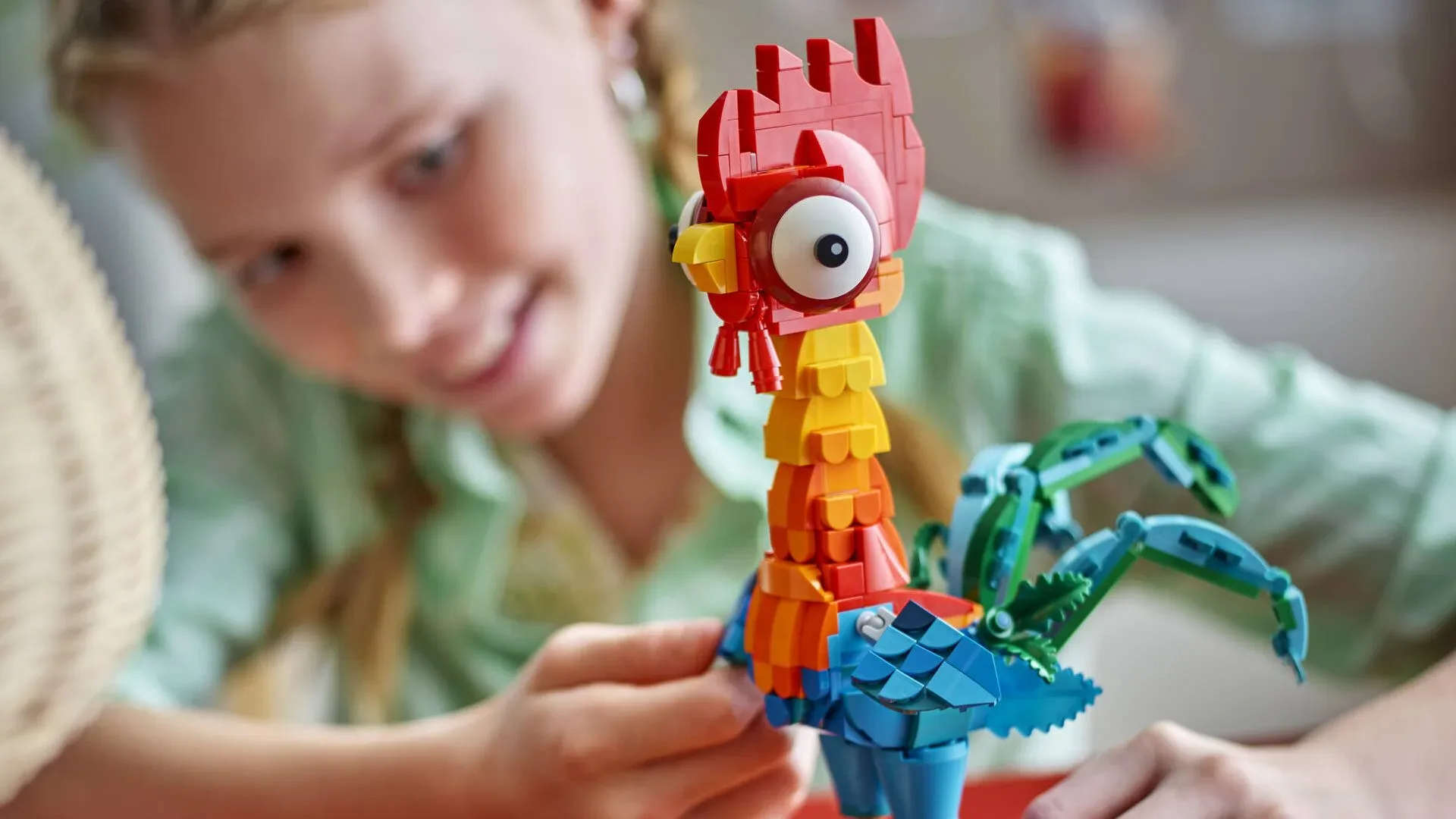
The result is a fan-made alternate build that recasts the LEGO Heihei set into the Falcon’s distinctive flattened, asymmetrical silhouette. It is deliberately colourful, with the original model’s flowers and brighter pieces still very much visible, but it is also immediately legible as Han Solo’s famous ship. Most notably, the builder says every piece from the original box has been used.
That claim is the part that makes the build more than a clever visual joke. A model can resemble another object if a builder reaches into a large supply of pieces for the exact shapes and colours required. Making the same visual argument with a single set’s inventory is a far tighter puzzle. The unusual donor model dictates the available parts, and the build has to work around those constraints rather than erase them.
A chicken-shaped parts palette becomes a spaceship
Heihei is not an obvious foundation for a Star Wars vehicle. The character build is a display-oriented model based around a bird, with prominent eyes, organic forms and a floral base. The Millennium Falcon, by contrast, is an angular, low-slung spacecraft whose appeal comes from a very particular set of proportions: a broad saucer-like body, a forward notch, a cockpit projecting from one side, rear-facing mechanical detail and a radar dish above the hull.
The fan build succeeds because it concentrates on those identifying shapes instead of trying to reproduce every panel line. The cockpit is especially important. On the Falcon, it protrudes at an unusual angle from the ship’s right-hand side, a feature that separates the silhouette from a generic flying saucer. Recreating that offset section with a limited assortment of parts gives the alternate build an immediate point of recognition.
Other small choices do a surprising amount of work. Circular elements at the rear suggest the Falcon’s engine-area grills. Cone-shaped pieces frame portions of the craft. A flower bud becomes the radar dish, while a spanner is repurposed as the central gun turret. None of these substitutions is intended to be a screen-accurate component. Their value is in visual shorthand: the part reads as the necessary feature even though it began life serving an entirely different purpose in a chicken model.
That approach is central to the charm. The build does not hide that it came from a character set. The floral elements remain part of its identity, making this Falcon look less like a miniature replica and more like a playful collision of two LEGO worlds. The bright parts are not a flaw to correct; they are the evidence of the challenge the builder accepted.
What “alternate build” means here
An alternate build is a model assembled from the parts of an existing set rather than from a newly purchased design. In fan circles, the term can cover many levels of difficulty. Some builds use most of a set’s pieces, while others are constrained to the exact contents of one box. The Heihei Falcon belongs to the more demanding end of that spectrum if its all-parts claim is taken literally.
Related coverage includes LEGO Fan Turns Moana's Heihei Chicken Set Into a Millennium Falcon.
Using every piece matters for two practical reasons. First, it avoids leaving a pile of awkward leftovers that were difficult to incorporate. Second, it turns the donor set’s inventory into the design brief. The builder needs enough parts for the Falcon’s broad body, must make the off-centre cockpit read correctly, and still has to find a role for pieces that may have been chosen originally to convey feathers, foliage or cartoon character details.
It also makes the creation appealing to people who already own the Heihei set. They do not need to treat the project as a shopping list for a separate custom model. The challenge is to disassemble what is already there and view every component by its shape, not its original identity. A bud can become a sensor dish; a tool can become a turret; floral decoration can become deliberately eccentric exterior dressing.
There is an important limitation, though: the available information identifies the finished fan model and its key details, but does not provide formal building instructions or a verified step-by-step inventory map. Anyone attempting a recreation should therefore regard it as inspiration unless the builder independently shares instructions or a parts guide. The appeal lies partly in that open-endedness. Alternate builds invite other builders to solve the same constraints in their own way.
Why the Falcon works as a rebuilding target
The Millennium Falcon is unusually suited to this kind of exercise because it can be recognized from a handful of major cues. A smooth circular craft without the side cockpit could be almost any science-fiction vehicle. Add the forward mandible-like gap, the offset cockpit, rear mechanical texture and a dish on top, however, and the visual language becomes much more specific.
That does not make the task easy. The model’s proportions are deceptively awkward. Its cockpit is neither centrally mounted nor parallel to the body, so a build must make an intentional-looking connection at an angle. Its broad hull needs to read as a single object rather than a collection of loose plates. And the ship’s famous weathered, utilitarian personality normally depends on an abundance of grey mechanical pieces—exactly the sort of palette a colourful Moana character set is not likely to prioritize.
Switz399’s model responds by aiming for recognizability rather than imitation. It preserves the ship’s overall outline and employs highly selective details where they are most useful. That is a strong strategy for a constrained build: establish the silhouette first, then use a few iconic markers to carry the theme.
The fan post’s “Will it Falcon” framing also places the creation within an ongoing community joke and design challenge: can an improbable LEGO set be converted into the Falcon? The earlier pumpkin conversion shows how flexible that idea can be. The test is not whether a donor model contains ideal spaceship parts. It is whether a builder can discover enough useful geometry inside something that plainly was not designed as a spaceship.
Creative reuse is the point, not screen accuracy
Official Millennium Falcon LEGO releases have their own purpose. They are designed around a recognizable version of the ship, with parts choices and construction methods selected to support that goal. A fan conversion from Heihei starts from the opposite direction. Its materials are fixed, and the builder must discover the Falcon within them.
That distinction is worth keeping in mind for collectors and builders considering which kind of project they want. An official set offers a dedicated build experience and a version of the vehicle intended to look like the vehicle. A one-set alternate build offers a creative constraint, a second life for an existing model and an outcome that may be more personal—or much stranger.
The Heihei Falcon makes a convincing case for the latter. It does not need to replace an official model. It is funny because the provenance remains visible: the ship’s flowers, unusual colours and improvised details tell the story of how it was made. In an era when many LEGO creations strive for ever more detailed realism, there is something refreshing about a build that proudly looks like a flower-adorned chicken was asked to make the Kessel Run.
For readers after a different corner of the galaxy far, far away, Joking Joystick is also tracking Star Wars: The Fall of Kylo Ren #3. This particular LEGO story, however, is a reminder that the most entertaining Star Wars builds can begin with no Star Wars pieces at all.
Practical lessons for builders trying a one-set remix
The Heihei-to-Falcon conversion offers a few useful principles for anyone looking at an existing LEGO model and wondering what else it could become.
- Start with the silhouette. Decide what one or two large shapes make the intended subject recognizable. For the Falcon, the wide hull and offset cockpit do more work than tiny surface details.
- Reinterpret pieces by outline. Ignore a part’s original character role. A flower, tool or decorative element may have a profile that works as machinery, a weapon or a sensor.
- Use colour as a feature when it cannot be avoided. A constrained palette can make a creation distinctive. Attempting to disguise every bright element may make the model less coherent than embracing the premise.
- Reserve unusual parts for recognizable details. A bud used as a radar dish and a spanner used as a turret are effective because each is placed where viewers expect that feature to be.
- Set the rules before building. “Every piece must be used” produces a different challenge from “only pieces from this set may be used.” Both can be fun, but they require different compromises.
The chicken Falcon is ultimately a compact demonstration of LEGO’s most enduring trick: pieces become interesting when they stop being what the instructions said they were. In this case, that means a character model associated with a Disney film can supply the outline, the details and even the radar dish for one of science fiction’s most recognizable ships—without leaving a single part behind.
Shop the products
Check current price, model and availability at the retailer.