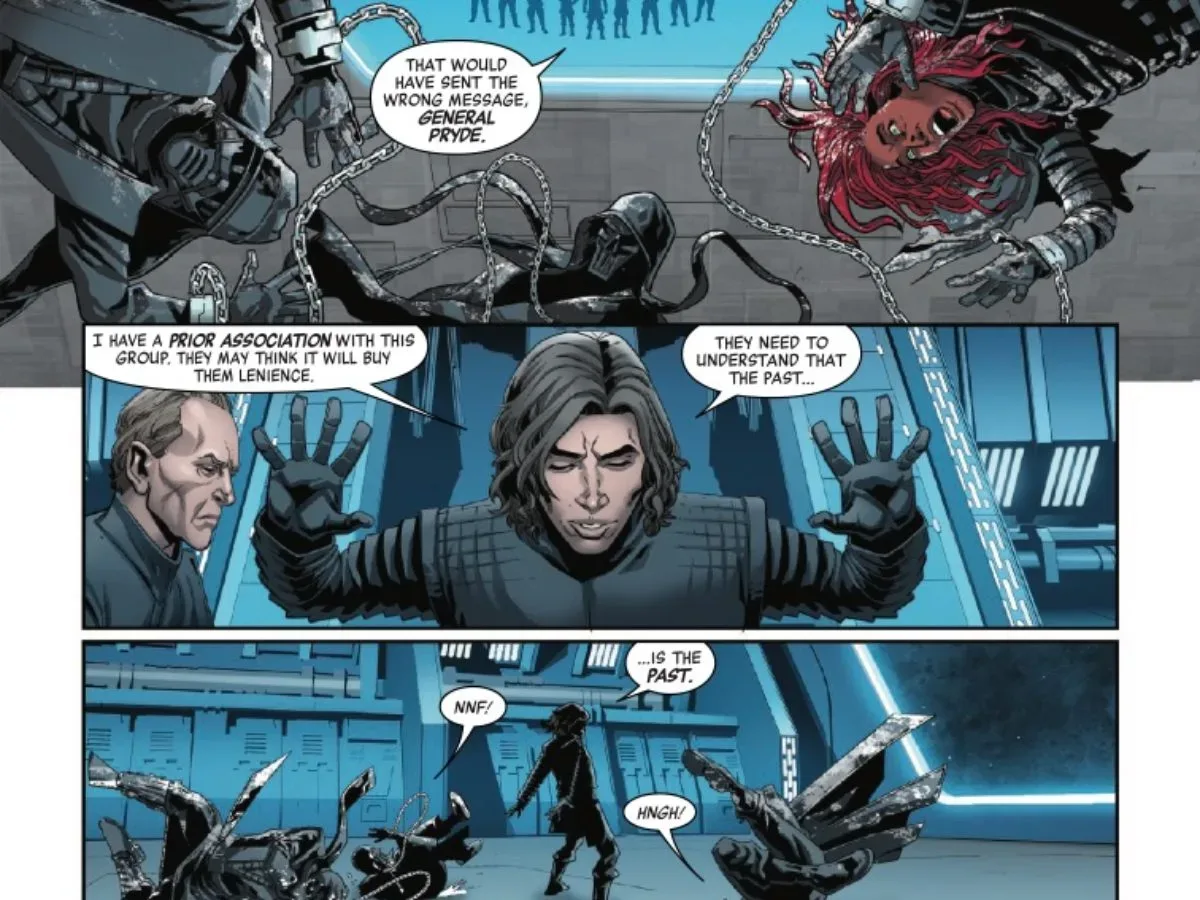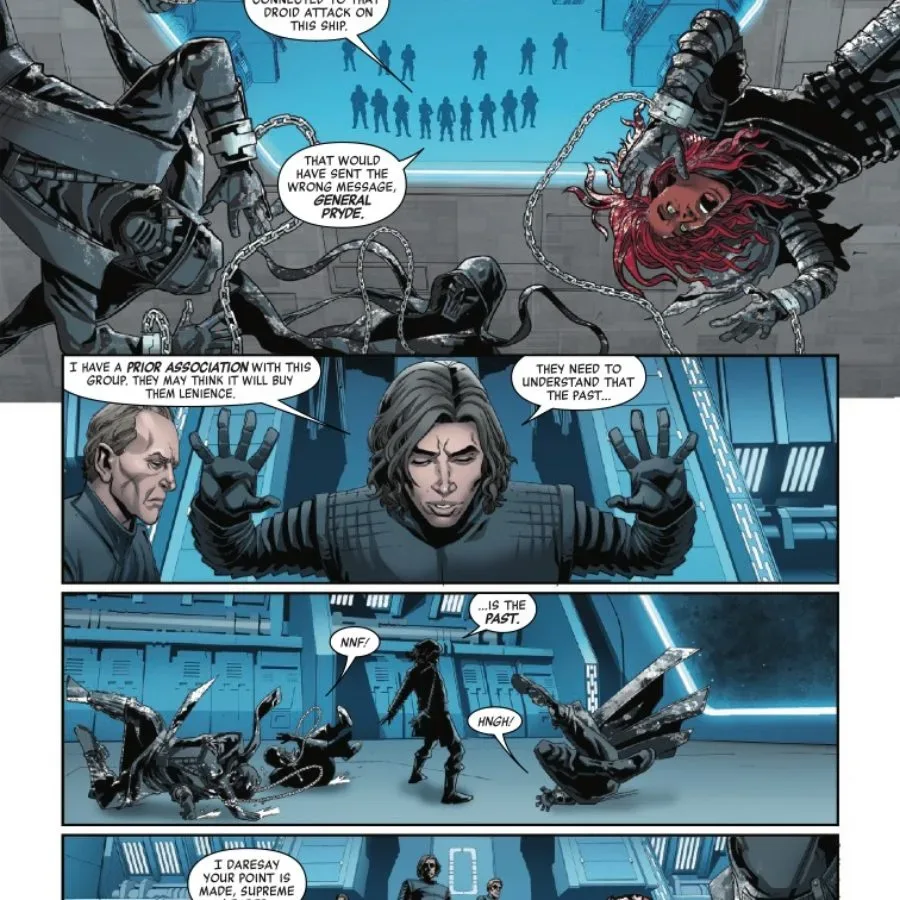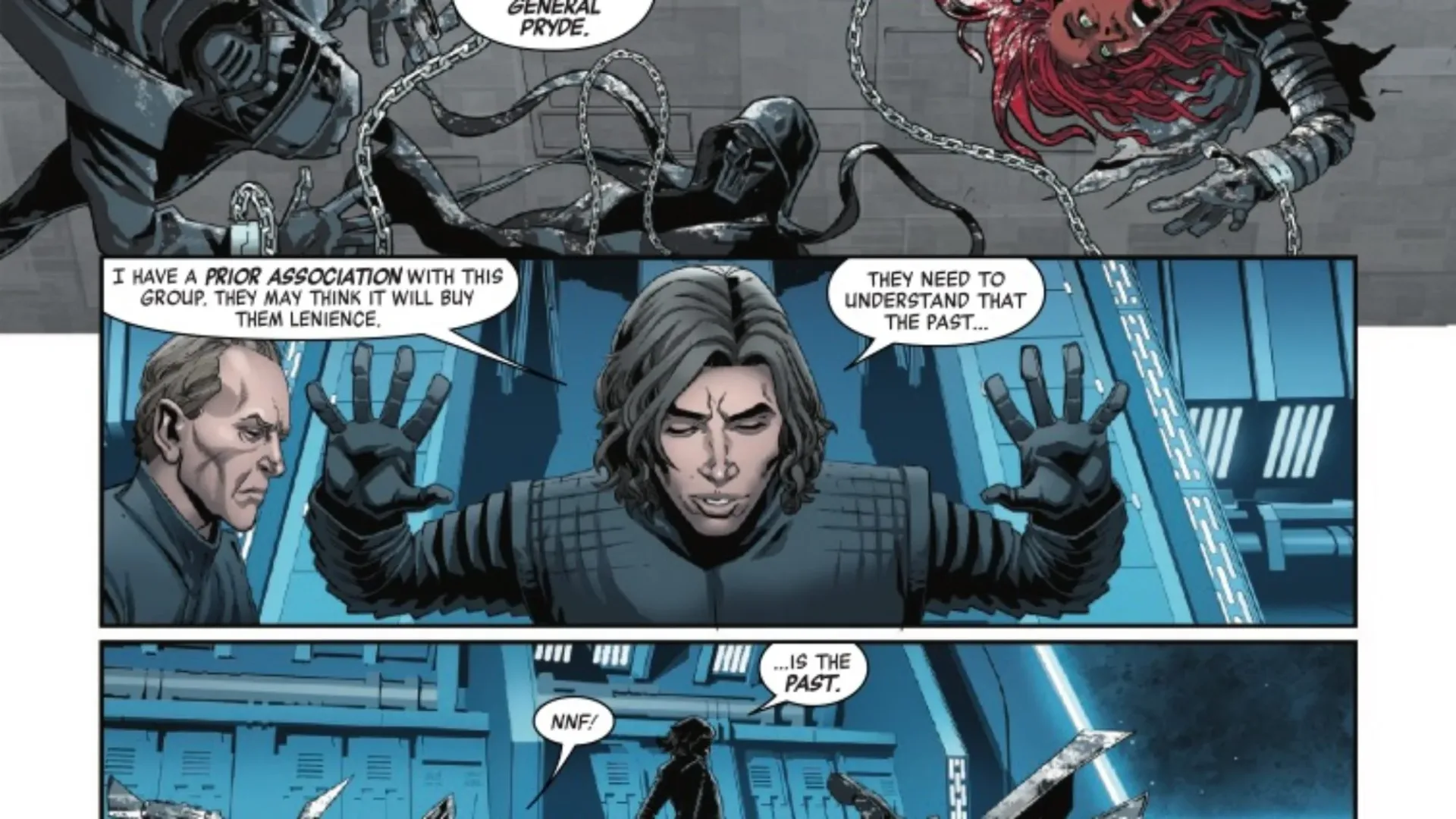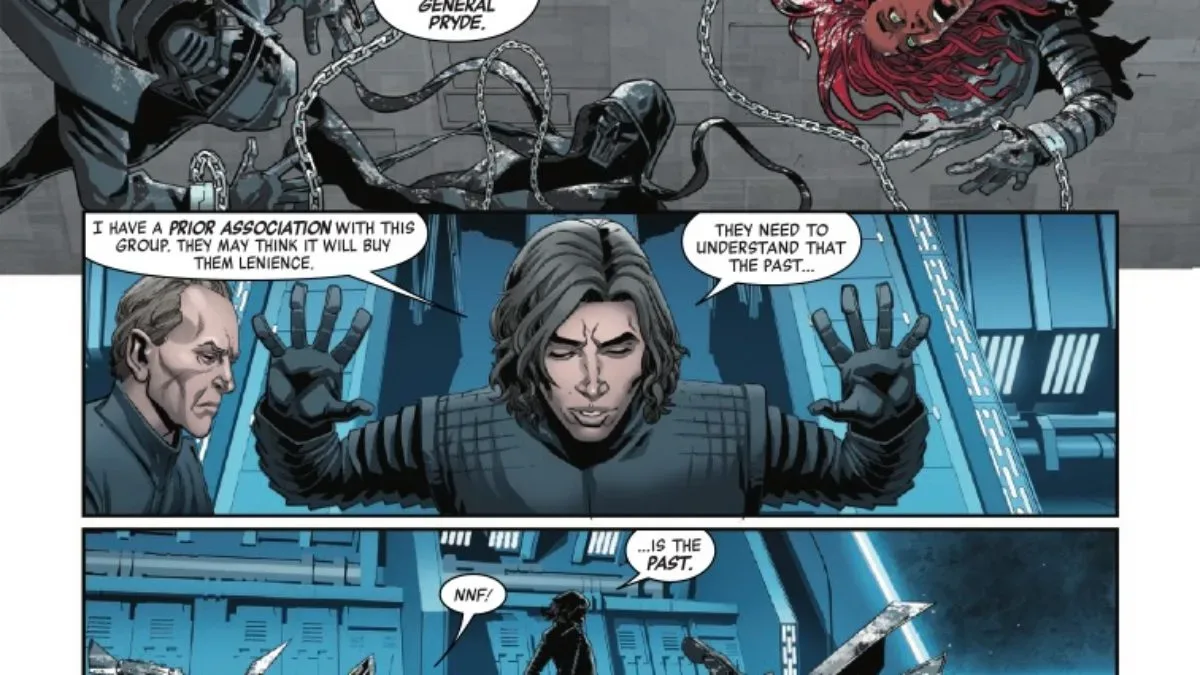
Kylo Ren’s leadership troubles are about to become considerably more combustible. Star Wars: The Fall of Kylo Ren #3 arrives from Marvel on Wednesday, October 21, 2026, with Kylo attempting to impose brutal control on the Knights of Ren just as a major threat reaches his flagship.
The issue’s central menace is an assassin droid described as impossible to kill—and, worse for everyone aboard a spaceship with presumably limited escape-pod seating, it reportedly returns stronger each time it is destroyed. Marvel’s synopsis frames the droid as part of a larger mystery involving the Knights of Ren and a forbidden dark side artifact. Allegiant General Pryde and General Hux are also set to appear.
That creates a very specific sort of Kylo Ren problem: an internal power struggle, an outside attacker, an unexplained artifact, and a machine that treats destruction less as an ending than an aggressively productive performance review.
Kylo Ren faces the Knights of Ren and a repeat-offender droid
The stated setup has Kylo taking forceful command of the Knights of Ren, the masked and violent group whose connection to him is central to the issue’s premise. The timing is particularly bad. The assault on his flagship means he cannot treat the Knights as merely a political or personal complication; leadership instability is happening in the same place as a threat that keeps escalating.
The assassin droid’s ability to come back stronger is the key hook. In science-fiction terms, it is a self-improving adversary: defeating it does not restore the previous status quo, but may create a more dangerous version of the same problem. The wording does not explain whether the upgrades are technological, mystical, or caused by the artifact. It does establish that conventional destruction will not be enough.
That distinction matters. A durable enemy can be delayed. An enemy that improves after defeat turns every failed solution into part of its development plan. Kylo, who is presented as facing the most dangerous dark side creation he has encountered, may need to identify the system behind the droid’s return rather than simply win another immediate fight.
Kylo Ren confronts the Knights of Ren and a threat aboard his flagship that cannot be permanently put down.
The forbidden artifact is the mystery at the center
Marvel links three elements directly: the Knights of Ren, a forbidden dark side artifact, and the recurring assassin droid. That connection is the issue’s largest unanswered question, and it suggests the action is designed to uncover or complicate a hidden relationship rather than deliver a standalone droid attack.
A dark side artifact, as the term is used here, is an object associated with forbidden dark-side power or knowledge. No further properties have been specified, so readers should be careful not to assume it controls the droid, created it, or belongs to a particular character. What is confirmed is that it is part of the secret connecting the major threats in this chapter.
The artifact also gives the conflict a second layer. The droid is an immediate physical danger, while the object represents an unresolved source of information and power. If Kylo is trying to bring the Knights under control, the discovery of a forbidden object with ties to the group could make that effort more precarious. It raises a basic question: is the artifact a tool, a liability, a prize, or evidence that someone’s loyalties are more complicated than Kylo would prefer?
For a character attempting to govern through intimidation, ambiguity is terrible for morale. It is difficult to run a clean chain of command when an artifact may be involved in making assassins harder to kill. The First Order’s HR department may not have survived long enough to print a form for “Recurring Murder Robot, Please Explain,” but the concern remains administratively valid.
What Pryde and Hux add to the flagship crisis
The issue features Allegiant General Pryde and General Hux, placing two First Order figures inside a story that is already balancing Kylo’s authority, the Knights of Ren, and the incoming droid threat. Their appearance broadens the conflict beyond a private showdown between Kylo and his would-be allies or rivals.
The available details do not say what either Pryde or Hux does in the plot, and that uncertainty is worth preserving. Their confirmed presence nevertheless puts military leadership around Kylo at the moment his flagship comes under attack. That can make the ship a pressure cooker: command decisions have consequences not only for Kylo’s standing with the Knights, but for the people and operations under First Order control.
There is also a useful contrast embedded in the premise. Kylo’s move against the Knights is described as brutal, emphasizing direct control. The droid, meanwhile, is a threat that cannot apparently be solved by direct violence alone. It is an invitation for the issue to test whether force can establish authority while simultaneously failing to neutralize the larger danger.
Creative team, format and variant covers
Star Wars: The Fall of Kylo Ren #3 is written by Charles Soule with art by Will Sliney. Phil Noto provides the main cover. The comic is a 32-page, Rated T release from Marvel, priced at $4.99 in the United States and $6.25 in Canada.
Two listed variants accompany the standard edition: a Dave Dorman variant and a Mico Suayan variant. Both are also listed at $4.99 US and $6.25 CAN. The provided release information identifies the editions but does not specify their cover imagery, print quantities, or retailer allocation, so collectors should treat them as alternate-cover options rather than assume any particular scarcity.
- On sale: October 21, 2026
- Publisher: Marvel
- Writer: Charles Soule
- Artist: Will Sliney
- Main cover artist: Phil Noto
- Format: 32 pages, Rated T
- Standard price: $4.99 US / $6.25 CAN
- Variants: Dave Dorman and Mico Suayan
Why the premise stands out
Issue #3 has a compact but effective escalation structure. Kylo must take control of the Knights of Ren. A deadly threat attacks his flagship. The threat cannot be permanently killed. And the explanation appears to involve a dark side artifact that links the immediate crisis to a larger secret. Each piece makes the others more difficult.
That makes the droid more than a monster-of-the-month obstacle. Its repeated returns ensure that it can affect the issue’s power dynamics even when it is not on panel. Anyone promising an easy solution immediately becomes suspect if the droid has already demonstrated that being blown up is simply its warm-up routine.
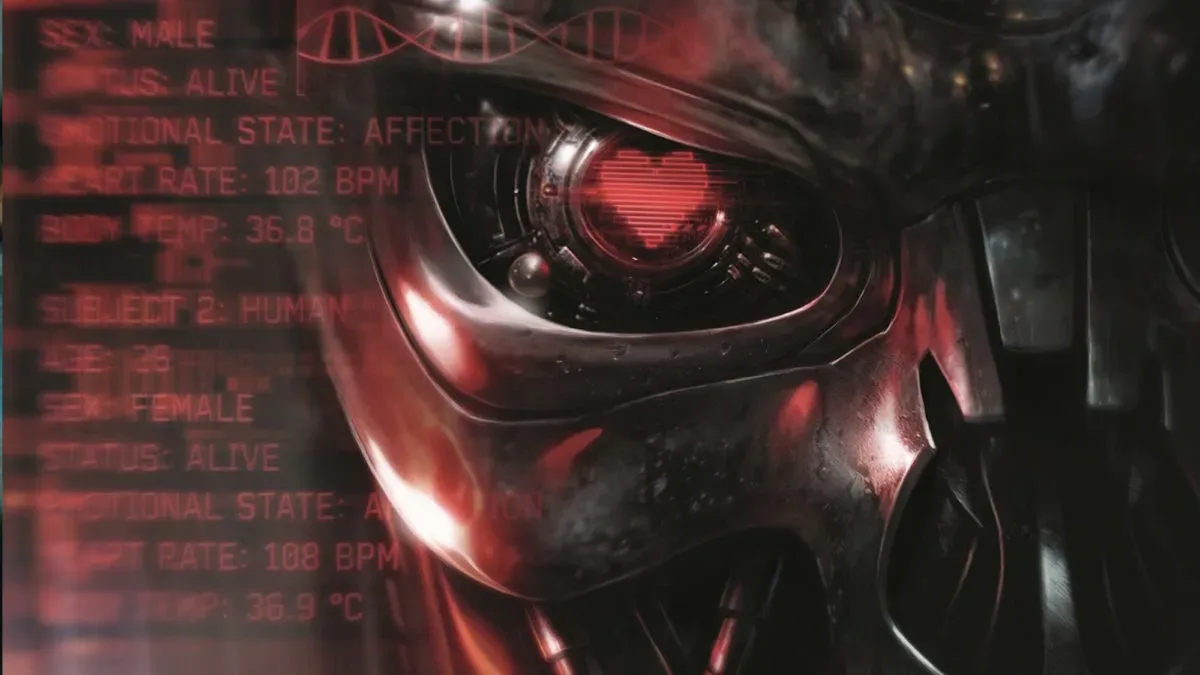
Readers who enjoy a similarly stubborn cybernetic menace may also appreciate the machine-focused chaos in The Terminator Valentine’s Day Special 2027. Kylo’s opponent is very much in its own galaxy, but the foundational nightmare remains recognizable: the machine is not impressed by the first solution, the second solution, or your increasingly frantic third solution.
For this chapter, the real suspense is not just whether Kylo can defeat the assassin droid. It is whether his attempt to dominate the Knights of Ren exposes the secret behind it—and whether that secret gives him control over the crisis or makes the crisis far worse.