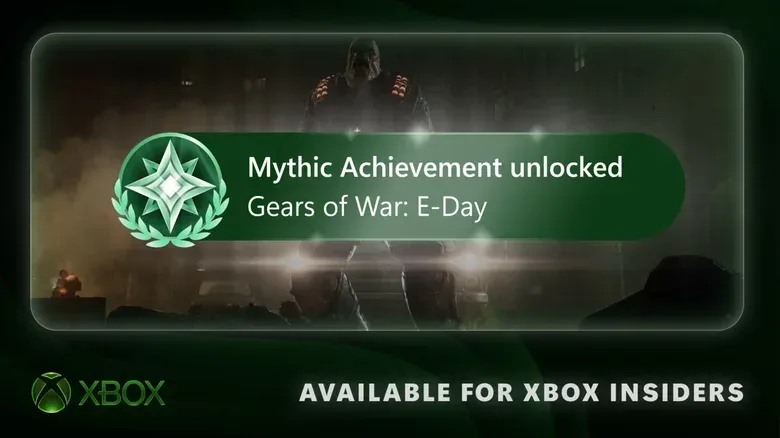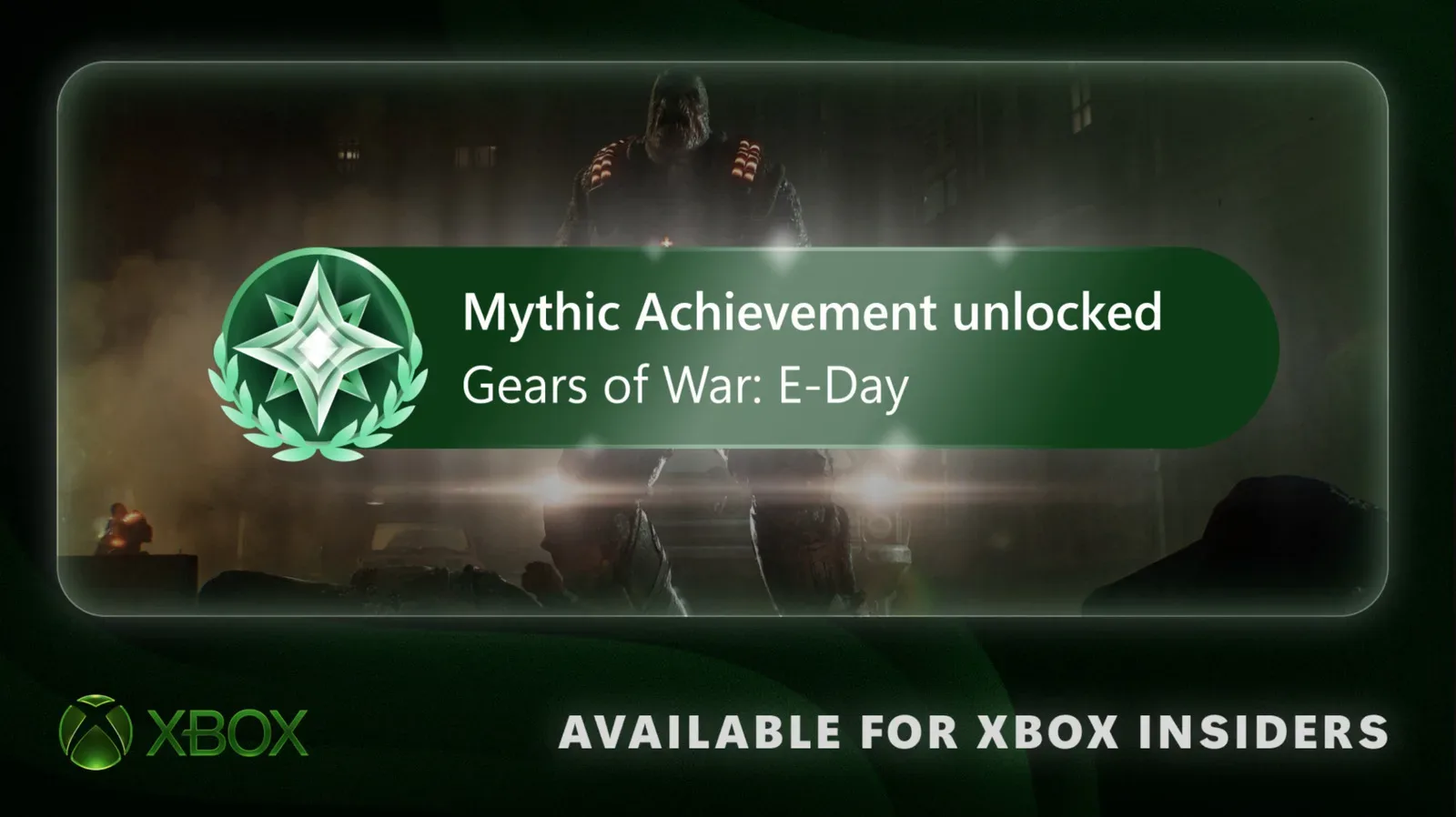
Xbox is giving completionists a clearer finish line with Mythic Achievements, a new profile distinction for players who have earned every original achievement in an eligible game. The feature is currently being tested through the Xbox Insiders program, but its design is immediately understandable: complete the base achievement list, and that game earns Mythic status on your account.
For players who treat an achievement list as more than a trail of pop-ups, that is a meaningful change. Xbox has long tracked individual achievements, yet it has not had a dedicated, platform-level completion tier that turns a fully cleared game into a separate, easily recognizable honor. Mythic Achievements add that layer without changing what players must do inside a game: the qualification is still the full set of original achievements.
The closest shorthand is PlayStation’s Platinum Trophy idea, where a complete trophy run produces a single marquee reward. Xbox’s version is not presented as a replacement for its existing achievement system. Instead, it sits above it as a summary of completion: an account-level signal that the entire original list is done.
What qualifies a game for Mythic status?
The key phrase is “all original achievements.” In practical terms, the initial achievement set is what matters for Mythic completion. Achievements introduced later through downloadable content or game updates do not affect the status. A player who secures Mythic status will keep it even if new achievements are later added.
That distinction matters because post-launch achievement lists can change the perceived size of a game’s completion task. A game may receive expansions, seasonal material, modes, or other updates long after its original release. Under the Mythic approach, those additions can remain goals for dedicated players without retroactively taking away a completion badge earned for the original game.
It also gives “100%” a more precise meaning in this specific system. Mythic status does not necessarily mean every possible piece of content ever released for a game has been completed. It means the player has completed the original achievement set recognized by Xbox for that title. For anyone comparing profiles, that boundary should make the badge more consistent and easier to interpret.
A brief technical distinction: achievements, score and Mythic status
An achievement is an individual platform objective tied to a game. A player earns them for meeting conditions set by that game, and Xbox has used these awards as a long-running way to record milestones across a library. Mythic status, by contrast, is a completion classification built from the original achievement list rather than a newly described in-game challenge category.
That separation is important. The new feature does not ask studios or players to adopt a fresh scoring language for every type of objective. It reads the existing list and recognizes the moment when it is entirely complete. The result is less about one especially difficult achievement and more about the breadth required to finish the whole original set.
Related coverage includes Xbox Introduces Mythic Achievements for Complete Achievement Runs.
Retroactive recognition reaches back to Xbox 360
Mythic Achievements are retroactive. Players who already completed eligible original achievement lists do not need to replay those games merely to receive the new distinction. When they visit their profile, previously completed titles may already show Mythic status.
Support goes back to Xbox 360 titles, which gives the feature particular appeal for long-time Xbox accounts. Old completion runs can become more visible alongside recent ones, rather than being buried in years of profile history. A finished Xbox 360 game is not being treated as a separate nostalgia exercise; it can contribute to the same new profile identity as a newer title.
This is one of the strongest practical elements of the rollout. A retroactive reward acknowledges the work that has already been recorded in the ecosystem. It also avoids creating an awkward divide in which only games completed after the feature’s arrival can display the platform’s new top-level marker.
There is still an important limitation in the information available so far: Mythic Achievements are being tested with Xbox Insiders, not broadly released to every Xbox user. Insiders test unreleased system updates, apps, features, and games before wider availability, and registration is free. Players outside that testing group should not assume the profile view is live for them yet, while existing completions may still be relevant if the feature expands as described.
Where players will see their completed games
The profile’s new Gaming tab is the hub for Mythic information. It is intended to show milestones, and each Mythic Achievement is displayed with a heroic frame. The presentation turns a completion record into something much easier to spot than a percentage hidden inside a game-specific list.
Xbox is also adding a progress bar at the top of each game’s achievement list. That gives players a direct view of how close they are to Mythic status before the final achievement falls. A progress indicator sounds simple, but it can change how a large backlog is approached: instead of opening a game only to scan a long list, players can quickly identify titles that are near completion.
There is a social use as well. Friends can check one another’s Gaming tabs and see which games have reached Mythic status. The example offered is Gears of War 2, but the broader point is profile readability. A fully completed game can become a visible part of someone’s Xbox identity without requiring another player to calculate a percentage or inspect every achievement manually.
That has a modest but real effect on how achievement hunting is shared. Completion is often personal—one player clearing a difficult task late at night is not automatically a community event—but recognizable profile badges make it easier to compare interests and effort. A friend’s Mythic games could reveal the series they return to, the older games they finished years ago, or the titles that they were determined not to leave at 95%.
Why the DLC rule is likely to matter most
The decision to exclude later DLC and update achievements from Mythic qualification is likely to be the detail completion-focused players watch most closely. It establishes a stable endpoint. Once every original achievement is earned, the player has secured the status permanently.
That does not diminish the value of DLC achievements. They can still represent extra challenges and additional game content. The difference is that they do not move the goalposts for the central completion label. A player can choose to pursue those additions because they want to, rather than because a profile badge has been withdrawn.
It is also a useful way to separate two kinds of commitment. Completing a launch-era achievement list is one documented accomplishment. Keeping current with every expansion and update is another, potentially open-ended pursuit. Mythic Achievements recognize the first in a way that should remain legible over time.
What this changes for Xbox achievement hunters
At a system level, Mythic Achievements make Xbox completion more immediately readable. Individual achievements already show what a player has done; the new label expresses what they have finished. That sounds like a small interface shift, but it creates a shared reference point for games across generations.
For players deciding what to play next, the new progress bar may be especially helpful. A title with only a few original achievements remaining becomes easier to identify, while a completed title receives a more satisfying endpoint than an all-but-forgotten 100% figure. It could encourage players to revisit unfinished library games, particularly older Xbox 360 entries now covered by the system.
There are limits to what Mythic status can tell viewers. It does not, by itself, explain whether a list was difficult, time-consuming, creative, or merely broad. Nor does it rank one completed game above another. It is a clean completion marker, not a universal measure of skill. That restraint is arguably the point: it records a specific achievement-list outcome without pretending every game asks the same thing of its players.
The timing also fits an Xbox environment where account history spans several console generations. A visible layer that organizes accomplishment across older and newer games makes a profile feel more like a record than a running total. Players interested in how other game ecosystems frame long-term engagement may also want to follow changes in the wider industry, including Rockstar’s comments on detail, density and interaction in GTA 6.
The testing status is the practical caveat
For now, the feature remains an Xbox Insider test. That means the most useful immediate takeaway is not that every player can begin chasing a newly visible badge today, but that Xbox has defined how the badge will work: complete the original achievement list, retain the result despite later additions, and receive credit for qualifying past completions.
Xbox is testing other tools with Insiders as well, including a service for creating digital versions of physical games and a free, ad-supported cloud gaming offering. Those experiments are separate from Mythic Achievements, but together they underline the role of the Insider program as a staging area for features before any broader rollout.
Mythic Achievements ultimately formalize something achievement hunters already understand: finishing every original objective is its own accomplishment. By making that accomplishment retroactive, durable, visible on profiles, and applicable back to the Xbox 360 era, Xbox is giving the completed game a dedicated place alongside the achievements that led to it.