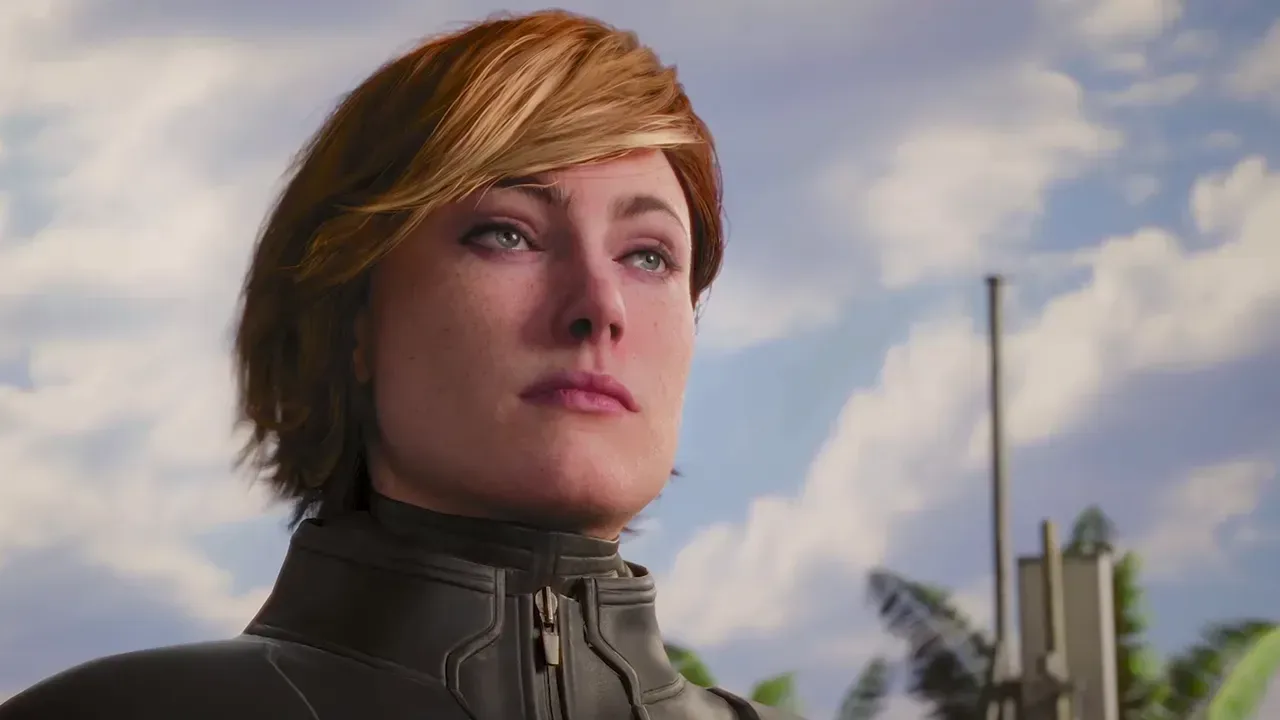
Newly surfaced footage from the canceled Perfect Dark reboot offers a brief but revealing look at the project The Initiative never got to release. The short clip appears to have originated in a visual-effects developer’s portfolio and concentrates on precisely the kind of work a VFX reel is built to showcase: weapons firing, explosions, environmental reactions, and objects breaking apart.
That narrow focus matters. This is not a comprehensive gameplay demo, a release build, or enough material to establish the reboot’s full structure. It does, however, provide a more concrete glimpse of the game’s moment-to-moment ambitions than its length might suggest. Alongside science-fiction weapons and destructible elements, the footage includes parkour movement through both unfinished and more fully realized spaces. Fruit taking the brunt of the environmental simulation has become the immediate talking point, because few things sell the promise of interactive scenery quite like produce caught in the blast radius.
What the footage appears to show
The visible material moves between greybox areas and environments that look substantially further along. Greyboxing is a development practice in which teams build a rough version of a level with simple geometry before final art is added. It lets developers assess scale, sight lines, routes, cover, movement, and encounter flow without waiting for polished textures and decoration.
In this case, the rougher spaces appear to be used for weapon and interaction tests. That makes the footage useful for illustrating systems work rather than confirming a specific mission, story sequence, or finished location. The more complete-looking portions show traversal with parkour, while the effects-focused editing highlights explosions and reactive props.
Reactive environments are objects or parts of a scene that visibly respond to player actions, whether through breaking, moving, igniting, scattering, or changing state after an impact. The clip seems designed to show that response. Destructible fruit is a particularly readable example: viewers can immediately see whether individual objects react when hit and how debris behaves afterward. It is a small detail, but it indicates that the team was investing effort in making action produce a visible physical consequence.
That does not prove that every object in the game would have been destructible, or that environmental damage would have been central to every mission. Portfolio footage is selective by design. It presents the systems a contributor wants to demonstrate, so explosions and physical reactions receive more attention than quieter gameplay elements would.
Parkour points to a more mobile Joanna Dark
The presence of parkour is one of the more meaningful details in the clip. Traversal systems can reshape how players read a level: vertical routes, ledges, windows, gaps, and alternate approaches become practical tools rather than background decoration. In a game centered on a secret agent, that kind of mobility could support an action-forward interpretation of Joanna Dark without defining exactly how stealth, gadgets, shooting, or objectives would have worked.
The footage alone cannot settle how open the levels were, how frequently parkour would be required, or whether movement options were primarily for scripted escapes and set pieces. Still, it shows the reboot was being developed with more than conventional corridor shooting in mind. The combination of traversal testing and environmental response suggests a team exploring how movement, weapons, and scenery could interact during action sequences.
Related coverage includes Canceled Perfect Dark Reboot Footage Reveals Parkour, Explosions, and Destructible Fruit.
For readers interested in how early systems can develop into playable projects, this broader discussion of game ideas becoming prompt-built projects provides separate context on experimentation in game creation. The circumstances and technology are different, but both underline a simple point: prototypes and tests are not the same thing as a finished game.
A portfolio clip is evidence, not a complete design document
It is tempting to treat any unreleased-game footage as a final verdict on what might have been. That would be an overreach here. The material is short, apparently assembled as a portfolio piece, and heavily centered on visual effects. It can credibly demonstrate that work on explosions, weapons, physical reactions, and traversal was underway. It cannot reliably answer larger questions about campaign length, mission design, multiplayer, progression, platform plans, or a release window.
That distinction is especially important with canceled projects. Games change repeatedly during development, and components shown in internal testing may be refined, removed, or repurposed long before launch. A greybox test does not necessarily represent an intended final level. Likewise, a polished effects shot can demonstrate a technical target without showing how often players would encounter it in normal play.
The footage is nevertheless valuable because canceled games so rarely receive this kind of system-level window. Instead of only a high-level announcement or a carefully staged reveal, it shows developers testing the texture of action: how a weapon looks when fired, how a blast changes a room, and how bodies and objects might move through a space.
The project’s cancellation leaves an unusually visible gap
The Initiative was established in 2018 and was working with Crystal Dynamics on the reboot. The studio closed before it could ship its first Xbox project, while Crystal Dynamics also faced layoffs following the cancellation. The shutdown ended the project despite indications that significant work had been completed.
Alix Wilton Regan, the actor attached to Joanna Dark, had previously described the game as “pretty far along” and said she had completed entire chapters within its universe. That statement provides context for why the newly surfaced footage has drawn attention, but it should not be used to infer that the game was near release. “Far along” can refer to many aspects of a production, and the available clip does not establish its overall completion state when work stopped.
A possible revival also reportedly came close to taking shape. Take-Two was said to have explored financing the reboot, though no agreement ultimately emerged and the reason remains unclear. Separately, id Software had reportedly considered pitches for a Perfect Dark project. Neither thread resulted in a public continuation, leaving the future of the series unresolved.
Why the reboot carried extra weight
The new game would have been the first Perfect Dark entry since Rare’s Perfect Dark Zero, released as an Xbox 360 launch title in November 2005. That makes the reboot more than another canceled internal project: it was a prospective return for a long-dormant Xbox property.
The circumstances also sit within wider changes around Xbox studios. Rare’s Everwild was canceled alongside Perfect Dark. Halo Studios experienced layoffs, with the Halo franchise handed to Activision for a team assignment on its next installment. World’s Edge and Rare have moved under Activision, while Obsidian is now part of Bethesda and working on a new Fallout game. Ninja Theory is also closing as part of the broader restructuring described around Xbox.
Those changes do not explain every decision behind Perfect Dark, and the released clip does not offer an answer to why the reboot ended. What it does preserve is a small record of a project that had advanced beyond concept art and broad promises. There were test environments, traversal experiments, weapons, impact effects, and an evident interest in making the world answer back when players caused trouble.
For now, the footage should be viewed as an incomplete artifact rather than a substitute for the game itself. But it makes the loss easier to understand: the reboot was not merely a title on a list of future Xbox releases. It was a work in progress with a visible design direction—fast-moving, effects-heavy, and apparently willing to devote serious attention to the noble art of exploding fruit.