
Bill Skarsgård’s lead role in Physint has an obvious surface-level appeal: it puts a major screen performer at the center of Hideo Kojima’s new action-espionage game. But Skarsgård has explained why the casting means more to him than a conventional high-profile acting job. He grew up playing the Metal Gear Solid games, from the original PlayStation entry through the later console releases, and sees the opportunity as a personal milestone.
Physint remains largely under wraps, but it has already been positioned as a new kind of spy-action experience that draws on the roots of Kojima’s Metal Gear Solid work without simply being another installment in that series. Skarsgård’s comments add useful context to what may be one of the project’s most important creative ingredients: its lead performer is not merely familiar with Kojima’s legacy, but says he has long been invested in its worlds, mythology and distinctive mystique.
A role connected to a longtime fandom
Skarsgård described the role as “a big deal” because of his history with Metal Gear Solid. He said he played every console entry he could, beginning with the PlayStation original and continuing through the most recent releases. That connection matters because Physint’s early public framing has repeatedly invited comparisons to Kojima’s stealth-and-espionage history, while carefully stopping short of presenting it as a direct return to an existing franchise.
The actor’s admiration extends beyond gameplay memories. He highlighted the mythology and universes associated with Kojima’s work, along with the creator’s public aura. For fans, that is a meaningful distinction. A performer can be aware of a famous game series without understanding why its audience treats it differently from a standard action property. Skarsgård’s remarks suggest his interest includes the wider construction of Kojima’s fictional settings and the cinematic presentation surrounding them.
“That’s a big deal for me,” Skarsgård said of joining the project, explaining that he had played the Metal Gear Solid games from the original PlayStation era onward.
That enthusiasm should not be mistaken for a promise that Physint will reproduce a particular Metal Gear formula. No gameplay breakdown, release window or detailed story premise has been provided here. Still, it gives the casting a useful creative dimension: the person leading the game arrives with a clear understanding of the kind of audience expectations attached to a Kojima-led espionage project.
Why Kojima’s cinema-game approach stands out
Skarsgård also spoke about Kojima’s relationship with film. He characterized him as an auteur working in games: a creator with a strong, recognizable authorial sensibility, rather than someone simply applying movie-style cutscenes to a conventional game. Skarsgård recalled asking Kojima whether he would ever make a film. Kojima’s answer was no, in Skarsgård’s account.
The actor’s explanation of that response is revealing. In his view, Kojima is already making something that combines features usually separated between film and games: a lengthy narrative experience and a world the audience can actively inhabit. Skarsgård described this as literal worldbuilding, where photorealistic technology and interactivity can increasingly coexist.
Related coverage includes Bill Skarsgård Calls Physint Role a 'Big Deal' After Growing Up With Metal Gear Solid.
It is worth separating that perspective from a concrete product promise. “Photorealistic” generally refers to visuals designed to closely resemble real people, places and materials. “Interactive” means that players participate through control and decision-making rather than solely watching events unfold. Skarsgård’s comments articulate an ambition for the medium, but they do not confirm the exact graphics, mechanics or structure Physint will use.
What they do reinforce is the creative lens through which he views the project. Rather than treating games as a step toward cinema, he sees the hybrid form itself as the point: narrative performance, virtual environments and player participation operating together. That outlook is well suited to a game billed as a new interactive spy-action experience.
Performance capture is confirmed
Skarsgård confirmed that he is providing performance capture for Physint. Performance capture, often shortened to mocap, records an actor’s physical movement and can also be used alongside facial and voice work to help create a digital character performance. It is not simply a vocal role. The process allows an actor’s gestures, posture and physical timing to inform the character seen in-game.
He is not new to that workflow. His experience includes work on Eternals and past involvement with performance-capture studio Goodbye Kansas, whose credited projects include Alan Wake 2, God of War and Cyberpunk 2077. That background does not reveal how Physint will play, but it does establish that Skarsgård has worked within the technical and physical demands of digitally realized performances before.
For an actor-led game, this can be important. Captured performance can preserve small physical choices that are difficult to convey through dialogue alone: a hesitant pause, the pace of a turn, tension in a stance or a change in expression. How much of that appears in the final game depends on many production decisions, including animation, cinematics, camera work and gameplay design. The confirmed point is narrower but significant: Skarsgård will contribute more than a likeness or voice to the project.
The cast and the espionage brief
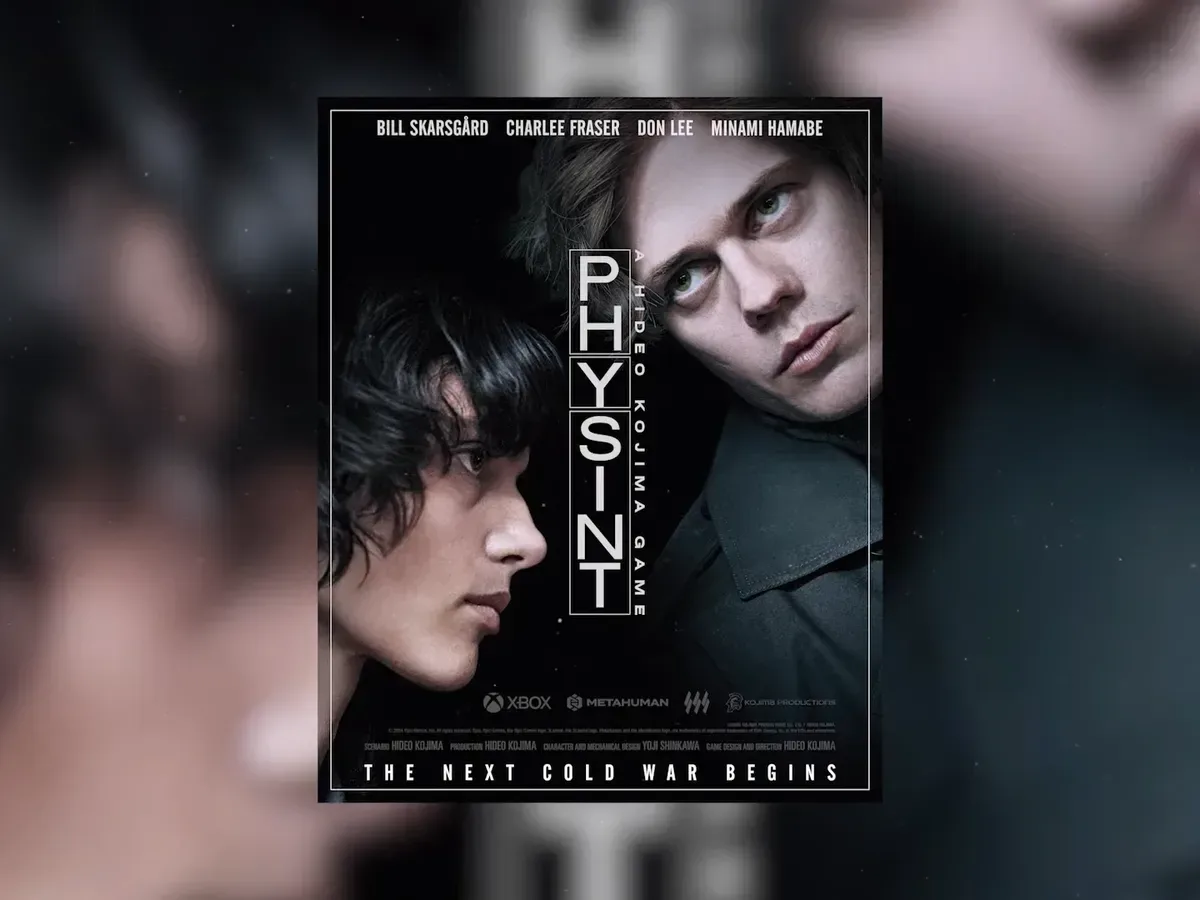
Skarsgård was confirmed as Physint’s lead in September 2026. The announced cast also includes Charlee Fraser, Don Lee and Minami Hamabe. Their roles and the relationships among their characters have not been detailed in the available information, so speculation about story alliances, villains or familiar series archetypes would be premature.
In early October, Kojima said he wants Physint to evoke the roots of the Metal Gear Solid games while delivering a new interactive experience with a different kind of spy action. That wording is the clearest official creative direction currently available. It acknowledges the lineage fans are likely to see in the project while emphasizing difference rather than replication.
“Spy action” is a broad label. It can encompass stealth, surveillance, infiltration, combat, deception, gadgets, political intrigue and cinematic set pieces. The phrase alone does not settle which of those elements Physint will prioritize. The practical takeaway is that players should read the Metal Gear connection as a statement of creative roots, not as confirmation of a sequel, a remake, or a list of returning systems.
That distinction is especially useful in an era when familiar names can create expectations faster than a project can define itself. Similar questions about scale, identity and audience expectation have surrounded other anticipated games; the debate over whether an anticipated sequel can become gaming’s next GTA 6-scale event illustrates how quickly a project’s public perception can outgrow the firm details available.
Physint’s move to Xbox
Physint has also undergone a major business shift. The project recently moved from Sony to Xbox after Kojima said it had faced cancellation by the PlayStation parent company and that Microsoft stepped in to keep it alive. That is a substantial change for a game whose early identity had been linked to PlayStation.
Reports have indicated that the project missed deadlines and was projected to exceed its budget while still years away from release. Those reports offer possible context for the change, but they do not provide a complete account of the project’s development or confirm every factor behind the decision. The clearest established result is the platform-holder transition: Xbox is now backing Physint.
For players, this is not yet the same thing as a complete platform and release plan. The available details do not set out a launch date, supported hardware list, exclusivity terms, pricing or distribution model. It is therefore sensible to distinguish the confirmed funding and publishing shift from assumptions about where, when or how the finished game will be available.
What is known—and what remains unknown
Physint has a recognizable direction, a confirmed lead actor, an announced supporting cast and a new Xbox association. Yet it remains early enough that most of the questions likely to matter to players still have no public answer. That includes the game’s setting, its central conflict, its moment-to-moment systems, the balance between stealth and combat, and its release timing.
Skarsgård’s comments do not resolve those questions, but they make the project’s intent easier to read. His account presents Physint as an opportunity to work with a creator whose games he already values for their cinematic sensibility, dense fictional worlds and interactive possibilities. His confirmation of performance capture also establishes that his participation will be physically embedded in the game’s production, not limited to a promotional casting announcement.
Meanwhile, Kojima has other projects in motion. A Death Stranding anime is on the horizon, and the horror game OD Knock, starring Hunter Schafer and Sophia Lillis, is another project to watch. Physint, however, occupies a particular place in the conversation because it is explicitly associated with a fresh interpretation of spy action—and because its leading performer sees that association as personally meaningful.