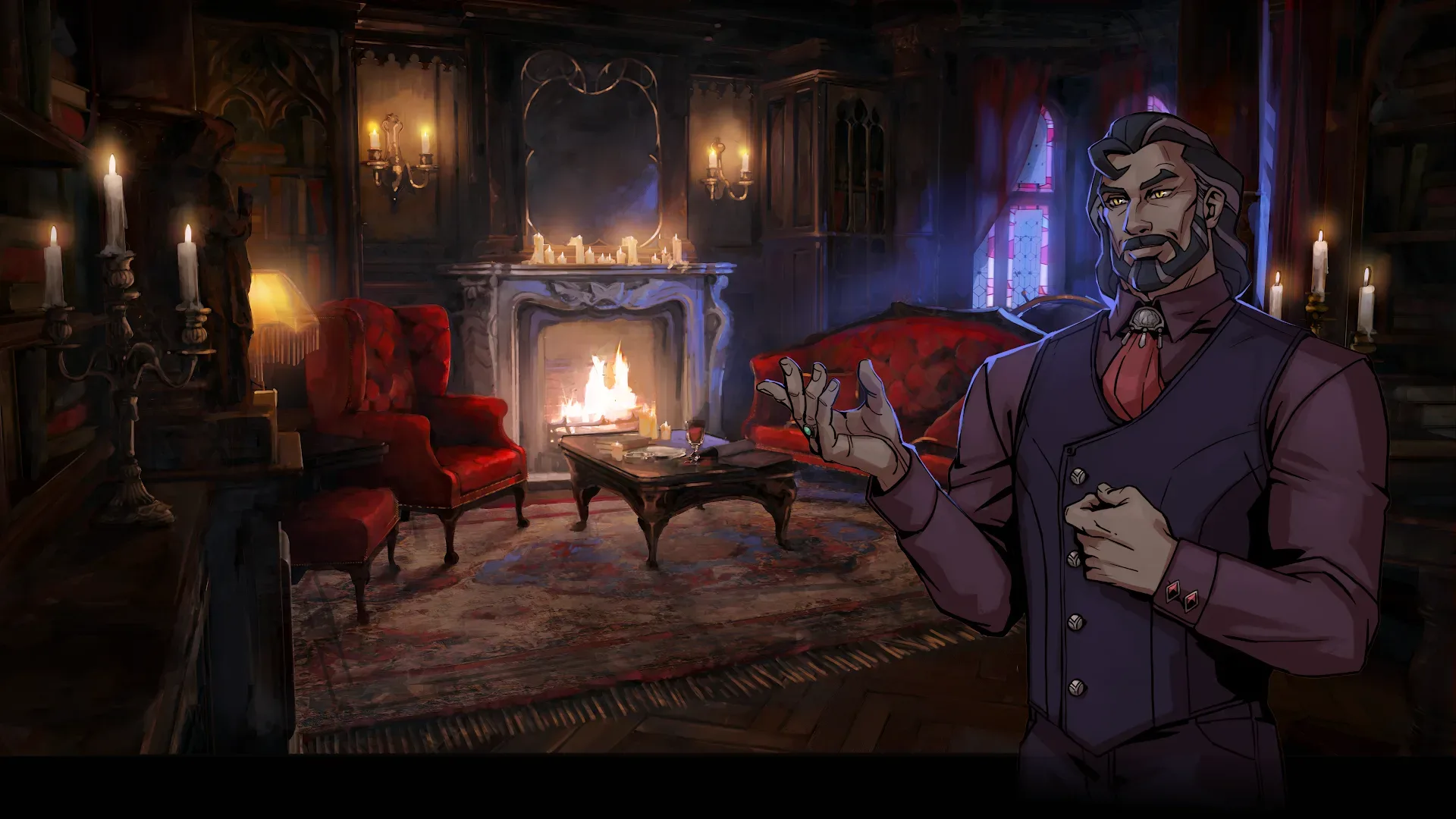
Vampire Therapist, the BAFTA-nominated visual novel about an immortal vampire attempting to help other immortals untangle their problems, is headed to iOS and Android on November 24.
The mobile release brings a premise that is deliberately more conversational than combative. Players inhabit an immortal bloodsucker working with a varied group of vampire clients, whose endlessly extended lives have not stopped them from developing deeply human troubles. The game uses real-world CBT techniques in those discussions, while addressing subjects including sexuality and religion.
That combination makes the game’s central idea easy to grasp: immortality may remove a few ordinary pressures, but it does not automatically produce emotional clarity. If anything, an inextinguishable life gives doubts, regrets and destructive patterns much more room to linger. Vampire Therapist turns that tension into the basis for a visual-novel experience.
A vampire game built around listening
Visual novels are games primarily driven by written scenes, character interaction and player choices rather than reflex-heavy action. That format is a natural fit for a game focused on therapeutic conversation: the dramatic question is not whether a player can defeat an enemy, but whether they can recognise the thought pattern or personal knot that is keeping a client stuck.
For more context, explore Pikachu Puppetronic’s 40% Cut Makes the Animatronic Pokémon Figure More Tempting.
Vampire Therapist’s clients are vampires with lives that have begun to unravel despite, or perhaps because of, their immortality. The player character’s role is consequently not that of a traditional hero cleaning up a supernatural crisis with weapons or magic. It is a more intimate role: hearing people out, engaging with what they say and applying the game’s CBT-informed approach to their stated problems.
The premise also gives the game room to approach potentially weighty material through a heightened gothic lens. Vampires are an especially useful vehicle for stories about time, identity, desire, guilt and alienation. They are fictional beings defined by long life and separation from ordinary human experience, yet their problems can still be recognisably personal.
For mobile players, the emphasis on reading and dialogue should make the game an especially sensible fit for phones and tablets. The announced information confirms the iOS and Android date, though it does not detail pricing, device requirements, controls, language options, offline functionality or how the release will be distributed. Those are details prospective players will need to check closer to launch.
What CBT means in this context
CBT stands for cognitive behavioural therapy. Broadly, it is an approach that examines links among thoughts, feelings and behaviours. In everyday terms, it can involve noticing an unhelpful conclusion, looking at the assumptions behind it and considering whether a different response might be more constructive.
Within Vampire Therapist, CBT is presented as real-world-informed material used in fictional vampire conversations. That does not mean a visual novel replaces mental-health care, professional assessment or therapy in real life. It does explain why the game’s dialogue has a more specific foundation than a generic “choose the nice answer” system. The stated focus is on engaging with the way its characters interpret themselves and their circumstances.
The distinction matters because CBT is often used casually to mean “positive thinking,” which is an oversimplification. A CBT-informed process is not simply insisting that every worry is false or that every difficult emotion should disappear. It is about examining thoughts and behaviour patterns with care. In a narrative game, that can create sharper choices: a response may sound reassuring on the surface while still missing the assumption a character is making.
Vampire Therapist’s supernatural setting can make those conversations playfully extreme. A person who has lived for an exceptionally long time may have accumulated centuries of habits, grudges, shame or isolation. But the point is not merely the novelty of a vampire on a couch. The premise uses fantasy to explore why people can remain trapped by a familiar story about themselves even when their external circumstances have changed dramatically.
Why the subject matter is notable for a visual novel
The game’s stated topics include sexuality and religion, placing it in territory that calls for more than a thin supernatural gimmick. Both can be closely connected to identity, community, values and personal conflict. In a conversation-led game, the value of that material depends on characters being allowed to express their own perspectives rather than being reduced to a single issue or lesson.
The available announcement establishes that Vampire Therapist has a diverse vampire clientele and that these themes are part of its discussions. It does not set out individual storylines, client names, branching routes or possible outcomes. That uncertainty is worth retaining: the broad concept is clear, while the particulars of how each topic is handled remain for players to encounter in the game.
There is a practical upside to a visual novel taking the form of focused conversations. It can invite a slower pace than games built around constant escalation. Instead of treating every interaction as a test of combat skill or resource management, it can ask players to pay attention to wording, context and emotional contradictions. That is not necessarily easier; listening closely is its own kind of challenge.
It also allows a different sort of fantasy. Power fantasies often place the player above a problem, equipped to overpower it. Vampire Therapist’s setup instead suggests responsibility: the player occupies a position where patience and thoughtful interpretation matter. The vampire framing keeps the tone distinct, but the underlying activity is recognisable. People are complicated, and being immortal does not make them less so.
What the mobile launch means
Bringing the game to iOS and Android gives this unusual visual-novel concept a route to an audience that often plays in shorter sessions. Dialogue-driven stories can work well in that setting because individual scenes can be read at a player’s own pace, whether they have a few quiet minutes or more time to settle into a longer exchange.
That said, the appeal is likely to rest less on convenience than on the game’s unusual thematic hook. Vampire fiction is common across games, but a vampire protagonist employing CBT techniques with other vampires is a far more specific proposition. The BAFTA nomination adds a notable marker of recognition, while the description of the game itself gives the clearest reason to watch the mobile release: it treats a fantasy premise as an opportunity for character-centred discussion rather than just another excuse for bloodshed.
Players interested in the announcement can find a separate report on the November 24 mobile date. For now, the confirmed essentials are straightforward: Vampire Therapist is coming to iOS and Android on November 24, and its counselling-room vampire drama will retain a focus on CBT-informed conversations with a diverse cast of immortals.