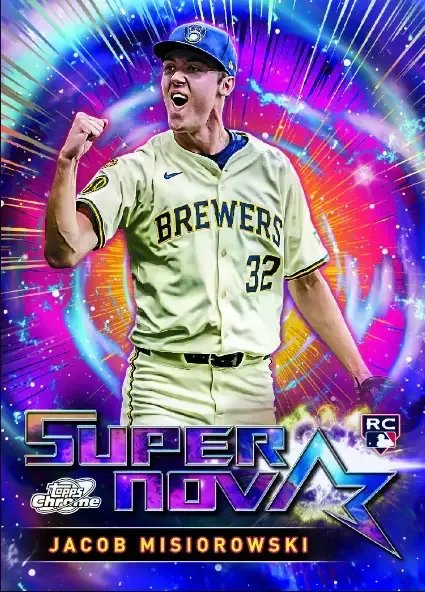
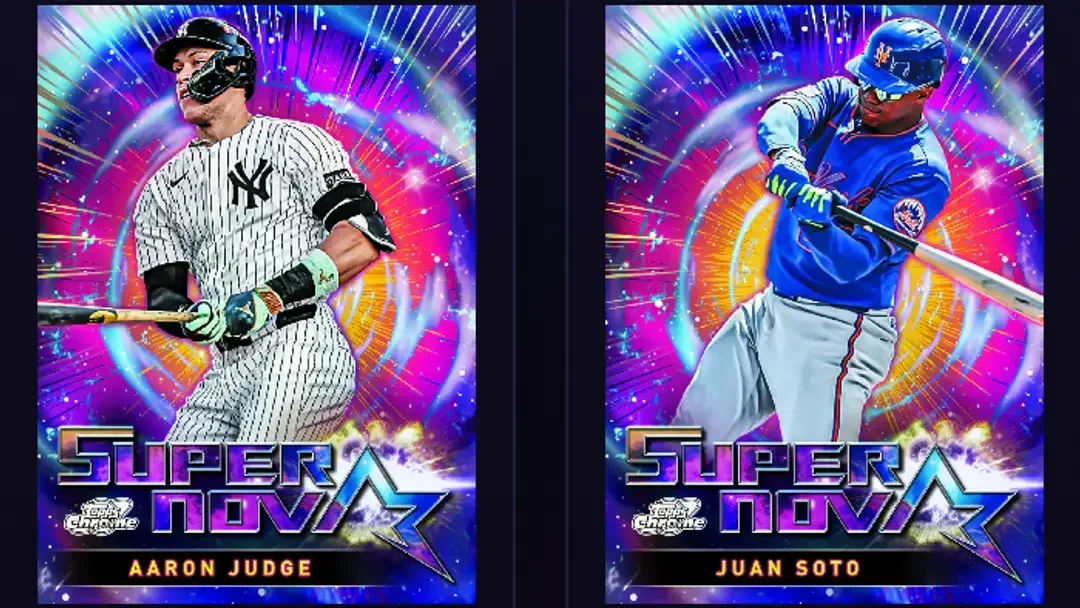
Topps has introduced a replacement path for collectors affected by a major production issue in 2026 Topps Chrome Cosmic. The company says that Super Nova inserts for 23 of the set’s 25 listed players were omitted from packs. Aaron Judge and Juan Soto were the only players whose Super Nova cards made it into the released product.
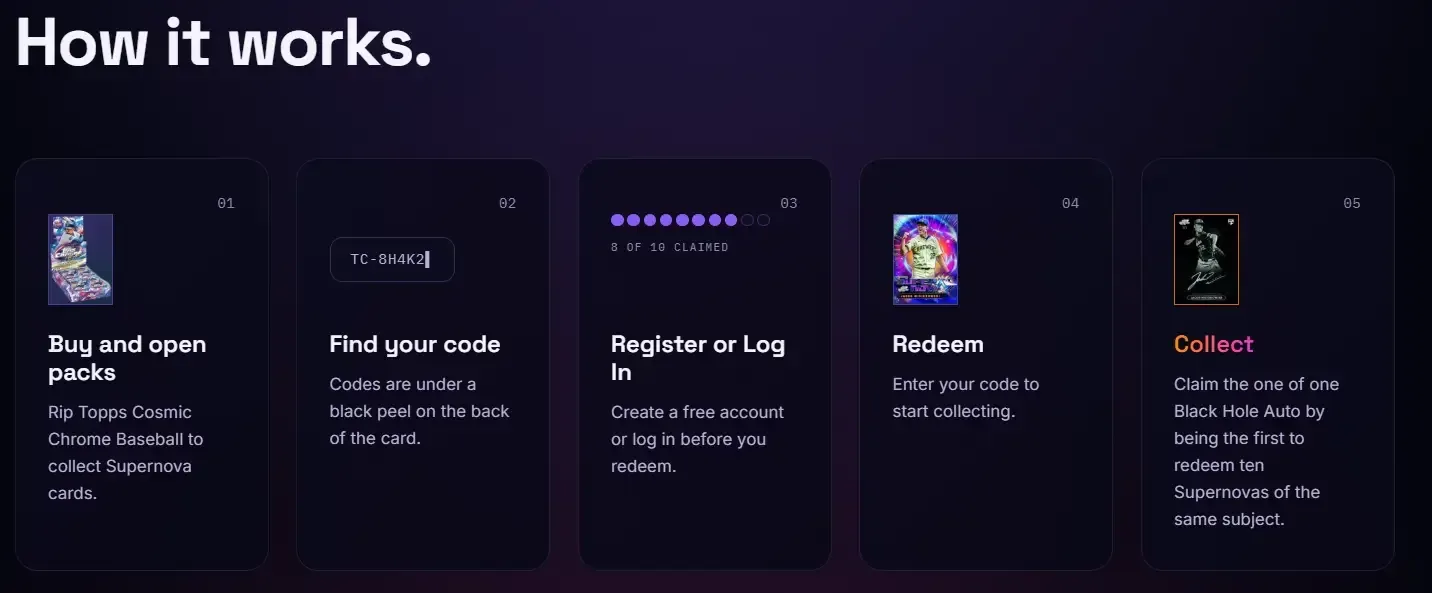
The issue matters well beyond a missing parallel or a checklist footnote. Super Nova is central to the product’s biggest collector challenge: the Black Hole program. Under that program, the first collector to assemble 10 Super Nova copies for one player can redeem them for a newly created, one-of-one autographed Black Hole card for that player.
With almost the entire Super Nova checklist absent from packs, that pursuit could not realistically proceed as initially envisioned for most players. Topps’ answer is a new Supernova Card Program, which lets qualifying collectors exchange a player’s Interstellar Gold /50 card for one corresponding Super Nova card.
What went wrong with the Super Nova checklist?
Topps Chrome Cosmic does not include guaranteed autographs, making its inserts a key part of the appeal for collectors opening packs. This year’s Black Hole promotion made Super Nova cards especially consequential. Rather than merely serving as difficult pulls, they became components in a player-specific race toward an exclusive one-of-one autograph.
That structure depends on the stated checklist being present in the product. Topps acknowledged that 23 players’ Super Nova cards were left out because of a production error. Only Judge and Soto Super Novas appeared in packs.
Judge and Soto are also listed first on the Black Hole program page. The available program tracker indicates that one Aaron Judge code has already been redeemed. Their inclusion in packs distinguishes them from the other 23 players, whose Super Nova cards are being addressed through the new submission process instead.
How the Supernova Card Program works
The remedy is tied to a different numbered insert: an eligible Interstellar Gold /50. “/50” is hobby shorthand for a card serial-numbered in a run of 50 copies. For this program, holding the right Gold /50 is not itself the end of the process; it is the required card a collector must submit to obtain the matching Super Nova.
A collector who has an eligible player’s Interstellar Gold /50 must contact Fanatics and provide the player’s name, the card’s precise serial number, and clear photographs of both the front and back. After that verification step, the collector receives a shipping label to send in the Gold /50 card.
Related coverage includes Topps Addresses 2026 Chrome Cosmic Super Nova Production Error.
When the submitted Interstellar Gold arrives, it is returned to the collector along with one Super Nova card for the same player. In practical terms, this is an exchange-and-return process: the qualifying Gold /50 is not permanently surrendered, and the Super Nova is added alongside it.
Important exclusions
- Gold autographed cards are not eligible.
- Aaron Judge and Juan Soto Gold /50 cards are not eligible, because their Super Nova cards were already inserted into packs.
- The program is for the corresponding player only. A qualifying Interstellar Gold /50 is used to obtain that same player’s Super Nova, not a Super Nova from another name on the checklist.
Collectors should pay close attention to the distinction between an eligible Interstellar Gold /50 and a gold autograph. Similar-looking cards and overlapping color descriptions can create confusion in modern card products, but Topps’ stated eligibility rule is specific: the qualifying route is the non-autographed Interstellar Gold numbered to 50.
The players covered by the remedy
The 23 players whose Super Nova cards were omitted, and whose eligible Interstellar Gold /50 cards can be used in the program, are Vladimir Guerrero Jr., Freddie Freeman, Bobby Witt Jr., Mike Trout, Shohei Ohtani, Ronald Acuna Jr., Francisco Lindor, Paul Skenes, Bryce Harper, Elly De La Cruz, Julio Rodriguez, Gunnar Henderson, Junior Caminero, Yashinobu Yamamoto, Nick Kurtz, Trey Yesavage, Chase Burns, Nolan McLean, Jacob Misiorowski, Samuel Basallo, Roman Anthony, Jac Caglianone and Minutaka Murakami.
That is a broad group, combining established stars, young major-league talent and prospects. It also means the impact is not confined to one narrow player market. Anyone buying, trading or chasing an Interstellar Gold /50 from that list needs to understand that the card now has a stated program use beyond its normal place in the Chrome Cosmic parallel hierarchy.
For wider baseball-card context, collectors tracking how player demand can move across products may also want to follow our latest rookie card watch, even though this Topps situation is specific to baseball and a production-error remedy.
Why the program tracker matters before a purchase
Topps says the Black Hole program website will identify which numbered Gold /50 cards have already been used to obtain a Super Nova. That tracker is a significant practical detail for anyone considering a secondary-market purchase specifically to enter the Supernova Card Program.
A serial number is unique within the /50 run. Once a particular numbered Interstellar Gold has been used for the corresponding Super Nova, a prospective buyer should not assume that exact card can be submitted again for another copy. The tracker is intended to make that status visible.
That creates a basic due-diligence checklist for collectors:
- Confirm that the player is one of the 23 covered by the replacement program.
- Confirm that the card is an Interstellar Gold /50, rather than a gold autograph or another gold-colored card.
- Record and inspect the exact serial number.
- Check the Black Hole program tracker before buying a card for the Super Nova exchange.
- Keep clear images of the front and back ready for the required submission.
The emphasis on checking the serial-number tracker is particularly important in a market where a card can change hands quickly. A seller may accurately possess an eligible-looking Gold /50, while the individual serial number could already have been used in the program. The program’s transparency feature is designed to reduce that uncertainty, but it only helps collectors who check it before committing to a deal.
What the fix changes—and what it does not
The new route addresses access to omitted Super Nova cards for eligible Gold /50 holders. It does not turn every Chrome Cosmic buyer into a program participant, and it does not change the fact that Judge and Soto were the only Super Novas placed in packs. Those two players remain separate from the remedy and from eligibility through Gold /50 submissions.
It also preserves the Black Hole program’s player-by-player framework rather than replacing it with a general giveaway. A collector still needs to build toward 10 Super Novas of a single player to pursue that player’s one-of-one autographed Black Hole card. The difference is that, for the affected 23-player group, the missing Super Nova cards can now be obtained through the defined Interstellar Gold /50 process.
For collectors, the immediate takeaway is straightforward: do not treat the absence of most Super Novas in opened packs as ordinary scarcity. Topps has identified it as a production error and has set a specific route for eligible holders. Before buying an affected player’s Gold /50 with the program in mind, verify the card type and its exact serial-number status on the program tracker.