
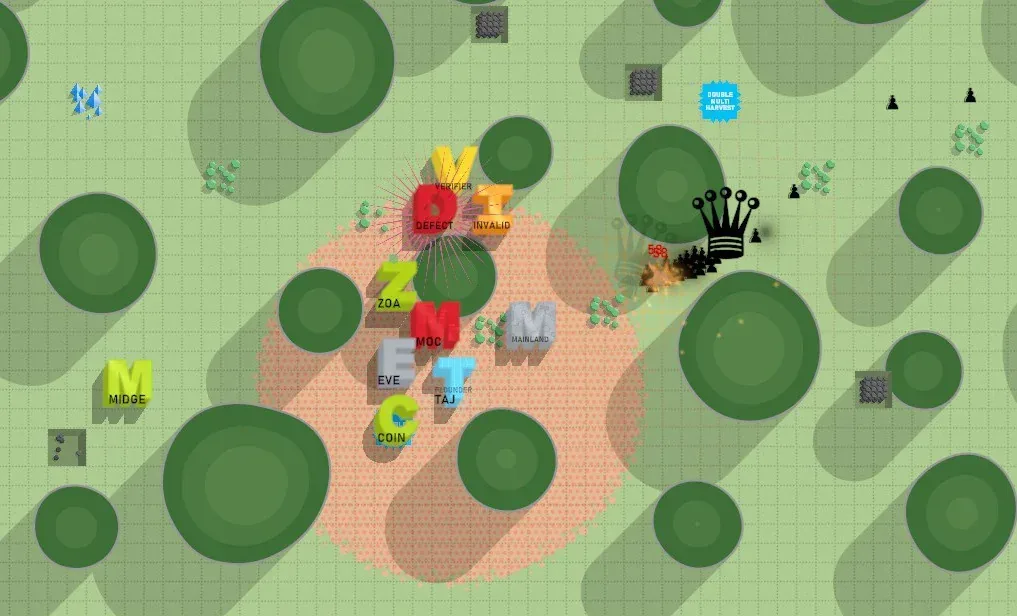
Towers of Babble starts from a wonderfully dangerous premise: what if a rack of letters were not merely an invitation to score points, but a box of building materials for a small, strange war? The game from Frank Lantz, known for the industrial absurdism of Universal Paperclips, combines word construction with map-based defense and run-to-run progression. It is a strategy game in which vocabulary is not flavor text. Vocabulary is the army.
The result is less about proving that a player knows an obscure seven-letter word than about discovering what happens after they make one. A noun can place a unit onto the map. Verbs and modifiers can become power-ups for those noun-units. Resources gathered by particular words can be spent on upgrades. And clearing waves eventually conquers a level that is, naturally, also represented by a word.
That basic loop gives Towers of Babble a playful answer to a familiar problem in strategy games: how do you make the choices before a battle feel as interesting as the battle itself? Here, the pre-battle decision is not simply which turret to buy. It is which available letters can be persuaded to become something useful, and what the game thinks that something should mean.
A tile rack with battlefield consequences
A campaign begins with only a handful of letter tiles. From there, players spell a noun to create a unit on the map. Those words come with predetermined roles, such as harvesters or defensive units. A harvester is a unit focused on producing the resources that fund later actions; a defensive unit is intended to help hold back attackers. The distinction means that even a valid word is not automatically the right word for the immediate situation.
Verbs and modifiers serve a different purpose. Rather than becoming the principal bodies on the field, they provide buffs or power-ups for noun-units. A modifier, in grammatical terms, changes or adds detail to another word. In Towers of Babble, that linguistic job maps neatly to game design: modifiers alter the capabilities of the things a player has already built. The game’s central joke is also its systems logic. Grammar becomes an equipment screen.
Once harvesting is underway, resources can be put toward upgrades, including access to a bigger tile selection and premium statistics attached to certain letters. That creates a meaningful tension between short-term defense and long-term flexibility. More tiles should expand the set of words a player can assemble. Better letter statistics suggest that the raw components of future words can matter alongside the words themselves.
It is a structure that should be immediately legible to anyone who has encountered a tower defense game, even if its vocabulary is much more literary than the genre’s usual turrets, walls and artillery. In a conventional tower defense setup, the player arranges defensive tools to withstand incoming enemy waves. Towers of Babble retains the waves and map-based planning, but substitutes an unpredictable word-building layer for a conventional shop menu.
Meaning is part of the ammunition
The game features roughly 200,000 possible word units and 120,000 levels. Those are huge numbers, but the more interesting detail is that words have loose connections to their definitions. A word’s meaning can inform the kind of effect it brings to battle: healing, poison clouds that deal gradual damage, stronger shields, or especially large missile attacks are among the stated possibilities.
Related coverage includes Towers of Babble Turns Letter Tiles Into a Strange Shared Strategy War.
This is where the game’s interest in semiotics matters. Semiotics is the study of signs and how meaning is communicated. Towers of Babble applies that idea with a deliberately magical bent. Rather than treating a word as a string of letters that passes or fails a dictionary check, it treats the word’s associations as material for a unit’s abilities. The result is not a claim that language operates with scientific consistency. It is a game system built around the pleasure of seeing language interpreted.
That makes experimentation a major attraction. Players are encouraged to try their own lingo and see how the game manifests it. The appeal resembles the open-ended curiosity associated with Scribblenauts: part of the entertainment lies in entering something unexpected and waiting to learn how the game responds. Towers of Babble channels that impulse into defense planning, where a surprising word may be a tactical resource as well as a punchline.
There is also room for compounded constructions: long, Germanic-style strings of combined words can be created from the system. The prospect is inherently comic, but it also reinforces the game’s broader design. It does not position language as a polished list of approved answers. It wants players to pull terms apart, bolt them together and inspect the resulting contraptions for both utility and weirdness.
Roguelike seasoning, not just a one-map puzzle
The game adds a roguelike-style layer to its campaigns. “Roguelike” is a broad term often used for games that make each attempt feel distinct through limited starting options, unpredictable combinations, escalating challenges and some form of progression or reset. Towers of Babble’s version begins with its limited letter hand and continues through the upgrades and word choices available during the campaign.
After enough enemy waves have been survived, the level is conquered. Some elements can carry over into the next struggle. That persistence is important: instead of every map being a sealed word puzzle, success can influence the choices available later. It also makes the decision to invest in extra tiles or enhanced letters feel like more than an answer to one immediate wave.
Maps and enemy types vary, and different maps call for different approaches. But the combat itself is not described as especially punishing. Enemy attack patterns are often predictable, and fights can be relatively easy to win before the conflict fully gets going. For players seeking an exacting tactical gauntlet, that is a useful expectation to set. Towers of Babble’s most distinctive strength appears to be its expressive systems rather than a relentless demand for defensive precision.
That is not necessarily a weakness. In many strategy games, an overwhelmingly difficult battlefield can discourage experimentation because every unusual choice risks ending a run. A more manageable combat layer can give players room to test odd phrasing, pursue personal linguistic jokes and find out whether an unusual combination of terms produces an unexpectedly effective force. The game’s personality depends on players feeling free to ask, “Can I make this?” before immediately asking, “Will this survive?”
One enormous tower, built by separate players
The individual campaign has a collective twist. Each player is called a Librarian, plays alone, and contributes conquered words to the same massive tower. In other words, the game frames personal progress as a small construction project within a shared structure. The eventual outcome once the entire lexicon has been cleared remains unknown.
This communal goal gives the 120,000-level figure a purpose beyond sheer scale. A vast number of word-themed stages could otherwise feel like an intimidating spreadsheet that learned to wear armor. By connecting each cleared word to one tower, Towers of Babble turns the abundance into an ongoing group project. Players do not need to be in the same battle to be working toward the same impossible-looking monument.
It is an unusual social design because it avoids making every Librarian directly compete. The solitary act of making words remains central, while the wider player base supplies the sense that language is being collectively excavated, one cleared term at a time. A personal construction can be eccentric; the larger tower can absorb all of it.
For anyone planning to spend time in games that depend on online connectivity, the boringly practical side still counts: a stable connection can help keep sessions smooth when several devices are active. Our guide to why Wi-Fi slows down when more devices connect explains the network-side basics.
Why the premise has legs
Word games traditionally reward recall, spelling and placement. Strategy games reward planning, adaptation and resource management. Towers of Babble uses the friction between those habits as its main engine. The player may spot a word because it fits the letters at hand, then have to reconsider because its assigned role does not fit the map. A strong defensive plan may be visible, but inaccessible until the right tiles arrive. The letters are therefore both language and economy.
That fusion also makes the game unusually personal. Two players can approach the same broad task with different vocabularies, different tastes in wordplay and different willingness to chase nonsense compounds. The stated combat predictability may mean the game is not chiefly about proving tactical superiority. Its intrigue is in making a player’s particular relationship to words visible on the battlefield.
Lantz’s prior work is a useful point of context only because Universal Paperclips likewise took an ordinary object and stretched it into a much larger, stranger system. Towers of Babble applies a related instinct to words: start with a modest tile rack, then keep escalating until it contains harvesting, upgrades, waves, missiles, poison and a shared tower reaching toward the heavens.
For the logophile who has always suspected a noun could be more useful with armor, that is an excellent premise. Towers of Babble may not promise the most ferocious tower-defense challenge, but it has found a more distinctive question: what kind of army is hiding inside the words you already want to make?