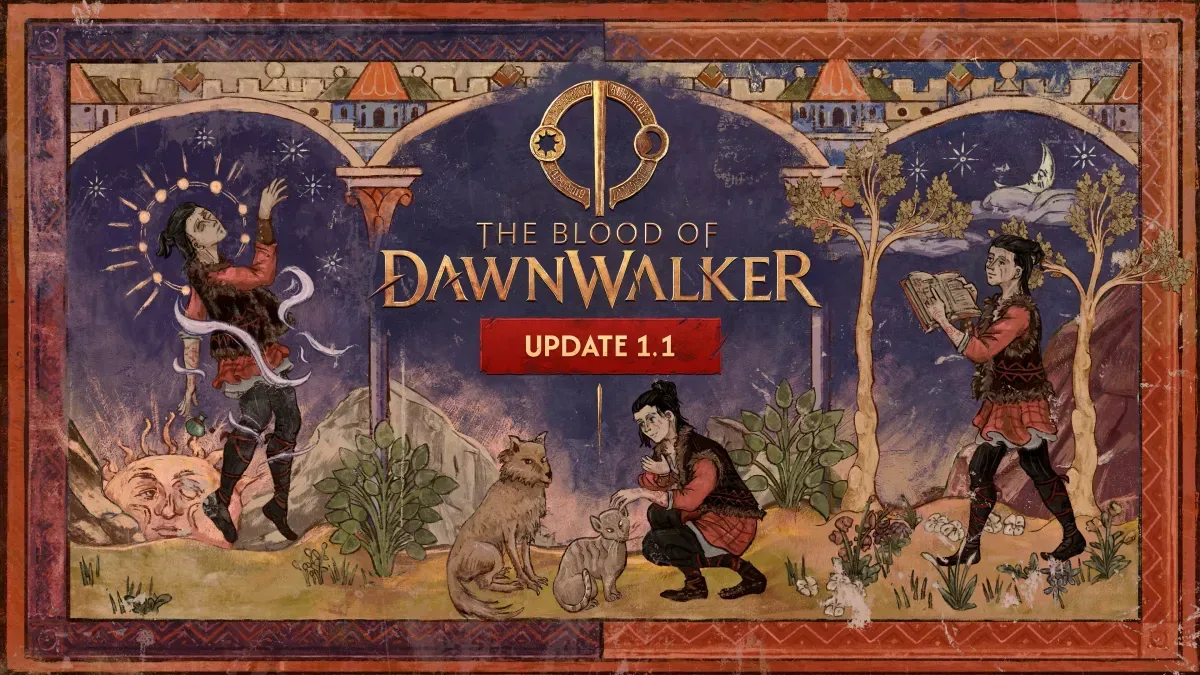
The Blood of Dawnwalker Update 1.1 is now rolling out with a broad set of changes aimed at smoothing out a release that had performance rough spots, particularly on consoles. Rebel Wolves’ first major post-launch update combines stability and crash fixes with more immediately visible tweaks: combat targeting and animation work, a less restrictive camera, changes to resilient animal enemies, an expanded difficulty structure, a way to rebuild a character’s skill allocation, subtitle-size options, and the ability to pet dogs and cats.
It is a notable mix because it addresses two very different player needs at once. Some players need the fundamentals to work more reliably, including steadier performance and fewer crashes. Others may have already made progress but want a less punishing combat experience, a camera that better supports what they are trying to do, or the freedom to change an early character-build decision. Update 1.1 is intended to touch both categories rather than focus on a single balance pass.
Performance and stability are the central practical issues
The game’s launch drew player feedback around console framerates, and higher framerates were made a priority. Even with that focus, the game could still struggle at times on PlayStation 5. Update 1.1 therefore matters most as a maintenance patch: beyond its headline features, it contains hundreds of smaller fixes intended to reduce bugs and crashes and improve overall stability.
Those terms are related but not interchangeable. Performance generally concerns how smoothly a game runs, including framerate consistency. Stability refers to whether it remains dependable over a session, avoiding crashes or other severe failures. A patch can improve one without wholly solving the other, which is why broad updates often include work in both areas.
The available details do not promise a particular framerate target, nor do they specify every scenario affected by the fixes. Players should treat the update as an effort to improve the experience rather than as a guarantee that every performance problem is gone. Still, putting performance, crash reduction, and stability at the center of a first major update acknowledges that technical reliability is not separate from a game’s design: it determines how well its combat, movement, exploration, and story can be experienced in the first place.
Combat adjustments reduce friction without removing choice
On the play-design side, Update 1.1 revises targeting and animations and makes the camera less restrictive. These may sound like incremental changes, but each affects the moment-to-moment readability of encounters.
Targeting is the system that helps translate a player’s input into the intended enemy selection or attack direction. When it is unresponsive or unclear, the player can feel as though they are fighting the controls as much as the opponent. Improved targeting is especially meaningful in a combat game with multiple threats, where choosing the correct target quickly can determine whether an intended tactic actually works.
Animation improvements can also have a mechanical effect, not merely a visual one. Animations communicate when an action begins, when a character is vulnerable, and when the player can react. Clearer or more responsive animation behavior can make combat easier to read even if the underlying challenge remains demanding.
Related coverage includes The Blood of Dawnwalker Update 1.1 Targets Performance, Combat and Player Freedom.
The camera change follows the same logic. A restrictive camera can obscure nearby enemies, limits a player’s view of the environment, or make positioning feel awkward. A less restrictive camera should give players more control over their perspective, helping them assess encounters and move through spaces with fewer unwanted constraints.
Rebel Wolves is also reducing the health of wolves and boars. These enemies had remained unusually durable even later in the game, so lowering their health is a targeted balancing change rather than a blanket reduction in difficulty. Animal encounters should take less time to resolve, particularly for players who had found those opponents disproportionately tanky relative to their place in the adventure.
Players should also find it easier to leave combat when they want to disengage. Disengaging means successfully breaking away from an encounter instead of being held in an extended fight. That can be useful when a player is low on resources, has entered an unfavorable situation, or simply decides a confrontation is not worth pursuing at that moment. Better escape options do not necessarily make every encounter easier; they give players more agency over when and how they commit to one.
Difficulty options now better distinguish story-first play
The update revises the game’s lower-difficulty naming and support structure. What had been called Story mode is now called Forgiving. A new Story mode takes its place and adds further combat assists for players who want more help during fights.
The terminology matters because difficulty labels communicate expectations. “Forgiving” describes a setting designed to be more tolerant of mistakes. The new Story option goes a step further by adding combat assistance, placing greater priority on progressing through the narrative and world rather than overcoming the same level of mechanical resistance expected elsewhere.
Combat assists are systems that lessen the burden of fighting, though the specific assists included here have not been detailed. Their presence creates a clearer option for players who may be interested in the game’s story but do not want combat to become a recurring obstacle. It also means that a player returning after time away, or finding a particular stretch frustrating, has another route forward without being forced to remain at a setting that no longer suits them.
This distinction between challenge settings is becoming more important in sprawling role-playing games. The same game can appeal to players who want demanding encounters and players who primarily want to explore its setting, experiment with its systems, or follow its narrative. Providing more than one workable path does not erase the harder route; it recognizes that players arrive with different needs.
A respec potion offers a fresh start for existing characters
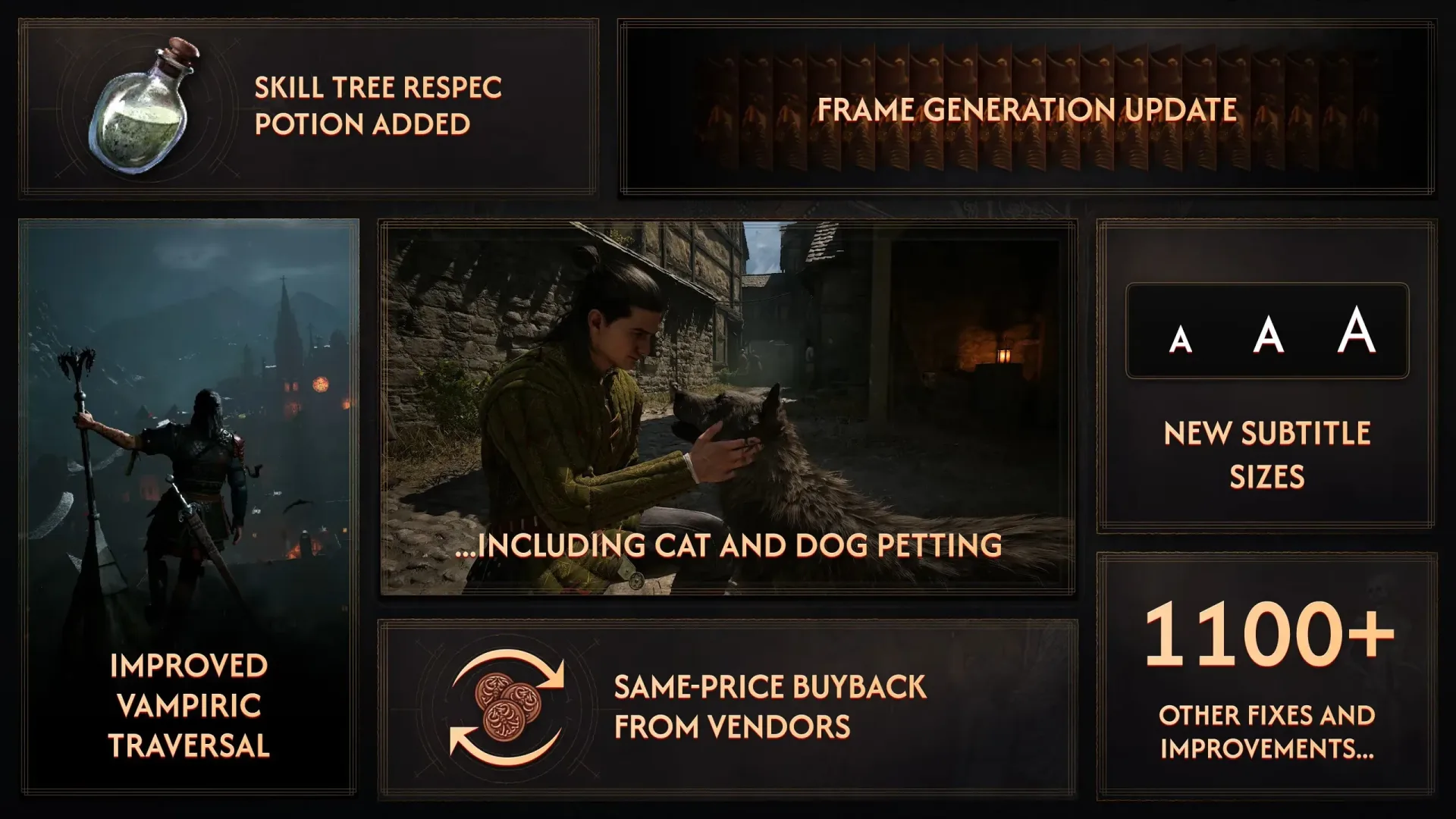
Outside combat, Update 1.1 adds the Daught of Mind Rebirth potion, an item that lets players respec their skill tree. To respec is to reset or reassign character-development choices. In this case, players can reallocate both time and skill points that were previously spent, giving them a way to alter their build instead of starting over.
A build is the combination of abilities and upgrades a player has chosen for their character. Early decisions can make sense before a player understands the full game or discovers a preferred approach. A respec system reduces the long-term penalty of experimenting. Someone who has committed points to one style but later decides another better matches their habits can revise that plan using the new potion.
The practical value is not just convenience. It makes experimentation less risky and gives returning players a useful option if combat revisions change how their preferred tools feel. It also complements the update’s wider emphasis on flexibility: easier combat disengagement provides choice during an encounter, while respecs provide choice across a whole playthrough.
The importance of version-numbered updates should not be understated, either. As with the clarification that Palworld: Side by Side is Version 1.1 rather than a sequel or expansion, a 1.1 label can signal a substantial revision without representing an entirely separate release. For Dawnwalker, the changes are meaningful, but the game remains the same core game rather than a new standalone product.
Accessibility and traversal changes may have an outsized effect
Players can now increase subtitle size. This is a small setting with broad value: larger text can help players who find default subtitles difficult to read because of screen size, viewing distance, visual needs, or simply preference. It also helps ensure that dialogue remains legible without requiring a player to alter other display conditions.
The update further improves responsiveness for the Shadowstep and Planeshift systems. Both are associated with teleportation, and their responsiveness matters because a movement ability must place the player where they intend to go. A teleport that lands a character on a wall below a desired rooftop, for example, changes from a useful traversal tool into a source of interruption. Better responsiveness should make those systems more dependable for navigating vertical spaces and selecting destinations.
As with the performance work, the patch notes’ wider scope is important. The feature list captures the changes easiest to describe, but the hundreds of smaller corrections may determine how consistently those headline improvements hold up across a full session.
Yes, dogs and cats can be petted now
Finally, Update 1.1 adds pettable dogs and cats. It is not a balance feature or a technical fix, but it is a welcome piece of world interaction. Small optional actions can give a game world more warmth and provide a pleasant break between quests, fights, and travel. In an update otherwise centered on difficult-but-useful work—crashes, camera limits, targeting, and character rebuilding—it is also the clearest reminder that quality of life can include simple pleasures.
For players deciding whether to return or begin a new adventure, the update’s most consequential additions are likely the performance and stability effort, combat readability changes, extra difficulty support, and respec potion. The subtitle setting and traversal responsiveness could matter just as much depending on how someone plays. And for anyone who judges a role-playing game by the courtesy it extends to its four-legged residents, the dogs and cats now have an answer.