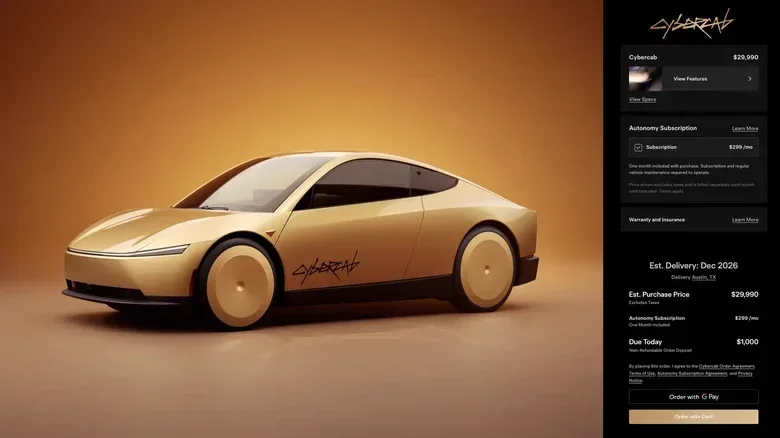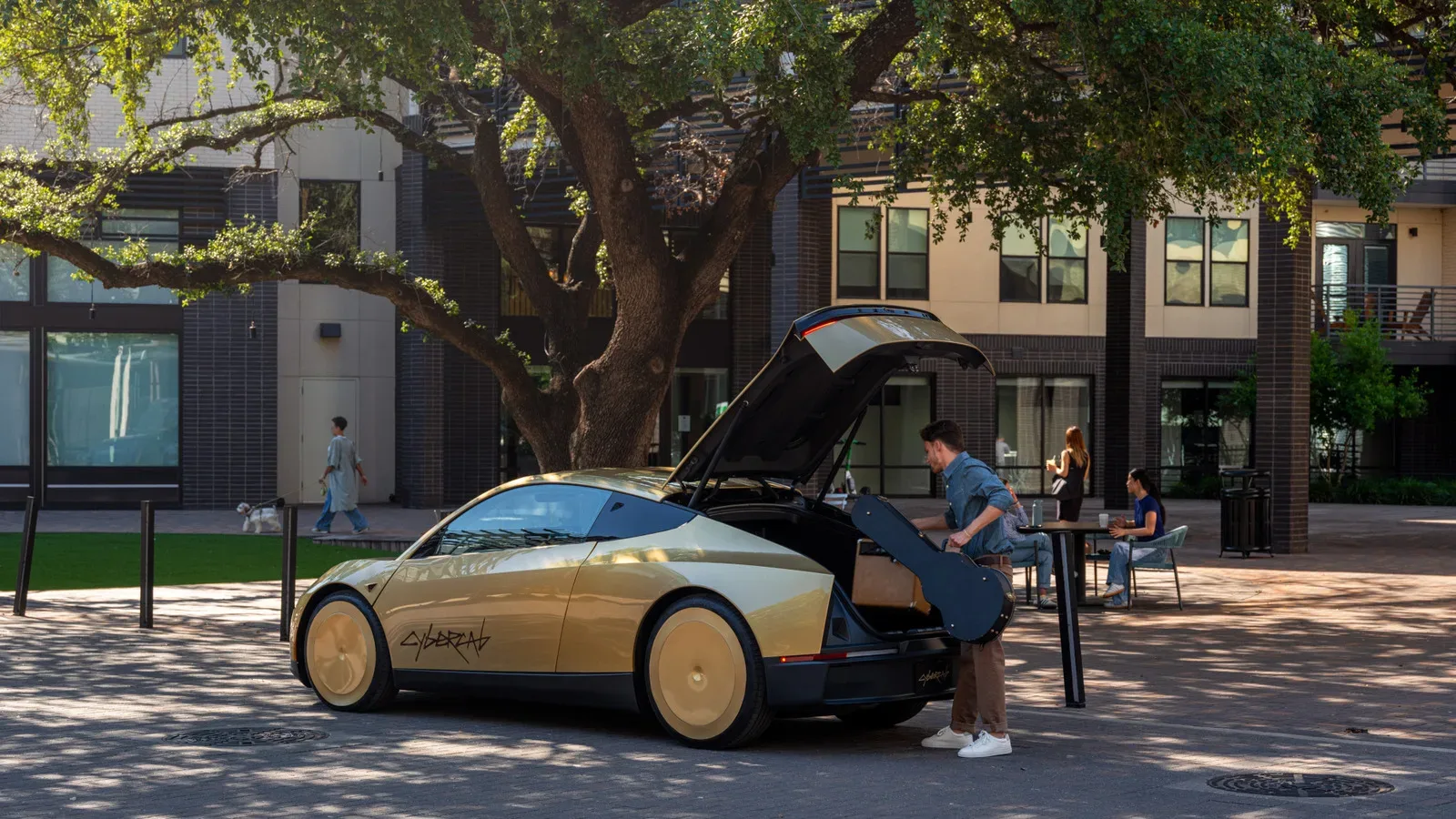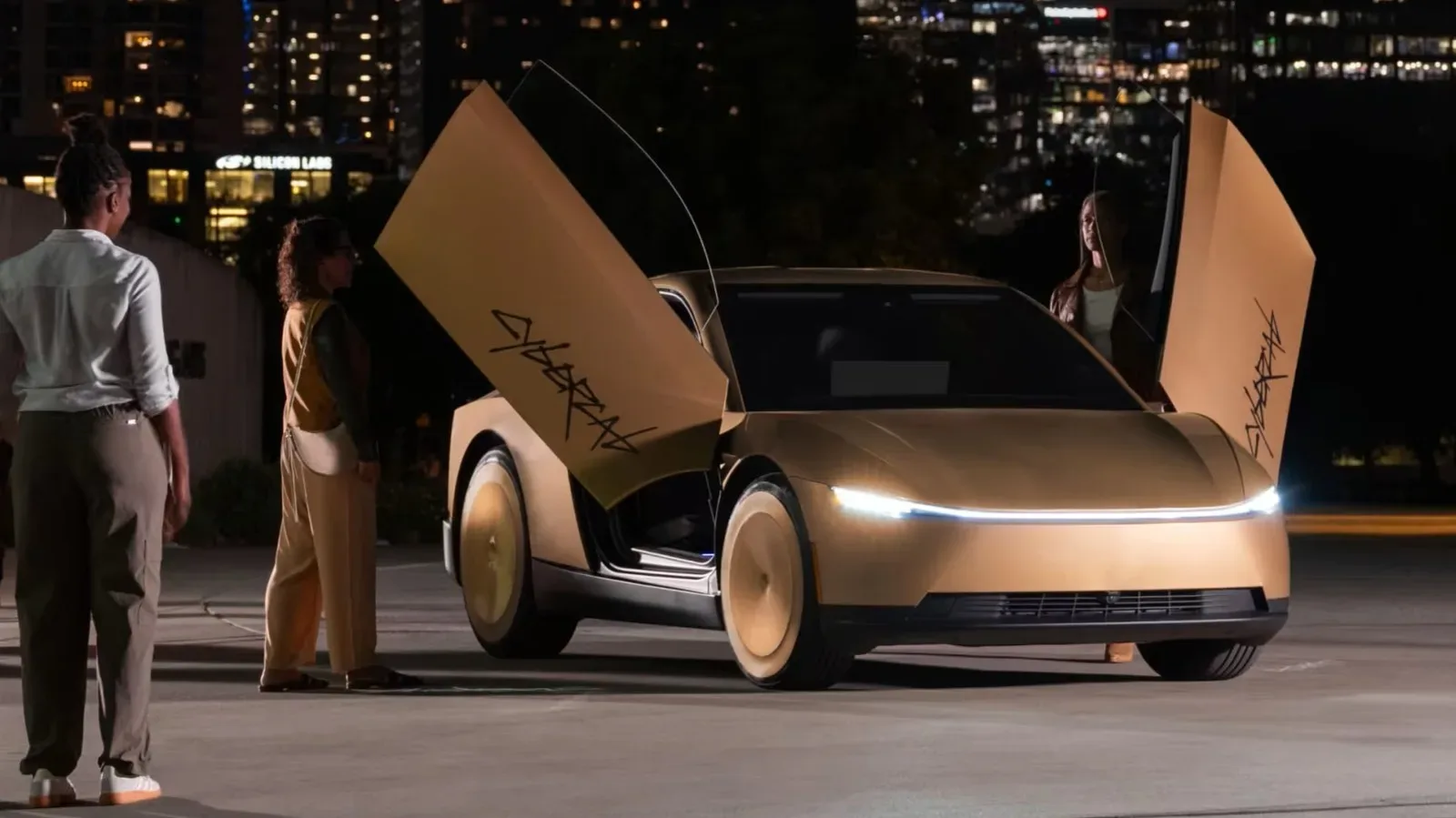
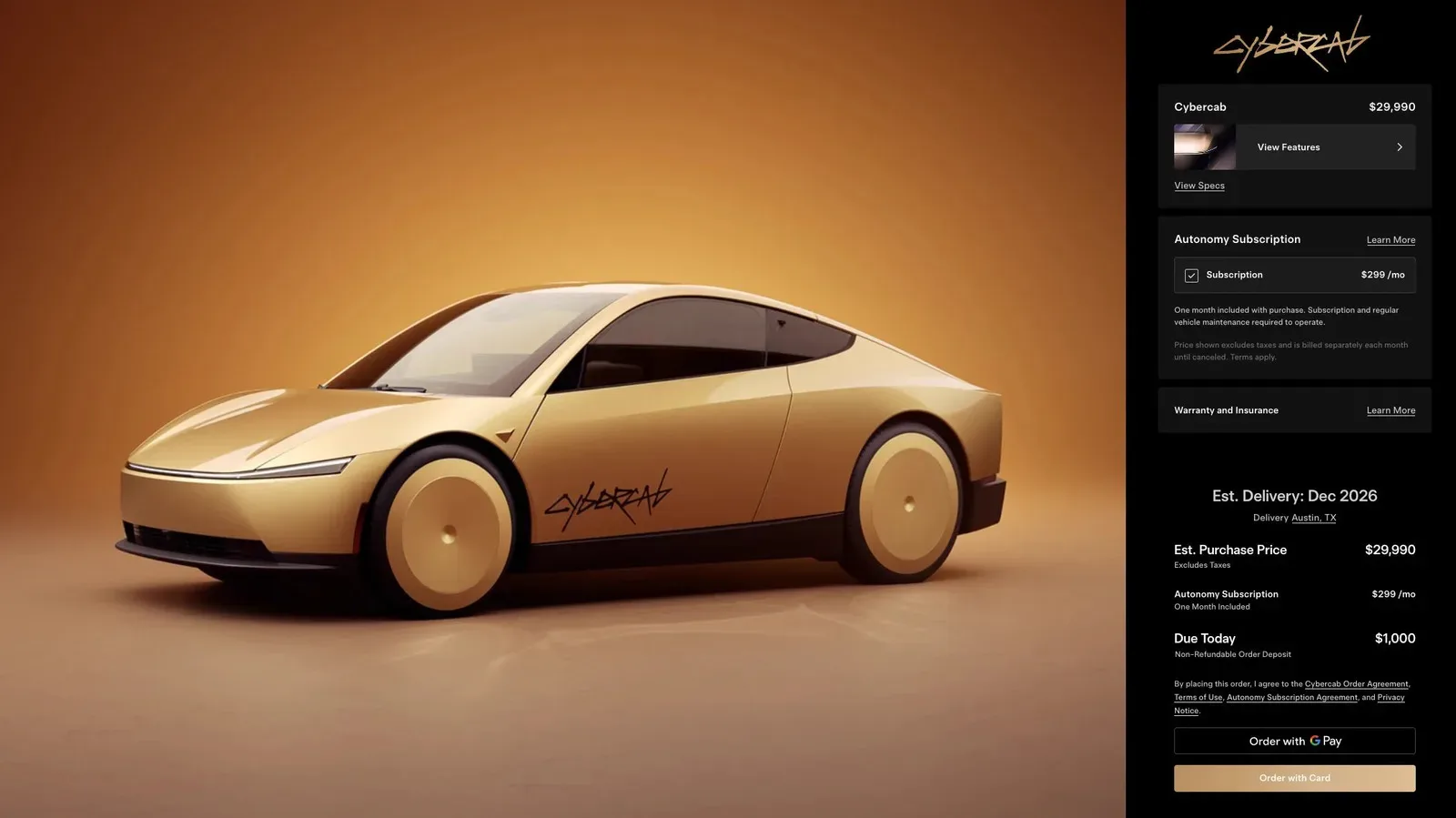
Tesla has begun sending invitations to select customers who want to purchase a Cybercab for personal use, moving its driverless two-seat vehicle beyond its initial role in the company’s robotaxi operation. The listed vehicle price is $29,990, but the purchase comes with a major condition: owners must also maintain a $299-per-month Autonomy Subscription for the Cybercab to function.
That requirement is central to understanding what Tesla is offering. The Cybercab is not a conventional car with an optional advanced-driving package. It was designed to operate without permanently attached manual controls such as a steering wheel, accelerator pedal and brake pedal. For a personal buyer, then, the subscription is not an add-on for extra convenience; it is presented as necessary for the vehicle to work at all.
There is a second, equally consequential limit. Personally owned Cybercabs will operate only in Tesla’s established robotaxi geofenced areas. Tesla AI lead Ashok Elluswamy said the vehicle will work unsupervised in the same geographic locations as the robotaxi service, while serving the owner’s needs rather than carrying robotaxi passengers. Tesla currently operates its robotaxi service in limited parts of Miami, Orlando and Tampa in Florida, plus Austin, Dallas, Fort Worth, Houston and San Antonio in Texas.
An invitation to buy is not unrestricted ownership
The new invitations appear to broaden Tesla’s early Cybercab strategy. The company had previously indicated that initial sales would go to organizations able to help build its robotaxi network, a framing that pointed toward fleet buyers rather than individual households. Inviting personal buyers changes the prospective customer, but it does not change the operating boundaries described for the vehicle.
In practical terms, a buyer is purchasing a vehicle for use within a defined service footprint, not an all-purpose personal car that can be manually driven beyond it. A geofence is a digital boundary tied to a real-world area. In this case, it means the Cybercab’s unsupervised operation is limited to locations where Tesla permits its robotaxi system to run. The supplied information does not establish how Tesla will handle trips approaching, leaving or beginning outside those boundaries, so prospective buyers should avoid assuming citywide or statewide access from the name of a listed metro area.
The distinction matters because the word “personal” can suggest freedom of use comparable to owning an ordinary vehicle. Tesla’s proposal is more conditional: an individual may own the Cybercab, but its core ability to travel remains dependent on an active service subscription and approved geography. Ownership of the physical vehicle and access to its autonomous operation are therefore separate parts of the product.
The advertised price needs the recurring fee beside it
The $29,990 Cybercab price is the upfront figure shown in Tesla’s posted screenshots. The required Autonomy Subscription adds $299 each month, or $3,588 over 12 months if the monthly rate remains unchanged for a full year. Combining the stated purchase price with one year of the stated subscription produces $33,578 before any costs not identified in the available information.
That arithmetic does not make the Cybercab more or less expensive than another vehicle by itself. It does, however, clarify the payment structure. A prospective buyer evaluating the offer has to consider both a one-time purchase and an ongoing charge that is required for use. If the subscription ends, the source material indicates the Cybercab will not work, because it has no steering wheel, pedals or brakes to fall back on.
Related coverage includes Tesla Opens Cybercab Invitations for Personal Buyers.
- Listed vehicle price: $29,990
- Required monthly Autonomy Subscription: $299
- Subscription cost across 12 months: $3,588, assuming no price change
- Vehicle price plus 12 months of subscription: $33,578, excluding unlisted costs
This is a distinctly service-led ownership model. Software subscriptions are familiar across consumer technology, but their importance varies. A subscription that unlocks a supplementary feature is different from one that enables the essential operation of a product that cannot be directly controlled by its owner. That makes clarity on recurring charges, service terms and permitted operating areas especially important for anyone considering an invitation.
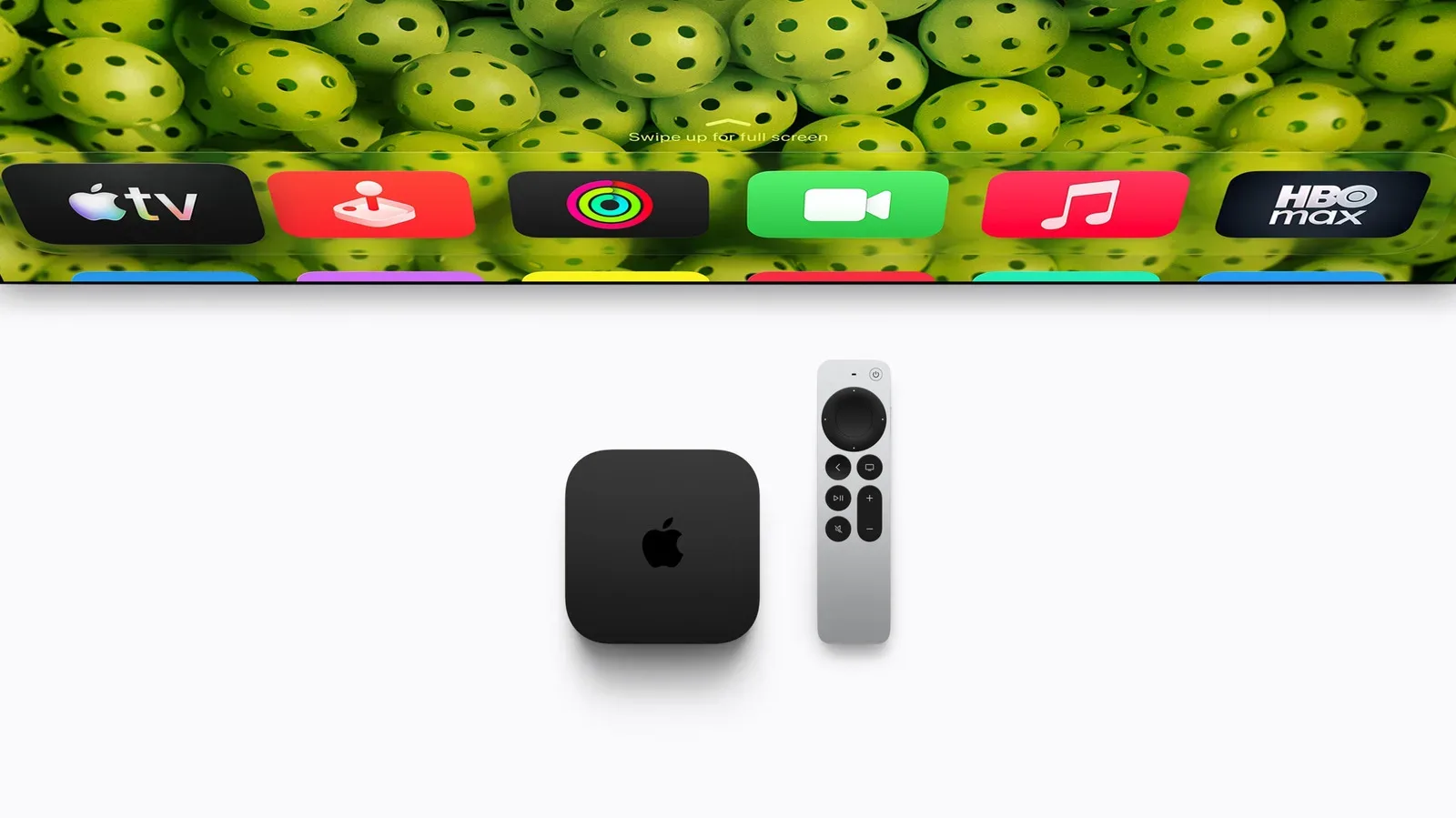
The consumer-tech world already offers many examples of hardware whose experience depends on software and connected services, even in much less consequential situations. For a useful example of how device capability can depend on compatible systems and specific conditions, see this guide to locating an Apple TV 4K Siri Remote with Find My. The Cybercab takes that general hardware-and-service relationship into transportation, where the practical stakes are much higher.
What “unsupervised” means in the announced plan
Tesla’s description uses the term unsupervised for Cybercab operation inside its robotaxi geolocations. In ordinary language, that means the vehicle is intended to perform its driving task without a person actively controlling it. The significance here is amplified by the design: the Cybercab lacks the permanently attached conventional controls that a human driver would normally use to take command.
It is important not to read more into that description than is stated. The available details establish where Tesla says the Cybercab will operate unsupervised: the same approved locations as its robotaxi service. They do not establish unlimited use, universal deployment, or the precise physical extent of each service area. Nor do they describe every condition that may apply to an individual owner’s use. The safest interpretation is the narrow one: the consumer version is tied to Tesla’s existing robotaxi operating geography.
For buyers, location could be the deciding factor. Someone living in one of the named metropolitan areas may still need to determine whether their regular origins, destinations and routes fall within the active geofence. Someone outside those areas would have a far more fundamental question: whether there is any approved place to use the Cybercab at all. The list of robotaxi cities should be treated as a starting point, not proof that every address in each wider region is covered.
Delivery is estimated for December 2026
Tesla’s stated estimated delivery date for the Cybercab is December 2026. An estimate is not a confirmed delivery commitment, and the path from invitation to personal delivery remains uncertain. The company’s move to invite select customers is meaningful because it signals an attempt to extend sales beyond network-building fleet entities, but it does not settle whether every personal-use order will ultimately reach a buyer on that timeline.
That uncertainty is especially relevant because the Cybercab has already drawn regulatory attention after entering commercial robotaxi service. The National Highway Traffic Safety Administration has opened an audit query examining Tesla’s self-certification process and the technical information used to support it. The agency specifically highlighted the lack of permanently attached conventional manual controls, including a brake pedal, gas pedal, steering wheel and mirrors.
NHTSA’s audit query puts the vehicle design under scrutiny
Self-certification is the process referenced by NHTSA in which a manufacturer certifies that a vehicle complies with applicable safety requirements. The agency’s audit query is aimed at examining the process and technical data Tesla relied upon in certifying the Cybercab, along with related matters. The supplied information does not provide an outcome from that examination, and an open probe should not be characterized as a conclusion about the vehicle.
Still, the audit is important context because the features that make the Cybercab unusual are not peripheral design choices. The absence of a steering wheel, pedals and other conventional controls is fundamental to Tesla’s description of the vehicle as fully autonomous and to the reason the Autonomy Subscription is necessary. The same traits that distinguish it from a regular personally owned car are therefore part of the regulatory focus.
“The vehicles lack permanently attached, conventional manual controls, such as a brake pedal, gas pedal, steering wheel and mirrors,” NHTSA said when it opened the audit query.
For consumers, the immediate takeaway is not that the Cybercab has become a normal retail vehicle simply because personal-use invitations have begun. The offer is a highly specific combination of vehicle, paid autonomy service and restricted operating zone, arriving while the federal safety agency examines the certification process behind the design.
What prospective owners should separate before deciding
The Cybercab invitation contains several layers that are easy to blur together: the purchase price, the subscription, the vehicle’s autonomous design, the local service boundary and the estimated delivery date. They are better assessed separately.
- Confirm whether the invitation is applicable. Tesla is sending invitations to select customers, not describing a broadly open purchase process.
- Identify the real usable area. The relevant question is not merely whether a buyer is near Miami, Orlando, Tampa, Austin, Dallas, Fort Worth, Houston or San Antonio, but whether Tesla’s robotaxi geofence serves the places they need to travel.
- Budget for a required service. The $299 monthly Autonomy Subscription is essential to vehicle operation, rather than an optional upgrade.
- Understand the no-controls design. The Cybercab was designed to be fully autonomous and lacks a steering wheel, gas pedal and brake pedal, eliminating the conventional manual-driving fallback implied by most personal vehicles.
- Treat the December 2026 date as an estimate. The available timeline is not a guarantee, and the broader delivery picture remains uncertain.
- Keep the regulatory context in view. NHTSA’s ongoing audit query concerns Tesla’s self-certification process and supporting technical data for the Cybercab.
Tesla’s personal-use Cybercab invitations make the company’s robotaxi concept more tangible for individual customers. But the product described is still defined by limits: invited access, a $29,990 listed purchase price, a necessary $299 monthly subscription, operation only in designated robotaxi geofences and an estimated December 2026 delivery date. For anyone considering one, those limitations are not fine print around the experience. They are the experience.