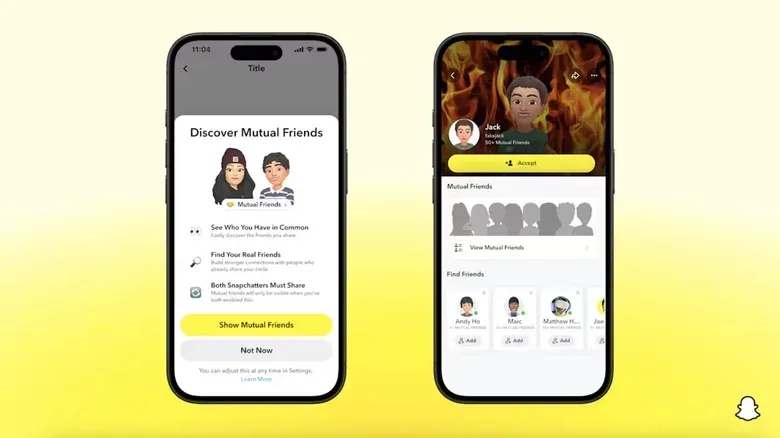
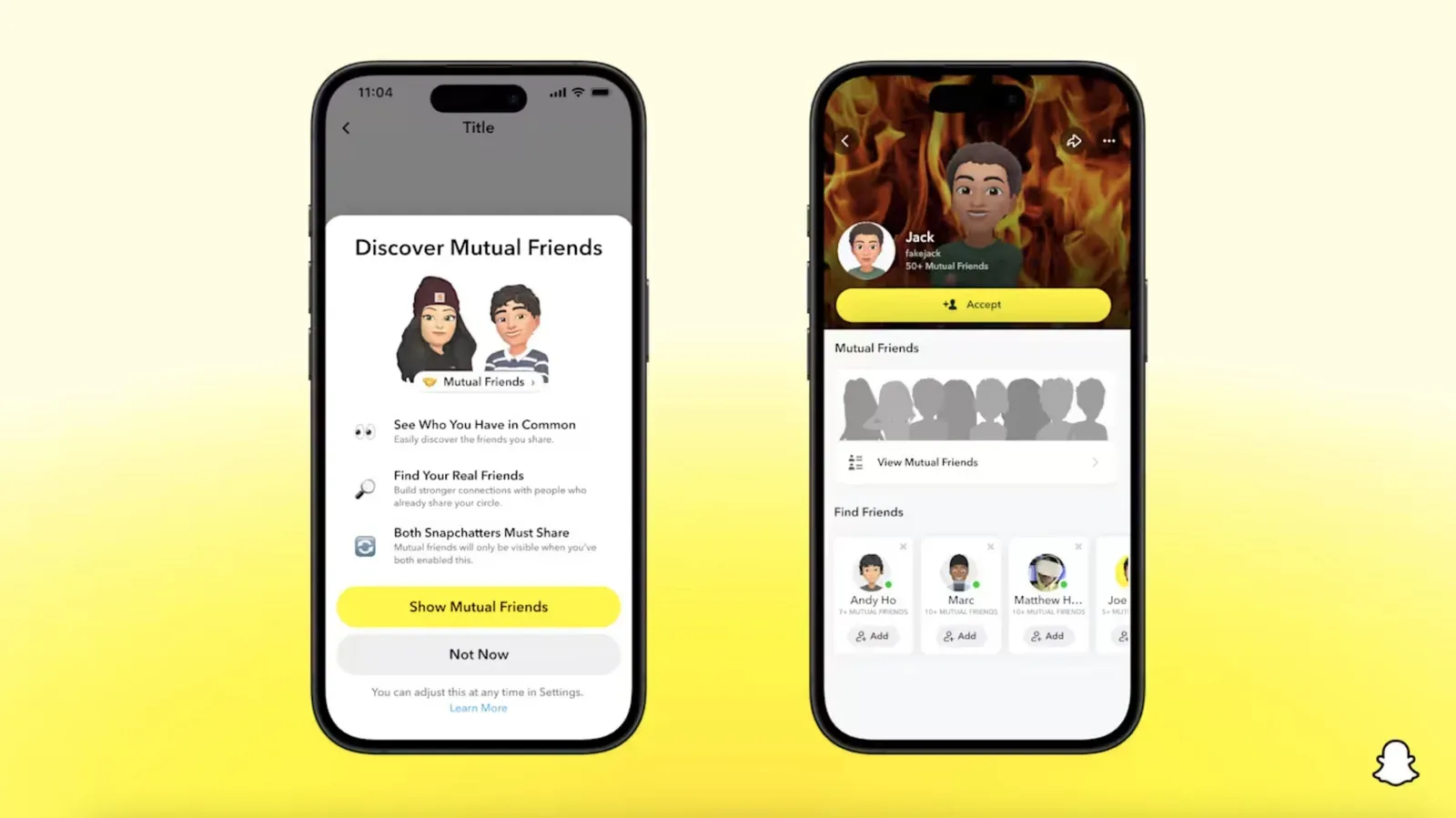
Snapchat has introduced a Mutual Friends feature that lets people see shared connections directly on another user’s profile. It is a small addition with an outsized social purpose: giving an incoming friend request a little more context before someone decides whether to accept it.
The rollout is currently limited to Snapchat users in the United States, Australia, France and Sweden, and the feature is available on both iOS and Android. There is no confirmed timetable for availability in other regions.
What Snapchat’s Mutual Friends feature does
The premise is straightforward. When viewing another person’s profile, a user can see friends they have in common with that account. In social-network terminology, a mutual friend is a person connected to both users. It is a familiar concept on many platforms, but it has not been a standard part of Snapchat’s friend-request decision-making until now.
That context can matter. A request from an unfamiliar account with a few recognizable shared connections may be easier to place: perhaps it belongs to someone from a school, workplace, club, group chat or event. Conversely, an account with no visible connection to a person’s existing Snapchat circle may warrant a closer look before it is accepted.
The feature does not turn a shared contact into proof that an account is legitimate, nor does it tell users why a connection exists. It simply supplies one more piece of information on the profile page. That distinction is important. Mutual connections can help people make a more informed choice, but they are a social signal rather than an identity-verification system.
Privacy is the central design choice
Snapchat is making Mutual Friends a fully opt-in feature. In practical terms, both accounts must enable it before mutual connections can be displayed. It is off by default, and the company is presenting users with a new prompt to control the setting.
Opt-in means a setting does nothing unless a person actively agrees to participate. Here, Snapchat has applied that consent requirement to both sides of the relationship. If either person has not chosen to enable Mutual Friends, the shared-friends information will not appear for that pairing.
That is a meaningful limitation by design. Mutual-friend lists can reveal parts of someone’s social graph, a term for the web of relationships between people on a service. Some users may welcome that visibility because it makes requests less opaque. Others may prefer Snapchat’s more discreet default, particularly when they use the app across separate friend groups or simply do not want their connections surfaced to strangers.
The two-person opt-in approach means users should not assume the feature is broken if no mutuals appear on a profile. An empty result can mean there are no shared friends, but it can also mean one or both people have not enabled the setting. The absence of displayed mutual friends is therefore not a definitive assessment of a request.
A practical way to treat friend requests
For users in the initial rollout countries, Mutual Friends can be useful as part of a basic request-checking routine. The most sensible use is to treat it as context, not a shortcut around judgment.
- Look for recognizable shared connections. A mutual contact can help explain how an account may know you, but consider whether the connection makes sense.
- Review the profile itself. Shared friends do not guarantee that the person behind an account is who they claim to be.
- Ask a trusted contact if needed. If a request seems connected through someone you know but still feels unexpected, checking with that friend can clear up confusion.
- Do not feel compelled to accept. A large number of overlapping contacts is not an obligation to add someone, and a lack of visible overlap is not automatically evidence of a problem.
This is especially relevant because online social circles are messy. A person can have legitimate reasons to send a request without any mutual contacts, while an unwanted account can sometimes appear connected through a large and loosely linked network. The feature is best read as a prompt to pause and consider the request rather than an automatic accept-or-decline meter.
Why the default matters
Snapchat’s decision to leave Mutual Friends disabled initially recognizes that social context can be sensitive. Many people keep different parts of their lives separate: family, classmates, colleagues, gaming friends and hobby communities may all exist in the same app without needing to be visibly connected to one another.
By requiring affirmative participation from both accounts, Snapchat gives people a choice between extra context and extra discretion. Someone who values easier request triage can switch it on. Someone who prefers a more private profile experience can leave it off. Neither decision should be mistaken for a statement about the person’s authenticity or openness.
The change also highlights a useful broader security principle: account safety is not just about passwords. Settings that govern how much relationship information is visible can shape who feels comfortable contacting you and how easily others can map your connections. Users reviewing their privacy habits may also want to consider the basics of login protection; this guide to switching password managers without leaving logins behind covers a related part of keeping accounts manageable.
Part of a wider Snapchat feature push
Mutual Friends arrives alongside other additions to Snapchat’s platform, including an event-planning tool and a paid storage option. The company has also said that Snapchat+ and related plans have surpassed 30 million paid subscribers.
Those updates point to a platform expanding in several directions at once: social coordination through events, storage through a paid option, subscriptions through Snapchat+, and now more profile-level context through mutual connections. Mutual Friends is arguably the least flashy of the group, but it addresses a routine moment that many users encounter: deciding what to do with a request from a name or avatar they do not immediately recognize.
For now, the feature’s usefulness will depend on participation. Because it requires both people to opt in, its visible reach may build gradually rather than appearing universally across profiles on day one. That trade-off is inseparable from the privacy model Snapchat has chosen.
Users in the United States, Australia, France and Sweden can look for the new prompt and decide whether the additional context is worth enabling. Everyone else will need to wait for Snapchat to outline a broader rollout. Until then, the clearest takeaway is simple: mutual friends can provide helpful social context, but they are only one clue—and Snapchat has made sharing that clue a choice.