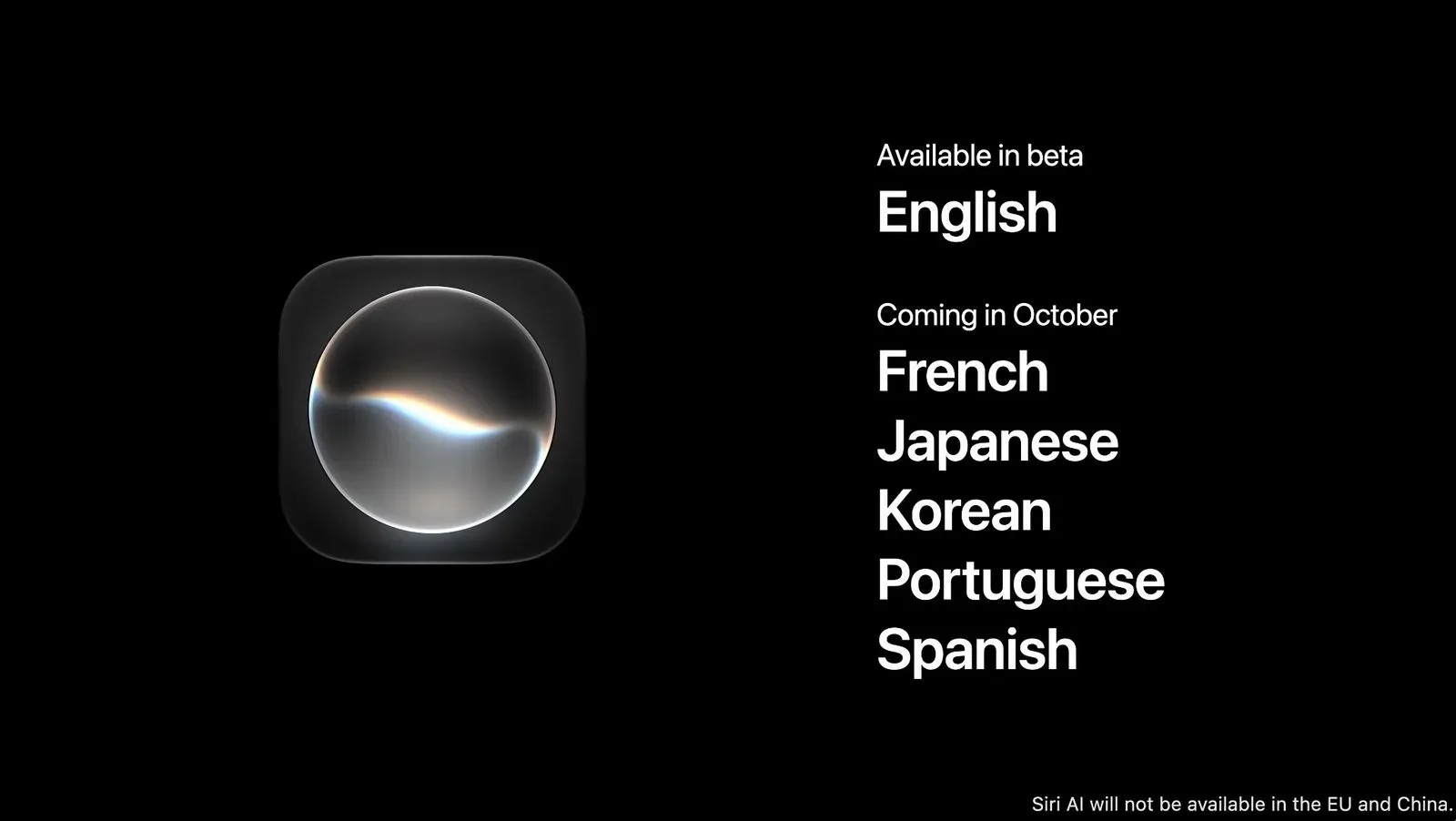
Apple plans to add Siri AI support for Chinese (Traditional), Norwegian, Turkish and Vietnamese later this year. The expansion continues a staged language rollout for the AI-powered Siri feature, which began with English in September before gaining French, Japanese, Korean, Portuguese and Spanish in iOS 27.2 and corresponding software updates.
The news is straightforward, but it matters because voice assistants are only as useful as the languages in which people can comfortably speak, read prompts and understand replies. A language listing is not simply a new menu option. It can determine whether users can interact with an assistant naturally, whether families can share a device without switching linguistic habits, and whether people can reasonably expect an AI feature to work in their preferred language.
What languages Siri AI supports now
Siri AI originally launched with English support. The first expansion arrived through iOS 27.2 and related updates, bringing French, Japanese, Korean, Portuguese and Spanish into the fold.
With the four newly announced additions, the supported-language list will grow to include:
- English
- French
- Japanese
- Korean
- Portuguese
- Spanish
- Chinese (Traditional)
- Norwegian
- Turkish
- Vietnamese
The key timing detail is that the newest group is planned for later this year. No more specific release date, operating-system version or device-by-device rollout information was provided. Anyone waiting for one of these languages should treat the announcement as confirmation of the direction of travel rather than a promise that it will arrive in the next update.
Why the Traditional Chinese detail is important
The wording specifically identifies Chinese (Traditional). That distinction should not be flattened into a general claim of support for every Chinese language or writing configuration. Traditional Chinese refers to a script form, and the announcement does not establish support for Chinese (Simplified), particular spoken varieties, every regional setting, or all possible combinations of language and Siri preferences.
That may sound like a fussy distinction, but it is a useful one. “Language support” can mean different things in a software announcement: the language used to speak to an assistant, the language used in written responses, system language availability, or a mix of those elements. The confirmed fact here is the addition of Chinese (Traditional) to Siri AI’s stated support list later this year. The precise behavior, regional scope and configuration requirements have not been detailed.
A rollout that is expanding in steps
The timeline shows a phased approach rather than a single global launch. English was available when Siri AI arrived in September. A later software round, iOS 27.2 and corresponding updates, added five languages. Four more are now on the roadmap for later in the year.
A phased rollout is especially understandable for an AI assistant. The central challenge is not merely translating a few static interface labels. An assistant needs to interpret requests and produce useful responses in the supported language. Names, places, sentence order and everyday phrasing can all vary significantly among languages. A capable experience must account for that complexity rather than simply recognize a handful of direct command words.
That does not mean every language expansion necessarily changes the feature set or intelligence of Siri AI. Nothing in the announcement says that these additions bring exclusive tools, improved capability tiers or different functions compared with existing languages. The confirmed development is language availability, not a newly described bundle of AI features.
What “support” should and should not be taken to mean
For users following AI announcements, it helps to separate a few related terms:
- Language support: A feature is offered in a named language. This is what has been announced.
- Locale or regional availability: A feature may be available only in particular countries or regions, even when a language is listed. No regional details were supplied here.
- System-language support: An operating system can display menus and settings in a language. That is separate from an AI assistant’s own supported-language list.
- Feature parity: This means every feature behaves the same in every supported language. The announcement does not make that claim.
Those distinctions are practical. A user may see a language listed for Siri AI and reasonably expect to use the assistant in that language, but should not infer unannounced details such as complete regional availability, all-device eligibility or identical behavior across every language. As with the earlier iOS 27.2 additions, the relevant software version and setup information will matter once the next rollout is closer.
What this means for users waiting to use Siri AI
If Chinese (Traditional), Norwegian, Turkish or Vietnamese is your preferred language, the biggest takeaway is patience rather than an immediate settings change. The announced window is later this year, and no release date has been attached. Keeping devices updated is sensible once the expansion arrives, but the announcement itself does not identify a required update.
It is also worth checking the wording in device settings and update notes when the rollout lands. Software features can present language options in specific ways, and the exact label—particularly in the case of Chinese (Traditional)—matters. Users should select the option that matches the announced support rather than assuming a similarly named setting will provide the same result.
People who already use Siri AI in English, French, Japanese, Korean, Portuguese or Spanish do not have a newly announced change to act on. Their languages are part of the existing supported group. For broader iOS 27.2 coverage, see the update’s new FaceTime dual-capture and accessibility support.
The bigger accessibility and usability picture
Voice and conversational interfaces often become most valuable when they fit a person’s ordinary way of communicating. A user should not have to translate a thought into a second language before asking an assistant for help. Expanding Siri AI into more languages therefore has implications beyond convenience: it broadens who can approach the feature without first changing their linguistic routine.
Traditional Chinese, Norwegian, Turkish and Vietnamese also represent four distinct linguistic contexts. Their inclusion is a reminder that broadening support is not a one-size-fits-all exercise. The announcement does not outline the technical work behind each addition, so it would be speculation to describe specific implementation methods. Still, the staged schedule itself indicates that Siri AI’s language footprint is being enlarged incrementally, rather than being treated as finished after its English launch.
For now, the firm details are limited but useful: Siri AI started with English in September; iOS 27.2 and matching updates added French, Japanese, Korean, Portuguese and Spanish; and Chinese (Traditional), Norwegian, Turkish and Vietnamese are due later this year. Further specifics on timing, availability and setup will need to wait for a future software release or additional product information.