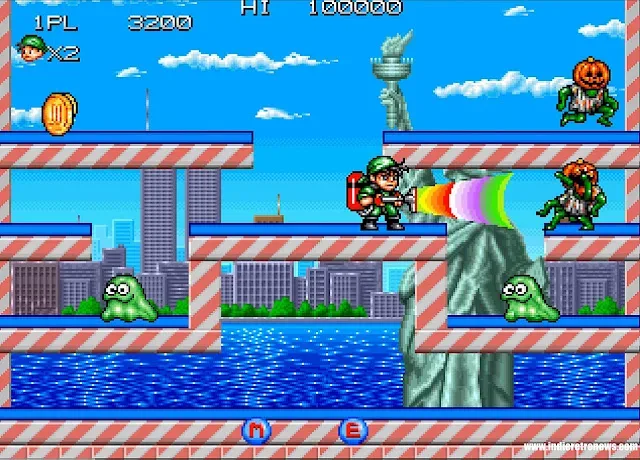

Tumblepop, the 1991 arcade platformer from Data East, has received an unofficial conversion for the Commodore Amiga from developer Acidbottle. The project brings the game’s ghost-catching, enemy-launching arcade formula to a platform closely associated with home-computer gaming, while also arriving with unusually direct caveats: development was AI-assisted, performance may vary between machines, and more optimisation and debugging could still be needed.
That makes this an intriguing retro release with an important asterisk. It is not presented as an official revival or a finished commercial reissue. It is an unofficial conversion of a known arcade game, and prospective players should approach it as a work that may still be in active need of refinement rather than assume identical behaviour across Amiga setups.
What Tumblepop is
Originally created by Data East and designed by Makoto Kikuchi, Tumblepop is an arcade platformer built around two ghosthunters travelling around the world on a mission to save it. Its defining idea is the vacuum: players use it to pull in hostile monsters, then send those captured foes back out as bouncing projectiles.
That reversal is the heart of the game. Enemies are not merely hazards to avoid or targets to remove one at a time. A successfully captured monster becomes a moving attack that can clear other foes and help deal with obstacles in the level. The resulting loop combines positioning, platform navigation and crowd management. A player must find room to use the vacuum safely, secure an enemy, then make a productive choice about where and when to fire it.
In practical terms, a vacuum mechanic is an action that draws an object or enemy toward the player character. In Tumblepop, it is more than a visual gimmick: it changes the usual platformer relationship between player and enemy. The opponent becomes ammunition. The mention of bouncing balls is significant because it suggests that released enemies can continue affecting the playfield after the initial shot, potentially reaching additional targets rather than stopping at the first point of impact.
That design is well suited to an arcade setting. Systems that turn a single successful move into a chain of damage reward quick reads of a crowded screen. They also give the game a recognizable identity beyond simply jumping between platforms and avoiding monsters.
An Amiga version with an explicit work-in-progress warning
Acidbottle’s conversion is described as aiming to preserve the nostalgic spirit of the arcade original for Commodore Amiga players. However, the accompanying disclaimer matters as much as the premise. It states that the project may crash or may run either too quickly or too slowly depending on the machine being used. Further optimisation and debugging may be required.
Those are not minor cosmetic notes. A crash is a complete interruption of play, while inconsistent speed can change how a platformer feels and plays. Timing is fundamental to navigating platforms, avoiding enemies and lining up an enemy launch. If a game runs faster than expected, reaction windows can narrow; if it runs slowly, controls and animations may feel less responsive and the rhythm of the action can be altered.
Related coverage includes Tumblepop Gets an Unofficial Commodore Amiga Conversion From Acidbottle.
Optimisation refers to work intended to make software run more efficiently, reducing demands on the hardware or improving performance. Debugging is the process of locating and correcting problems in the program, such as crashes or unintended behaviour. The warning does not establish the cause of any reported issue or promise a particular fix. It does establish that players may encounter technical differences and should calibrate expectations accordingly.
For a retro-computing project, machine-to-machine variation is especially relevant when the developer has specifically flagged it. Players considering the conversion should keep the stated warning in mind, avoid treating its current performance as definitive proof of the project’s ultimate quality, and watch for updates if they choose to follow its development.
AI-assisted development: what is actually disclosed
The project disclosure says development has been AI-assisted. That is the full extent of the information provided. It does not identify which development tasks involved AI, what tools were used, or how extensively they were used. It would therefore be speculation to attach the disclosure to a particular asset, line of code, audio element or design decision.
The useful takeaway is straightforward: AI assistance is part of the developer’s own stated description of the conversion. Readers can weigh that disclosure alongside the project’s technical status, but it should not be inflated into claims that have not been supplied. “AI-assisted” can cover many possible workflows; without more detail, it is a transparency note rather than a technical breakdown.
Why an unofficial conversion still draws attention
The appeal of this release is easy to understand. The Commodore Amiga remains a platform with an enthusiastic retro audience, and arcade conversions have long been a natural fit for players interested in bringing coin-op-style action to home hardware. Tumblepop also has a distinct enough central mechanic to make the prospect more interesting than a routine port: the game asks players to turn danger into an offensive tool.
At the same time, “unofficial” is a meaningful label. It distinguishes the conversion from a release authorised by the original rights holder. The available information identifies Data East as the original creator and Makoto Kikuchi as designer, while crediting Acidbottle for the new Amiga conversion. Those roles should not be blurred. This is a new fan-made adaptation of an existing arcade work, not evidence of a new official Data East product.
The project also underlines a broader reality of retro gaming: preservation, adaptation and new development often overlap, but they are not the same thing. A conversion can be motivated by admiration for an original game while still needing technical work of its own. Faithfulness to the source is an ambition that players will naturally care about, yet stable performance is equally important when the original game relies on quick, readable action.
What prospective players should keep in mind
- Expect the classic premise: two ghosthunters use a vacuum to capture monsters and fire them back as bouncing attacks while navigating platform stages.
- Do not assume universal performance: the developer warns that the game may crash or run at the wrong speed on some machines.
- Treat its technical state as provisional: optimisation and debugging are still identified as possible needs.
- Read the AI disclosure precisely: development was AI-assisted, but no further task-by-task detail has been provided.
- Recognise its status: this is an unofficial Amiga conversion, not an announced official re-release.
For players assembling a period-appropriate setup, the display is also part of the practical experience. Our guide on giving an old TV a second life as a gaming display offers useful considerations for anyone thinking about older hardware and screens.
A promising concept, with caution attached
Acidbottle’s Tumblepop conversion puts a memorable 1991 arcade concept in front of the Amiga community: catch monsters, weaponise them, and use their bouncing path to control hectic platforming encounters. The core game’s identity is clear, and its move to another retro platform will be of interest to arcade and Amiga enthusiasts alike.
But the responsible reading of this release is not simply that a classic has arrived on a new machine. It is that an unofficial, AI-assisted conversion has surfaced with developer-stated stability and speed concerns. That candour gives interested players a clear basis for deciding whether to try it now or wait and see whether further optimisation and debugging improve the experience.