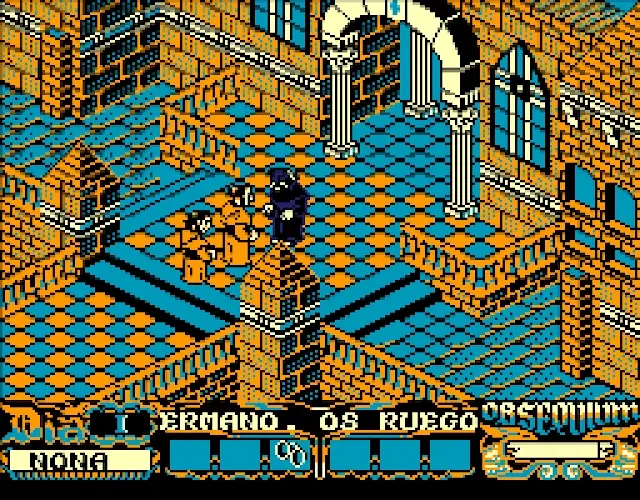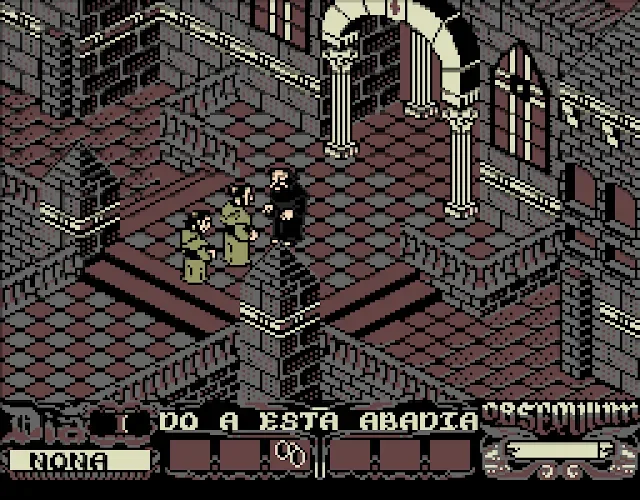
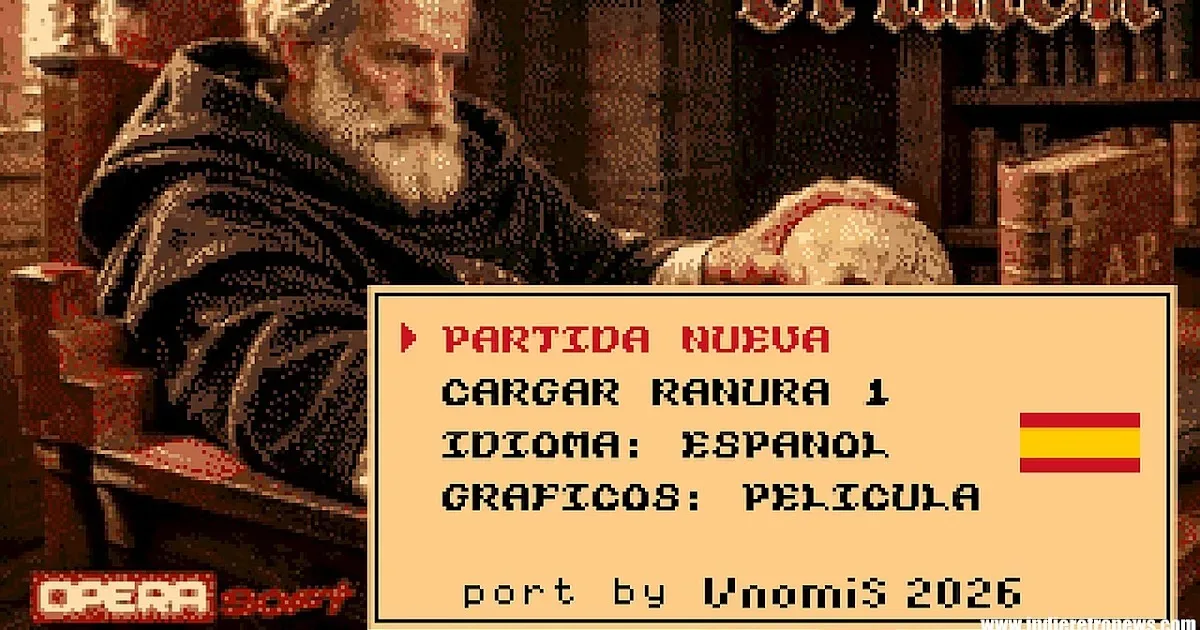
The Abbey of Crime, the 1987 Spanish isometric mystery created by Paco Menéndez and Juan Delcán for Opera Soft, has received a new Amiga 500 version from developer vnomis. The port is framed as a faithful revival rather than a wholesale redesign: its central investigation, restrictive monastery setting and original game logic remain in place, while the new edition adds options intended to make a famously demanding adventure more approachable.
Players again take the role of Friar William, accompanied by the novice Adso, arriving at an isolated monastery where a series of deaths must be investigated. There is a firm deadline: the mystery has to be solved within seven days. More unusually, investigation does not take place in a vacuum. The Abbot expects the pair to observe a fixed daily routine of meals and prayers. Failing to follow that schedule risks being expelled before the case is finished.
That premise gives the game’s murder mystery a second, equally important pressure. It is not simply a matter of locating clues and deciding what to do with them. Players must make progress around the institution’s required hours and rules. In practical terms, the timetable is part of the puzzle’s structure: time is both a limited resource and a condition for remaining in the monastery long enough to use the information gathered.
A preservation-minded Amiga conversion
The release is designed to boot from a single floppy disk on a standard PAL Amiga 500 configured with 512 KB of RAM. That specification is significant because it establishes the intended target as period-appropriate Amiga hardware rather than an expanded setup. The port therefore aims at a very particular technical and historical fit: an adaptation of an 8-bit-era Spanish game built to run on a baseline Amiga 500 environment.
Memory limits were a defining concern for machines of this class. RAM, or random-access memory, is the working space a computer uses while software is running; a 512 KB target puts a clear ceiling on what can be held and processed at once. The contrast with modern discussion of memory requirements is striking, even if the contexts are entirely different; one recent look at contemporary RAM buying reflects just how far the scale has moved since machines such as the Amiga 500 were standard hardware. Modern RAM conversations now operate on a vastly different scale.
Yet the port’s technical target is not presented as an excuse to strip away usability. Its additions concentrate on how a player reads, moves through and manages the adventure. That is a sensible focus for a game whose reputation rests partly on the severity of its rules. The underlying mystery is kept intact, but the friction around interacting with it can be adjusted.
What stays difficult, and what becomes easier to manage
“Faithful” can mean different things in retro projects. Here, the stated commitment is to the original game logic. That matters more than a cosmetic resemblance alone. Game logic is the underlying system that governs events, player actions and outcomes: the schedule, the investigation’s progression, the consequences of ignoring rules and the relationships between the adventure’s tasks. Retaining that logic means the monastery’s discipline remains a real constraint.
The new version instead gives players tools around those systems:
- English and Spanish text can be selected.
- Audio can be set to original or enhanced forms.
- Three visual presentations are available: a classic Amstrad CPC palette, an enhanced style and a Film mode.
- Direct directional controls sit alongside the original tank-style movement.
- Save slots are stored on disk.
- Dedicated object and mirror screens reduce the need for keyboard input.
- A bot can handle the daily routine between canonical hours.
- A self-playing movie mode can complete the mystery automatically, with the option for a player to take control.
These changes address different kinds of difficulty rather than treating all challenge as the same thing. Solving a mystery under time pressure is an intended intellectual and structural obstacle. Needing frequent keyboard commands to access items or mirrors is an interface burden. Likewise, learning a legacy movement scheme may be part of the original experience, but it can also stand between a new player and the actual deduction game. The port distinguishes between those layers by preserving the rules while offering alternate ways to operate within them.
Direct movement versus tank-style controls
Tank-style movement generally means that inputs turn a character and move them forward or backward relative to the direction they face, rather than moving immediately in the direction pressed. In an isometric game, where a scene is viewed from an angled overhead perspective, that convention can require a period of adjustment. It can be especially awkward when the player is concentrating on positioning around rooms, other characters or points of interaction.
Direct directional controls offer another route. The player can choose a movement approach that feels more immediate without removing the original scheme for people who want it. This is a notable preservation choice: the older control language has not been erased, but it no longer has to be the only doorway into the game.
Object and mirror screens reduce keyboard friction
The dedicated object and mirror screens are another targeted accessibility improvement. The supplied details do not define every action performed on those screens, but their purpose is clear: to cut down on reliance on the keyboard. For an adventure with objects to manage and a setting built around close observation, fewer keyboard-dependent steps can make the act of investigating more legible and less cumbersome.
Importantly, this is not described as automatic clue solving. It is an interface revision. Players still face the original logic and the pressure of the Abbot’s rules; they are simply given more convenient routes to the relevant game functions.
Three visuals, two audio choices and two text languages
The port also provides unusual flexibility in how it is presented. The classic Amstrad CPC palette nods to the game’s earlier visual identity, while the enhanced look offers an alternative presentation. A third option, Film mode, gives players another distinct visual treatment. The supplied information does not specify the exact graphical differences between enhanced and Film modes, so it is best understood as a choice of visual style rather than a promise of changed content or gameplay.
Audio follows the same philosophy. Players can select original audio or an enhanced alternative. As with the visual choices, this allows the release to serve more than one audience. Someone interested in a closer period-flavored presentation can retain the original-style option, while someone who prefers an updated audiovisual treatment can switch modes without changing the mystery’s rules.
Language selection between English and Spanish is more than a menu nicety for a text-driven investigation. The Abbey of Crime originated as a Spanish classic, so Spanish text recognizes that heritage, while English expands readability for another audience. The option also avoids forcing the port into one singular “definitive” presentation.
The routine bot and movie mode change the relationship with time
Among the additions, the bot that handles daily routines between canonical hours may be the most consequential for players intimidated by the schedule. The game’s core premise still hinges on observing meals and prayers. But the bot can take care of routine obligations during the intervals between those designated hours, reducing the repeated work involved in staying compliant.
This does not mean the schedule disappears. The canonical hours remain part of the game’s framework, and the risk of violating the Abbot’s requirements remains central to the original setup. What changes is the amount of manual routine management demanded from the player. It is a quality-of-life feature with a specific purpose: preserving the monastery’s temporal discipline without making every ordinary transition a source of repeated input.
The self-playing movie mode goes further in a different direction. It can solve the entire mystery automatically, but players can intervene and take over. That makes the mode useful as a way to observe the game’s full progression, not merely as an alternative control method. For a title known to be unforgiving, an automatic run can lower the barrier to seeing the mystery unfold, while the takeover option preserves the possibility of personal participation.
There is a meaningful distinction between this and simplifying the game’s solution. The available description says the movie mode solves the case automatically; it does not say that the core adventure has been rewritten, shortened or stripped of its original consequences. Players seeking the traditional challenge can engage directly with the retained logic, whereas curious newcomers have a guided way to approach its structure.
Why this port’s approach matters
Retro revivals often face a basic tension. Preserve too little and the result can lose the qualities that made the original distinctive. Preserve every point of friction and a new audience may never reach those qualities at all. The Abbey of Crime’s Amiga 500 version takes a middle path based on choice. Its murder investigation, seven-day limit and monastery routine are retained. Its language, sound, visuals, movement, saving and routine handling can be tailored.
That approach is particularly suited to a game where atmosphere and restriction are closely connected. The secluded abbey, the sinister deaths and the Abbot’s regimen are not interchangeable decoration. They are the conditions that define the player’s role as Friar William. A port that removed the timetable outright would risk changing the investigation’s character. A port that insists on every old interface hurdle, however, might make the character of the original inaccessible in a less useful way.
By keeping the canonical structure while adding direct controls, on-disk saves, dedicated screens, a routine bot and a watchable automated path through the story, vnomis’ version makes a clear argument for selective modernization. The goal is not presented as replacing the 1987 game. It is to bring its logic, setting and challenge to standard PAL Amiga 500 hardware in a form that offers players more ways to meet it.