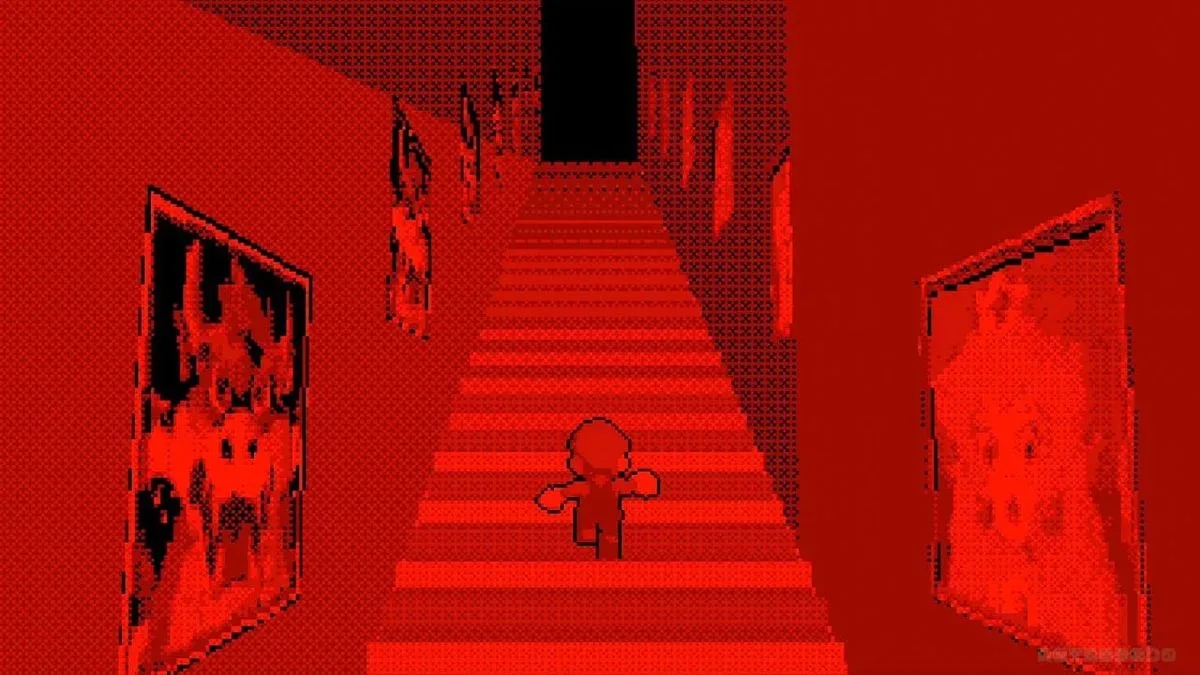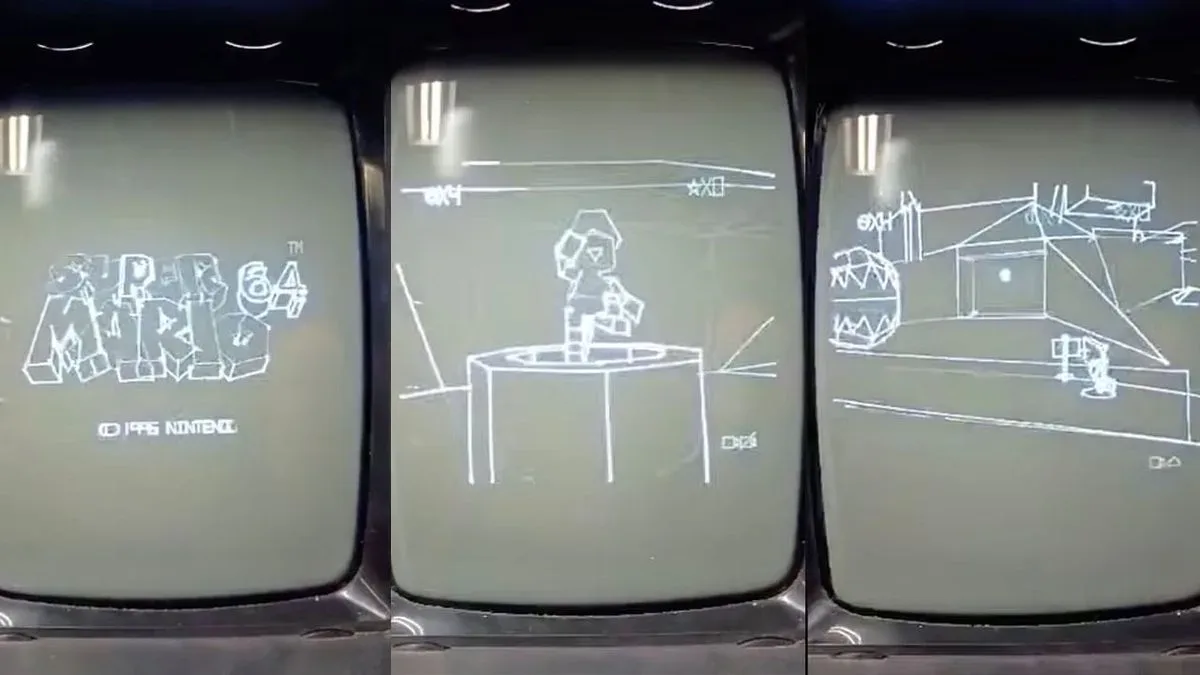
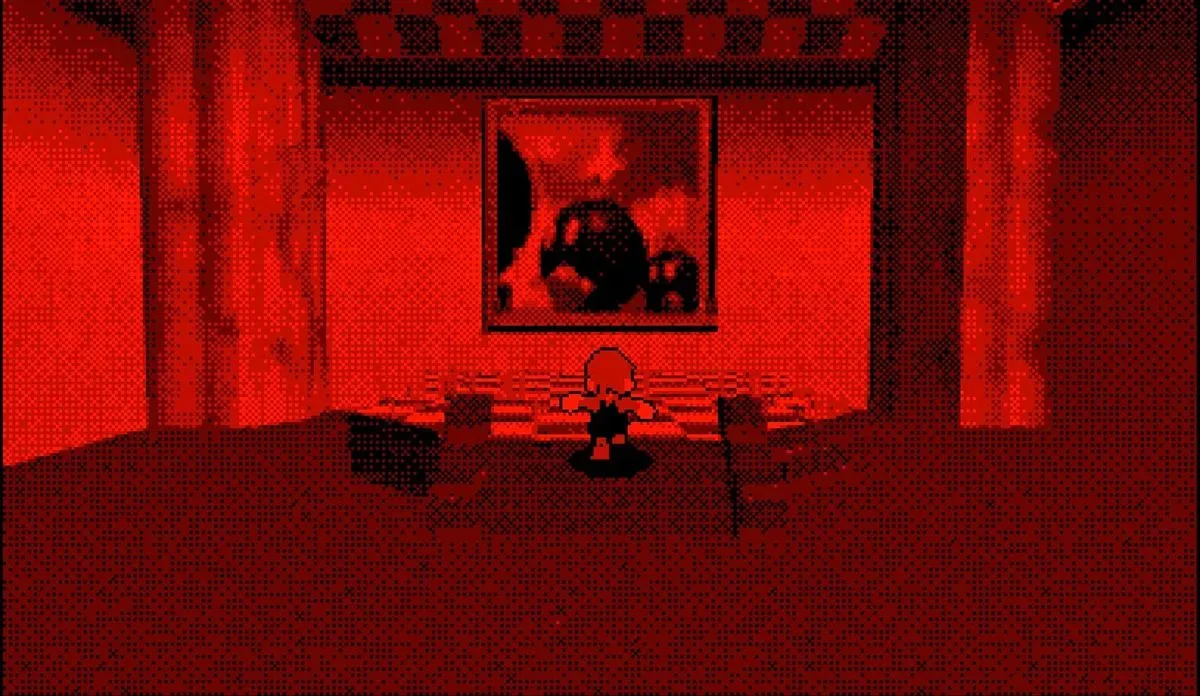
A fan project from Mochi64 is attempting one of retro gaming’s more improbable transformations: bringing Super Mario 64 to Nintendo’s Virtual Boy. The work-in-progress conversion has reached a playable slice running in stereoscopic 3D at 50 frames per second on actual Virtual Boy hardware, reshaping the Nintendo 64 classic into the red-and-black presentation associated with the visor-like system.
The present demo is limited in scope, but its technical approach is the important part. Mochi64 says the build covers the game’s launch sequence through the King Bob-omb encounter. Rather than asking the Virtual Boy to calculate every part of a 3D scene as it plays, the project pre-renders the environments and stores that visual data on the cartridge. Mario and enemies are then drawn live over those prepared scenes.
It is an inventive compromise tailored to a piece of hardware that was never built to run a game with the scale and real-time 3D demands of Super Mario 64. It also means that the headline figure—50fps—needs to be understood in the context of a carefully engineered conversion, not as a straightforward port of the Nintendo 64 game running its original rendering pipeline.
What the project currently contains
The publicly described build begins with the familiar opening material and reaches King Bob-omb, a meaningful early milestone rather than a complete game. Mochi64 has indicated that a demo will be released after more levels and Stars have been prepared. No release date has been provided, and the eventual number of areas in that public demo has not been confirmed.
That restraint matters. Fan projects are often discussed as though a first functioning section guarantees a full release, but this conversion has a specific and substantial storage constraint. Mochi64 identifies ROM space as the limiting factor: the project is working with a 16MB ROM, and the current expectation is that roughly five levels may be achievable within that limit.
“I try to get it done as much as possible. The limiting factor here is ROM space which is only 16MB. My hunch is that 5 levels is doable but for the complete game I already have a patch for the emulator in order to allow me bigger ROM sizes but for the VB hardware a custom cartridge would be needed for the complete game.”
That leaves two separate possibilities. A relatively compact demo could run on original hardware in its current form. A much more complete version could be possible in an emulator with a patch allowing larger ROM sizes, while a full build intended for a real Virtual Boy would require a custom cartridge. Those are possibilities described by the creator, not a confirmed roadmap or promise of a finished full-game release.
Why pre-rendering changes the equation
In a conventional real-time 3D game, the system continually calculates what geometry, textures, lighting and objects should appear from the player’s current viewpoint. When the player moves the camera, turns a character or enters a new space, the machine has to produce a new image. That workload is central to why Super Mario 64 was such a landmark Nintendo 64 title.
Related coverage includes Super Mario 64 Virtual Boy Demo Reaches 50fps on Original Hardware.
Pre-rendering moves much of that workload out of the moment-to-moment play experience. Scenes are calculated in advance and saved as data. During play, the hardware displays the prepared imagery instead of generating the full environment from scratch. In Mochi64’s approach, the game still draws Mario and enemies live on top of the pre-rendered world, retaining moving foreground elements while avoiding the expense of fully live environment rendering.
The method comes with a clear trade-off: data takes space. If every environment is rendered ahead of time and placed on the cartridge, the project exchanges a processing problem for a ROM-capacity problem. That helps explain why the stated 16MB limit is not a small footnote. It may define how many environments can fit, how much visual information each can contain, and whether original Virtual Boy hardware can host a larger version without specialized cartridge hardware.
The reference to ray tracing is also worth unpacking. In this context, it describes the advance rendering used to create the stored scene material. It should not be mistaken for a claim that the Virtual Boy is performing contemporary real-time ray-traced graphics during play. The live portion is the overlay of Mario and enemies; the environmental rendering has been prepared beforehand.
Stereo 3D and 50fps are distinct achievements
Two claims sit at the center of the demo: stereo 3D and a 50fps presentation. Stereo 3D means the game presents separate views to create depth for the player, fitting the Virtual Boy’s defining display concept. The conversion’s red-and-black look likewise follows the machine’s characteristic visual format rather than trying to preserve the Nintendo 64 original’s full-color image.
Meanwhile, 50fps refers to the rate at which the game is presented. Frame rate is simply the number of frames shown each second; a higher number can make animation and motion look smoother. Here, the figure is especially notable because it is being attributed to original Virtual Boy hardware, not solely to modern emulation. However, it should not be used as a broad measure of the Virtual Boy’s normal ability to handle a fully real-time Super Mario 64-style world. The project’s pre-rendered design is precisely what makes the result viable.
That distinction is not a knock on the demo. It is the accomplishment. Retro development is often at its most interesting when it exposes the boundary between an old system’s fixed limitations and the new tricks developers can apply inside them. This is less a matter of brute-forcing a Nintendo 64 game onto an incompatible platform than redesigning the game’s visual delivery around Virtual Boy constraints.
Original hardware remains part of the goal
Mochi64’s work is notable not just because it depicts Super Mario 64 in Virtual Boy style, but because it is intended to function on the original device. The creator says that the available sequence, from the start through King Bob-omb, runs on Virtual Boy hardware. That gives the project a different character from a visual mock-up, a PC-only reinterpretation or an emulator proof of concept.
For people who own the hardware, the practical route described for playing a future demo is a flash cartridge, specifically such as the Hyper Boy, loaded with the ROM once it becomes available. A flash cart is a cartridge device that can load game files, allowing compatible original hardware to run software that is not distributed on a conventional retail cartridge.
That is important because the project’s physical-hardware ambitions are connected to its storage issue. A regular demo-sized ROM and a full conversion are not necessarily the same proposition. Mochi64 has said that an emulator patch already exists to enable larger ROM sizes, but the original Virtual Boy would need a custom cartridge for a complete game at that larger scale. In other words, “runs on original hardware” is true of the demonstrated material, while the delivery method for any hypothetical complete edition remains an engineering question.
What to watch for next
The next meaningful update will not simply be another performance clip. It will be evidence of how the rendering technique holds up across additional levels, camera situations and Star objectives. More areas would also test the project’s central challenge: balancing visual material, live elements and finite cartridge space without abandoning compatibility with original hardware.
There are several details still unconfirmed: which extra levels will be included, how many Stars the first release will contain, when that release will arrive, and whether the five-level estimate changes as development continues. The creator’s own wording frames five levels as a hunch, so it is best treated as an informed target rather than a locked specification.
For now, the project stands as a sharply focused technical demo with a clear method behind it. It turns a Nintendo 64 game associated with free-roaming 3D spaces into a version designed for a much more constrained, monochrome stereoscopic machine. The result is not trying to pretend those platforms are equivalent. Instead, it uses stored, pre-rendered worlds and live character overlays to make an unlikely version of Mario’s adventure possible on the hardware it was never meant for.
Fans interested in similarly unconventional retro conversion work can also see how static recompilation is being used in an early unofficial Amiga port of Insector X. The techniques are different, but both projects illustrate how modern fan development can revisit older machines by adapting software to the realities of each platform rather than treating a port as a simple copy-and-paste exercise.