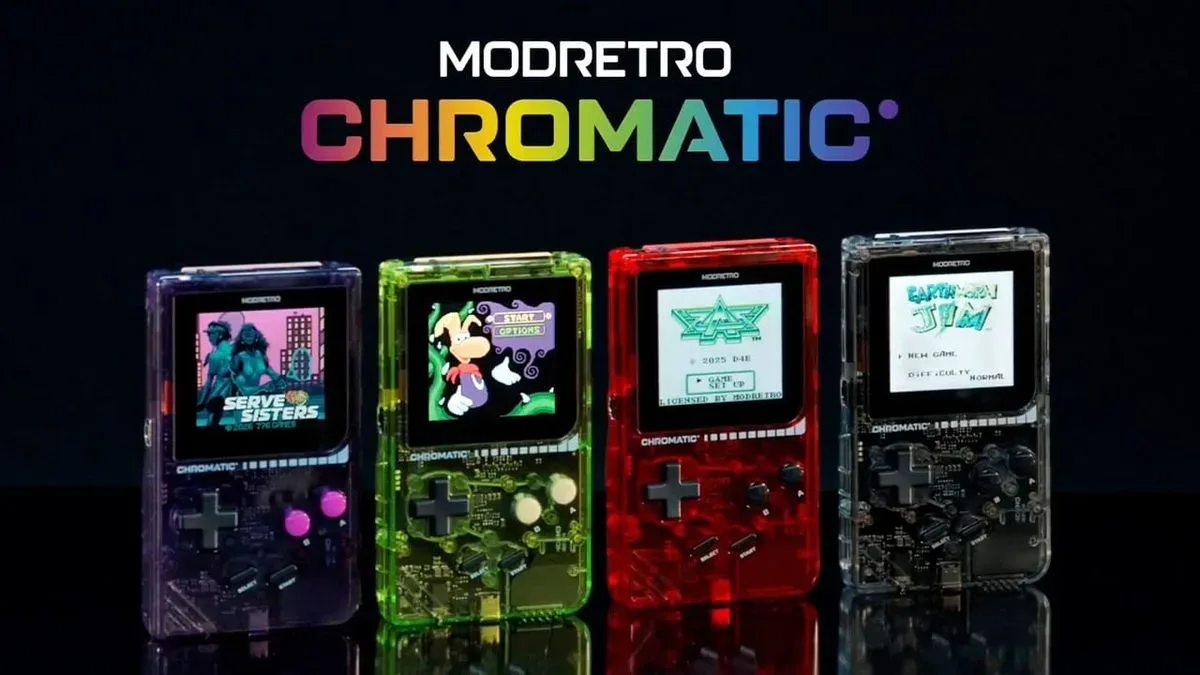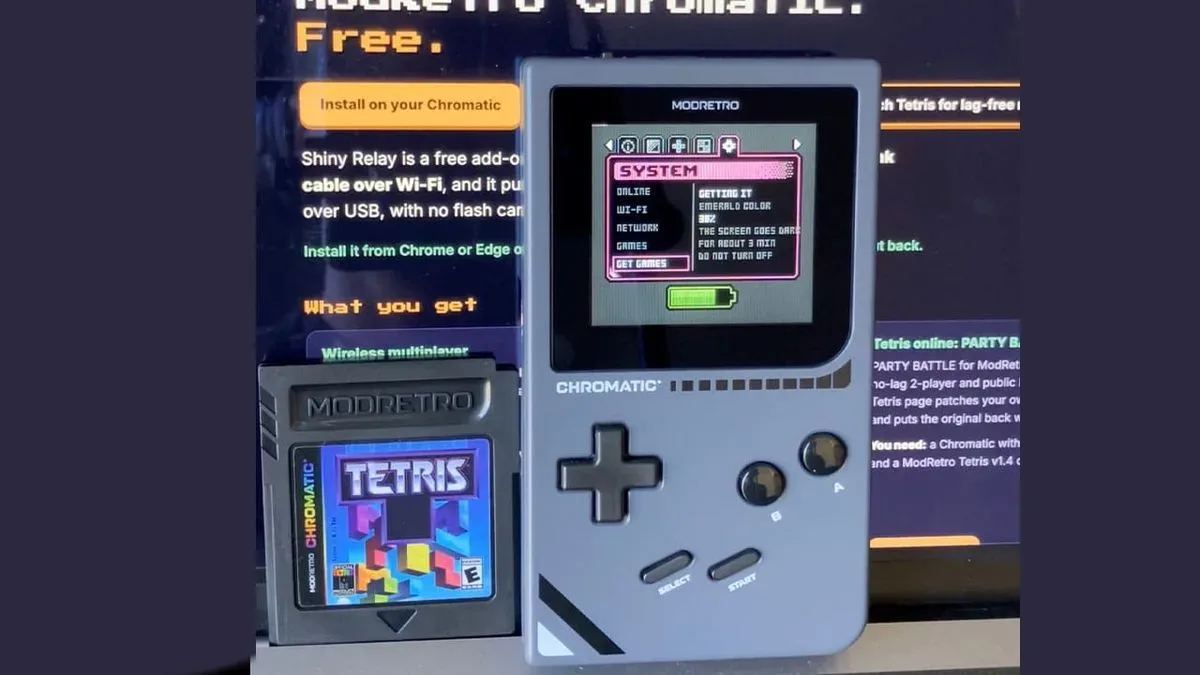
The ModRetro Chromatic has gained a notable community-developed capability: owners can now download games to the handheld over Wi-Fi through ShinyRelay. The update, credited to developer David Walter, expands the ways software can reach the system beyond a USB connection and offers a choice of where that software is stored.
Games can be sent to the Tetris Cartridge, the Chromatic’s built-in flash storage, RAM, or an SD card. The practical appeal is straightforward: the handheld can receive a game wirelessly, rather than requiring a cable for every transfer. But the storage destination matters a great deal, particularly for players deciding whether a downloaded game should persist after the system is powered down.
What the Wi-Fi update changes
The headline feature is wireless game delivery. With the required ShinyGen setup in place, the Chromatic can receive downloads via Wi-Fi and place them into one of several destinations. That creates different use cases rather than a single, one-size-fits-all storage method.
- Tetris Cartridge: Games can be written to the cartridge, with USB writing already supported.
- Built-in flash storage: A portion of the Chromatic’s firmware-oriented flash has spare capacity that can hold games persistently.
- RAM: A temporary place to load a game for the current powered-on session.
- SD card: Another available destination for downloaded software.
The update also supports local and online multiplayer for games loaded to the built-in flash or RAM. That is meaningful because it pairs software delivery with the ability to play with others without treating a physical link cable as the only path to a multiplayer session.
It is worth separating those two ideas. Local multiplayer means players can connect in the same physical setting, while online multiplayer refers to play over a network. The reported support for both means the storage choice is not simply a solitary-play convenience. It can be part of a multiplayer setup as well.
Flash storage versus RAM: the key distinction
Of the available options, the most important difference is between built-in flash and RAM. Both can be used to hold downloaded games, but they do not behave alike once power is removed.
Flash storage is non-volatile memory. In plain terms, data saved there remains after the handheld is switched off. The available space is described as only a few megabytes in total and is principally intended for firmware, but there is reportedly room left over for games. That makes it the better fit when the goal is to keep a download on the Chromatic rather than repeat a transfer later.
RAM, or random-access memory, is volatile working memory. It is useful for loading a game quickly for an active session, but it is cleared when the device loses power. A game sent to RAM therefore disappears when the Chromatic is turned off. It should be treated as temporary by design, not as a failed permanent installation.
Related coverage includes ModRetro Chromatic Gains Wi-Fi Game Downloads Through ShinyRelay Update.
That split gives users a simple decision: use flash for something they want to remain available after shutdown, or use RAM for a temporary session. The choice may be especially helpful for multiplayer experimentation, where a short-lived load is sufficient, while a frequently played title is the more logical candidate for persistent storage.
Wireless firmware updates are part of the package
ShinyRelay 1.1.0 and later adds another convenience feature: firmware updates over Wi-Fi. That means a Chromatic using the update need not be connected by USB merely to receive future firmware changes through this workflow.
Firmware is the low-level software that helps a device operate and controls hardware-facing behavior. Updating it wirelessly does not mean every game or configuration task automatically becomes wireless, but it removes a recurring cable step from ongoing maintenance. Alongside Wi-Fi game downloads, it makes the handheld feel less dependent on a computer after its initial setup.
The change is particularly notable in a retro-styled handheld space, where physical media, cables and device-specific workflows are often part of the experience. It does not replace the appeal of cartridges, and the Tetris Cartridge remains one of the supported write targets. Instead, it adds flexibility: a player can choose a cartridge-based route, internal persistent storage, removable SD storage, or a temporary RAM load depending on the moment.
A community tool, with practical caveats
This functionality comes from the ShinyRelay ecosystem rather than being described here as a standard out-of-box Chromatic feature. Anyone considering it should understand that distinction and follow the relevant project’s current installation instructions carefully. Firmware-related modifications and community software can require attention to compatibility, storage limits and the behavior of temporary memory.
The source material identifies David Walter as the developer behind the work. Walter has described using Claude Opus 5.5 alongside his own software-development experience during the update’s creation. That is best understood as AI-assisted development: a developer using an AI tool in the process, rather than evidence that the technical work was generated and deployed without human engineering oversight.
The technical result is more consequential than the novelty of a Wi-Fi download button. The Chromatic can now receive games without a USB transfer, retain some of them on internal flash, use RAM for short-term loads, and update compatible firmware wirelessly. The storage options create limitations as well as opportunities—most clearly, the fact that RAM-resident games vanish at power-off—but they give owners a clearer set of trade-offs to work with.
Why it matters for handheld players
Handheld hardware is often judged as much by its day-to-day friction as by its screen, controls or styling. A wireless workflow can reduce that friction without changing the core identity of the device. Someone who wants a game to stay on the handheld can use persistent flash storage where capacity allows. Someone who only needs to load a game for a session can use RAM, knowing exactly why it will not survive a shutdown. Someone who prefers removable storage has the SD-card option.
It also broadens the role of the Tetris Cartridge. Rather than functioning only as a conventional physical object, it can serve as a writable destination in the expanded workflow. For a device that draws heavily on the rituals of classic portable gaming, that blend of cartridge use and modern wireless transfer is an interesting compromise: physical hardware remains involved, while the computer-cable bottleneck is reduced.
The broader handheld conversation increasingly includes questions of convenience and control, not just raw specifications. Features such as back buttons can matter greatly when adapting particular games to portable controls, as explored in our look at handheld control upgrades for an Ocarina of Time remake. In the Chromatic’s case, the major new convenience is not another input but a wireless path for software and firmware.
For now, the clearest guidance is to choose storage based on persistence. Built-in flash is the option described as keeping games after power-off; RAM is explicitly temporary. With ShinyRelay 1.1.0 or newer, Wi-Fi firmware updating adds an additional reason the Chromatic may spend less time connected over USB and more time simply being used as a handheld.