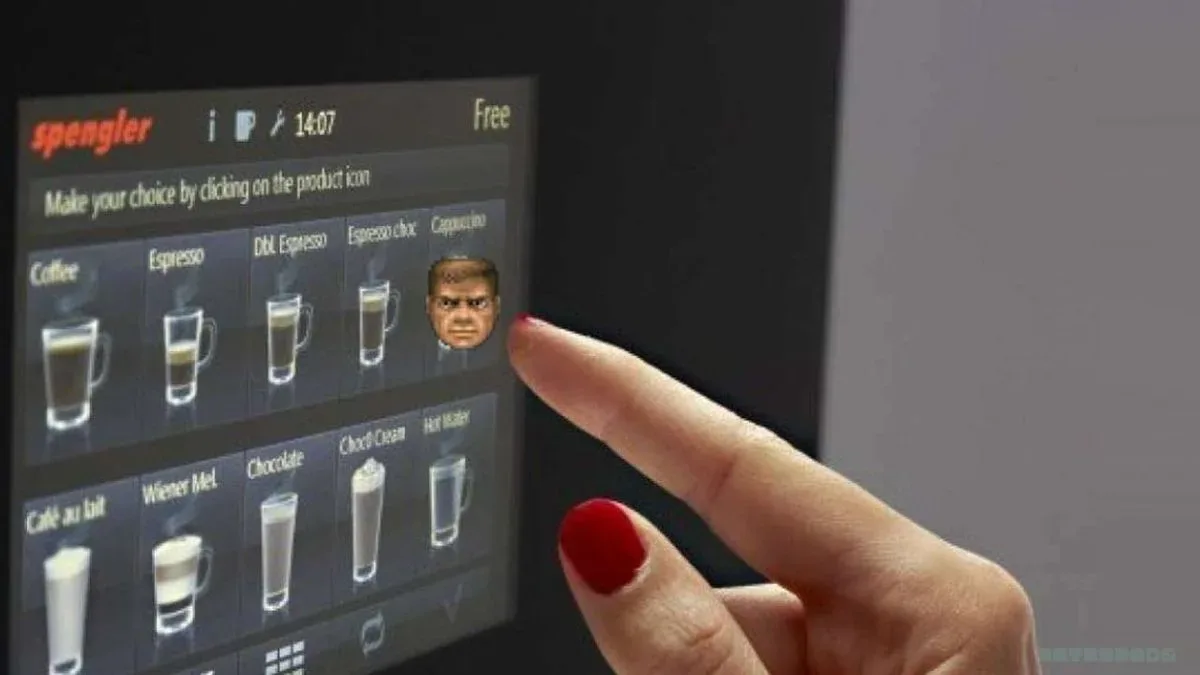
The answer to the long-running question of whether a device can run DOOM has acquired another wonderfully impractical entry: a coffee machine. A Spengler PSL50 self-service coffee kiosk has been modified to launch and play fbDOOM, placing one of gaming’s most persistent technical party tricks alongside the controls normally used for hot drinks.
The project was demonstrated by a YouTube user known as rmassink, identified in accompanying project material as Robin M. The machine in question is not a basic domestic brewer with a couple of physical switches. The PSL50 is described as a self-service coffee kiosk, meaning it already has the kind of screen-based interface and onboard computing hardware that make this sort of experiment possible.
That does not make it a sensible replacement for a PC, console, or handheld. It does make the result deeply funny: a touchscreen intended to guide someone toward a cappuccino or espresso can instead become a tiny portal to Hell.
What is actually running on the machine?
The coffee-machine build uses fbDOOM. In this context, that is the software used to get the game running on the device, rather than an officially supported feature from the coffee-machine manufacturer. The footage shows a playable version of DOOM, not simply a logo, static image, or menu placed on the kiosk display.
“Playable” matters in these projects. A display can show almost anything if it is receiving video from another system, but the appeal of the “Can it run DOOM?” tradition is that the target device itself is doing the work of launching and operating the game. Here, the Spengler kiosk is the platform being repurposed.
Robin’s documentation reportedly explains the steps used for the setup. The loading process involves placing a memory stick into the rear of the coffee machine. The available details also indicate that the machine had limited security restrictions, allowing the project to proceed in a way that would be far less straightforward on more locked-down equipment.
Why DOOM keeps becoming the benchmark for improbable hardware
DOOM has become a shorthand test for unconventional computing because it is recognizable instantly and because getting it to run feels more meaningful than displaying a novelty animation. The game has already appeared in famously strange places, including a lawnmower, a fast-food ordering screen, and even within a PDF. The coffee machine is the latest example of that broad instinct to look at a screen-equipped object and ask whether it has enough accessible computing underneath to run id Software’s landmark shooter.
There is a practical technical reason the joke has endured, too. The original game is old enough that modern everyday devices can possess vastly more capability than the hardware associated with its original era. But “old game” should not be mistaken for “no effort required.” Getting a game onto an appliance can depend on the operating environment, display access, input handling, file loading, and how tightly the manufacturer has secured the device. The coffee machine did not wake up one morning and decide it needed a first-person shooter.
Related coverage includes DOOM Is Now Playable on a Coffee Machine, Because of Course It Is.
That distinction is the heart of the appeal. The point is not that anyone needs to fight demons while waiting for a drink. It is that a purpose-built appliance contains sufficiently flexible technology for somebody with the know-how to transform its intended interface into a game platform.
A kiosk is not a gaming system—and that is the joke
The PSL50 project has an obvious limitation: using its interface for DOOM makes the ordinary coffee-machine controls unusable during play. The novelty works precisely because the equipment has been redirected away from the job it was made to do. Nobody should expect this to be an efficient way to pass a few minutes while a drink is being prepared.
It also makes the project distinctly different from ordinary portable gaming. A handheld is designed around game controls, comfort, software support, and repeatable use. A coffee kiosk is designed around beverage selection and operation. If the aim is simply to play DOOM, purpose-built hardware remains the less chaotic solution. For players interested in current portable-PC features rather than appliance experiments, Microsoft’s Auto SR rollout for the ROG Xbox Ally X is an example of the far more conventional direction gaming hardware is taking.
But the coffee-machine version is not competing with conventional hardware. It is a demonstration of curiosity, access, and a willingness to treat an everyday electronic object as a puzzle. The amusement comes from the mismatch between function and outcome: a beverage kiosk is suddenly hosting a frantic action game whose demons have nothing at all to do with a morning caffeine routine.
The security angle is more important than the punchline
There is a serious edge beneath the gag. The project’s account says the machine had very limited security, with a memory stick used to load the necessary material. That does not establish that every machine of this type is equally accessible, nor does it provide a complete security assessment. It does, however, underline a useful point about connected or computerized appliances: screens and specialized menus can conceal general-purpose software and storage pathways that deserve careful protection.
For owners and operators, the responsible lesson is not to attempt an unapproved game installation on equipment that serves customers or manages a business function. Altering a kiosk could interrupt normal operation, create support problems, or breach the rules governing the equipment’s use. Public-facing machines are especially poor targets for casual experimentation, even when the result is entertaining online.
For technical enthusiasts, the more constructive takeaway is that old and unusual devices can be compelling learning platforms when they are personally owned, safely isolated, and treated with care. Documentation is valuable because it turns a one-off stunt into an explanation of how a system was understood and adapted. Still, a proof of concept is not a recommendation to put untrusted software on an appliance responsible for food or drink service.
A tiny victory for tinkering
The Spengler PSL50 running fbDOOM does not expand the game in a meaningful commercial sense, and it is not a newly supported way to play. Its value is cultural rather than practical. For decades, DOOM has served as both game and technical mascot: familiar enough that everyone understands the achievement, compact enough to invite experiments, and energetic enough that a running build looks immediately more impressive than a static desktop.
On a coffee machine, that tradition lands especially well. The kiosk’s display is ordinarily a polite, functional place for selecting a drink. Recasting it as an arena for demon-slaying turns a routine piece of service hardware into a reminder that many modern appliances are computers with a very specific job description. In this case, someone found a way to give that computer a dramatically different shift.