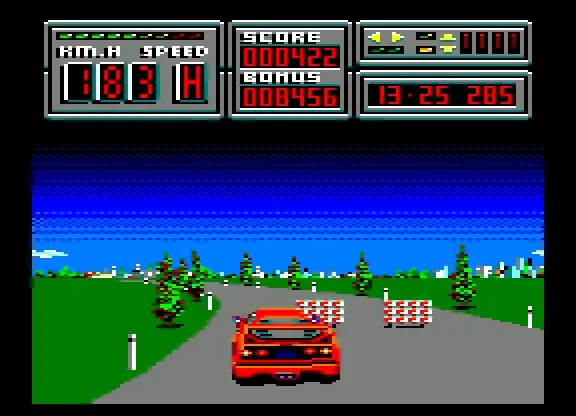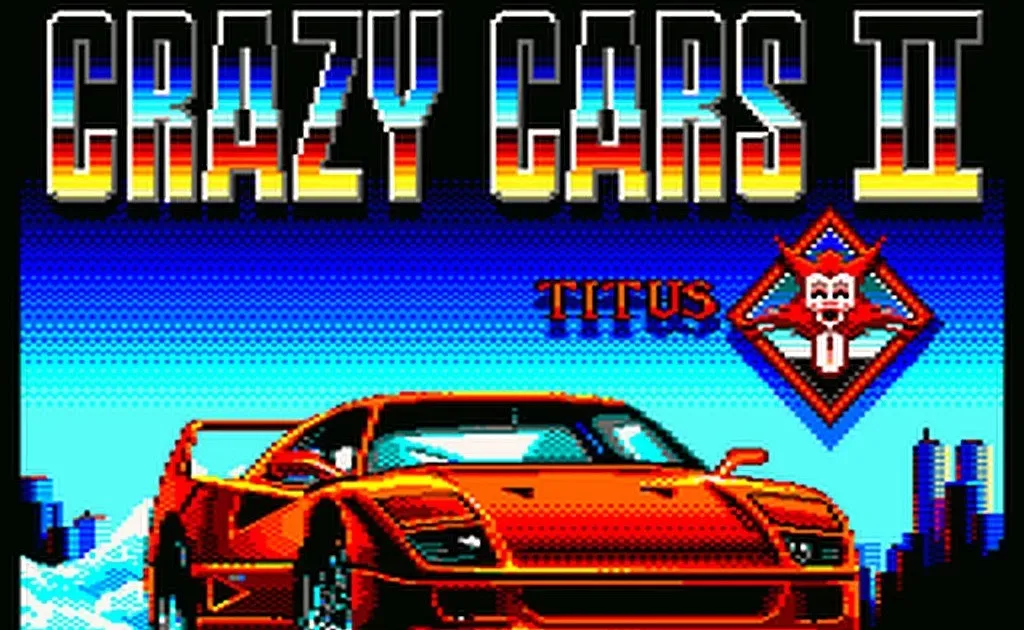
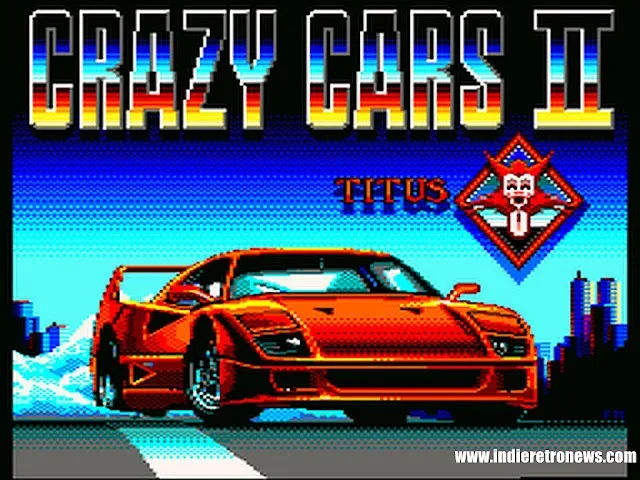
Crazy Cars 2+ is a work-in-progress refresh of the Amstrad CPC driving game, built by developer thealfest. Rather than replacing the original game’s premise, the project focuses on making its high-pressure road race clearer, smoother and less punishing in several practical ways.
The core remains intact: players drive a Ferrari F40 across four US states, racing against a time limit toward a distant city. Progress depends on choosing the correct junctions with the help of an in-game map. There is no civilian traffic to weave through, but the road is still hostile. Police cars pursue the player, and roadblocks need to be smashed through. That makes route awareness and momentum central to the experience, not mere background systems.
The upgrade’s most significant stated change is a performance improvement of more than 50 percent. It also adds smoother Ferrari animation, GPS-style turn prompts, a new intro screen, a high-score tracker, an easier difficulty option and a dedicated congratulations screen for successful runs. Under the hood, the work addresses a score-overflow problem as well as other unspecified fixes.
A preservation-minded upgrade rather than a remake
Projects such as Crazy Cars 2+ matter because older games can be difficult for modern players to approach on their own terms. The challenge is not simply that they are old; it is that their original interface and feedback systems may assume familiarity gained through repeated play. A junction map can be enough to navigate a route, but it asks the player to constantly translate map information into immediate steering decisions while the clock and police pressure continue.
The new GPS turn hints appear designed to reduce that translation burden. In this context, “GPS” should not be read as a claim that the Amstrad CPC game has become a modern navigation simulation. It describes an on-screen driving aid that points players toward the required turn. The original route-planning element remains meaningful, but the game can communicate its next demand more directly.
That is especially useful in a time-trial racer. Missing a turn is not a small cosmetic error: it risks consuming the very time the player is trying to protect. A prompt at a junction can make failure feel more connected to driving, police pressure or roadblocks, rather than to losing track of the map at the wrong moment.
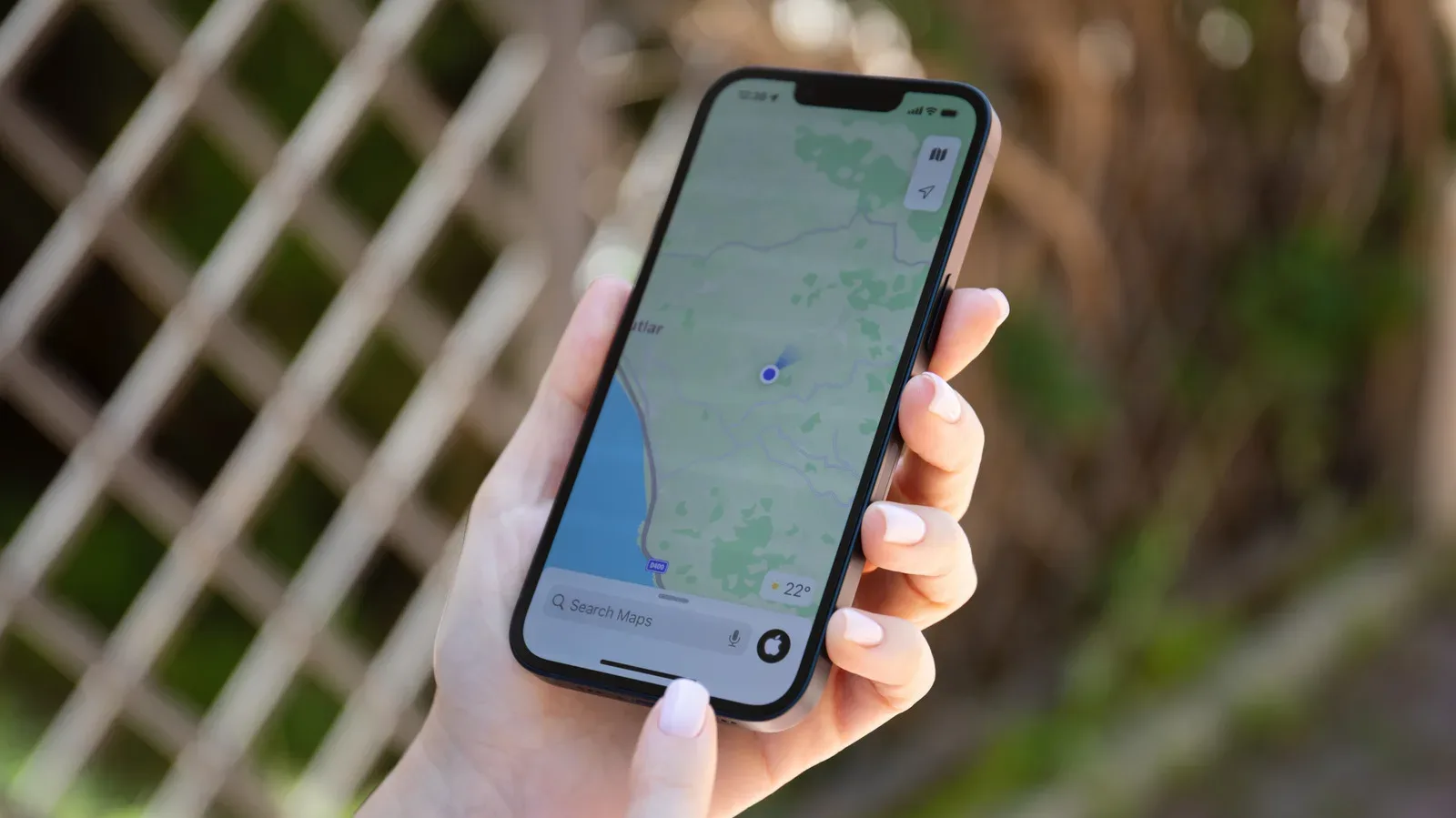
There is a useful parallel in the way contemporary mapping tools emphasize timely, situational guidance instead of making drivers interpret a static route on the fly. For a broader look at navigation features built around everyday travel decisions, see Apple Maps’ less-obvious tools for travel and daily drives. Crazy Cars 2+ applies the basic idea to a much more compact and frantic retro-racing loop.
Why speed and animation changes can alter the feel of play
A claimed gain of over 50 percent in performance is substantial, even without a detailed technical breakdown of the implementation. In a driving game, performance affects more than presentation. It can shape how quickly the player receives visual information, how confidently they can react to junctions and obstacles, and whether the game’s pace matches its intended sense of speed.
Related coverage includes Crazy Cars 2+ Revives an Amstrad CPC Racer With Faster Performance and New Driving Aids.
The smoother Ferrari animation works alongside that improvement. Animation is the visual sequence used to convey movement; in a racer, it helps the vehicle’s changes in direction and speed read clearly. Better motion feedback can make a road game feel more responsive even when the broader design has not changed. For a game about covering distance under pressure, that clarity is not merely decorative.
It is important, however, not to overstate what has been confirmed. The available details establish the performance claim and the animation improvement, but do not specify frame-rate measurements, hardware comparisons, or every system affected by the optimization. The safest reading is that Crazy Cars 2+ aims for a noticeably faster and smoother version of the existing CPC experience, not an entirely different driving model.
Accessibility options without erasing the original challenge
The addition of an easier difficulty setting is another meaningful change. Difficulty settings are not automatically a sign that a game has been simplified across the board. At their best, they let more players learn a game’s route logic, controls and threat patterns before committing to its tougher demands.
Crazy Cars 2+ still frames success around reaching the destination before time runs out, while escaping police cars and forcing through blockades. That means its identity is still built around pressure. The easier setting simply creates a more approachable entry point for people who want to understand the game before confronting the full challenge.
The high-score tracker similarly gives repeat runs a clearer purpose. A high score system records a player’s best result, allowing performance to be compared across attempts. In an arcade-style driving game, that kind of persistent record can turn a completed route into a reason to return: finishing is one objective, but improving the result becomes another.
The proper congratulations screen is a smaller addition with a surprisingly important role. Older games sometimes make an ending feel abrupt or ambiguous, especially when their available space and memory are limited. A dedicated victory message confirms that the player has completed the intended goal. It gives the end of a demanding run an explicit payoff.
The score-overflow fix, explained
Among the technical corrections, the repair for a score overflow bug may be the most consequential. An overflow happens when a program tries to store a value larger than the space set aside for it. If a score counter has a maximum representable value, exceeding that maximum can cause the number to wrap around, display incorrectly or otherwise behave in an unintended way.
For a game that now includes a high-score tracker, reliable scoring is essential. If the score can fail at high values, the game’s record-keeping loses credibility just when skilled players are most likely to depend on it. Fixing the issue therefore supports both fairness and replay value. It also demonstrates that the project is not limited to visual additions: it is addressing a concrete logic issue that affects player results.
The mention of further general fixes indicates more work has occurred, but their individual scope has not been detailed. It would be premature to assume that every remaining quirk or limitation has been changed. As a work in progress, Crazy Cars 2+ should be understood as an active enhancement effort rather than a final archival release.
AI assistance and cross-platform optimization work
Thealfest used Claude Code to help speed development. That describes AI assistance in the creation process, not an in-game feature. The supplied details also say that the project incorporates optimizations originally developed for a ZX Spectrum modification.
In practical terms, an optimization is a code or technical change intended to make software run more efficiently. Bringing optimization ideas from one version or related project to another can save effort, provided they can be adapted to the target machine and game. The Amstrad CPC and ZX Spectrum are distinct platforms, so the important point is not that code was simply copied wholesale, but that prior optimization work informed the CPC enhancement.
This is a useful reminder that retro development often combines preservation with active engineering. The visible changes—a turn prompt, smoother animation or an ending screen—are what players immediately notice. The less visible work, such as performance improvements and numerical bug fixes, is what can make those additions fit naturally into a game that was designed around far older hardware constraints.
How players can approach the current build
Crazy Cars 2+ can be played online through the Retro Virtual Machine emulator. An emulator is software that reproduces the behavior of another computer system, allowing its programs to run on different hardware. For interested players, that provides a convenient way to examine the project’s current state without treating the work-in-progress label as a promise of a finished build.
The sensible expectation is a familiar CPC racer with a more legible route-following experience, faster performance, smoother car movement and more complete feedback around both scores and victory. The project does not discard the original tension of its race-against-time structure. Instead, its changes target the places where friction can obscure that tension: unclear turns, rougher motion, limited options and a scoring bug that could undermine strong runs.
For retro players, that approach may be the appeal. Crazy Cars 2+ is not presented as an attempt to turn an Amstrad CPC game into a modern racer. It is a focused effort to make the existing race easier to read, more technically polished and more satisfying to master while retaining the police chases, roadblocks, map-led junction decisions and deadline-driven pressure at its center.