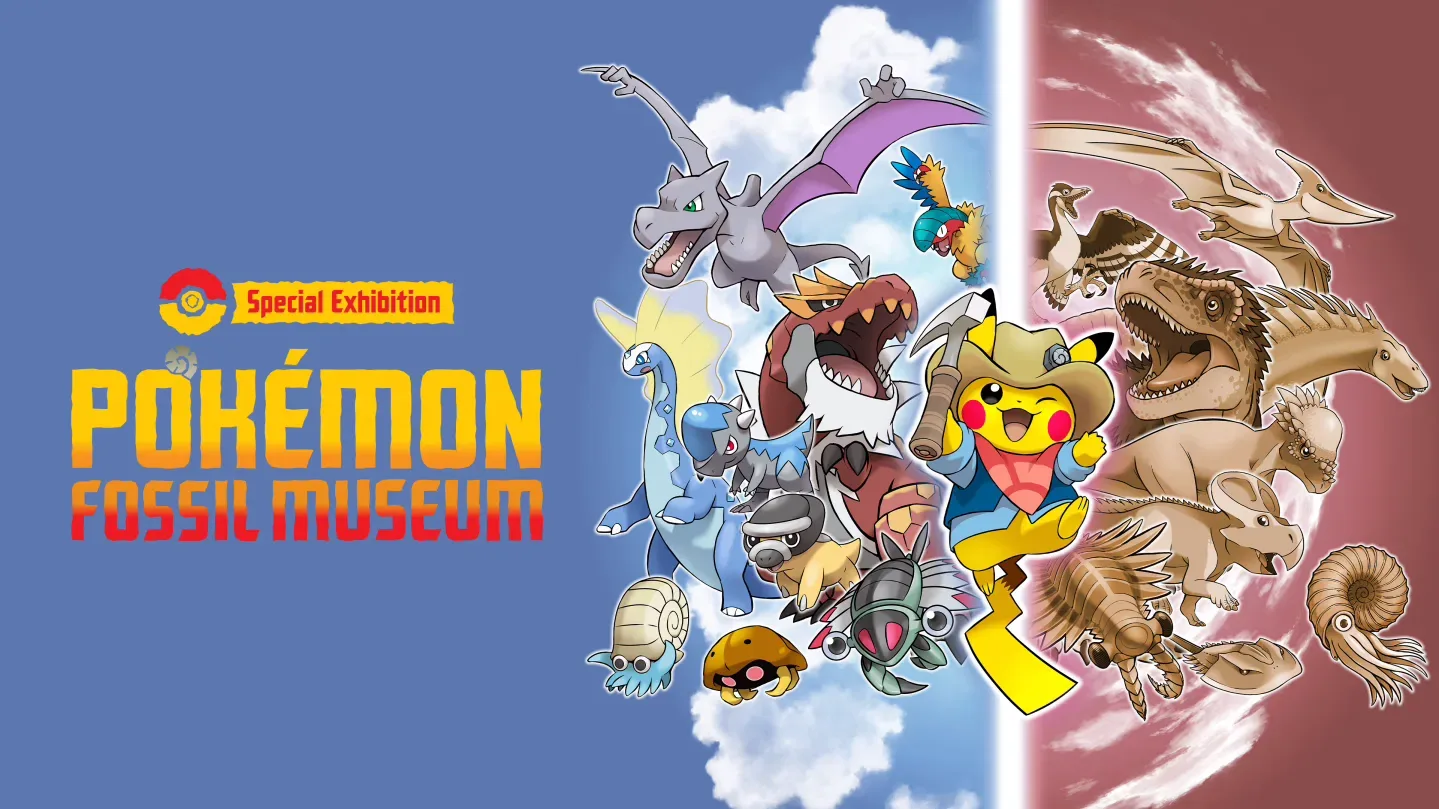
The Pokémon Fossil Museum will open at the Denver Museum of Nature & Science on May 28, 2027. The special exhibition brings together real-world fossils and fossil casts with life-size models of Fossil Pokémon, using the familiar Pokémon setting to introduce visitors to the ways paleontology investigates ancient life.
Denver will be the exhibition’s second North American stop. It previously debuted at Chicago’s Field Museum, where it remains on display until April 11, 2027. The Denver engagement begins a little more than six weeks after the Chicago run is scheduled to end.
This is not a trading-card release, a game event, or an announcement of new Pokémon species. It is a museum exhibition designed around a particularly durable connection in the franchise: Pokémon whose designs and stories echo the real scientific work of finding, examining, and interpreting fossils. For fans, that creates an unusual opportunity to see fictional creatures presented beside the physical evidence and scientific tools that inform the broad idea of prehistoric life.
What visitors can expect
The exhibition’s core format is straightforward: real fossils and casts will be displayed alongside life-size models of iconic Fossil Pokémon. Signage will explain how fossils are found and studied in the real world and in the Pokémon world.
A fossil is preserved evidence of past life or activity. Museum visitors may encounter original fossil material, but exhibits also often use casts: reproductions made from an original specimen. A cast can make an object easier to display, study, compare, or share with audiences while protecting the original. The announced exhibition explicitly includes both fossils and casts, an important distinction for visitors who may otherwise assume every displayed object is an original specimen.
The Pokémon half of the equation is not simply decorative. Fossil Pokémon give the exhibition a common vocabulary for guests who know the games, animation, or card game. Rather than asking those visitors to begin with an unfamiliar scientific subject, the show starts with recognizable fictional ideas and directs attention toward real questions: what counts as fossil evidence, how is it recovered, and how do researchers study it?
A bridge between fandom and paleontology
Pokémon has long made fossils part of its fictional worldbuilding. The museum exhibition uses that connection to set the real world beside the imaginary one, rather than treating them as interchangeable. That distinction matters. Pokémon can spark an interest in ancient life, but real fossils are evidence that must be located, documented, preserved, and interpreted.
The exhibition signage is intended to illustrate methods in both worlds. In practical terms, this should help younger visitors and longtime fans compare a game-inspired premise with the more methodical work of paleontology. The point is not that the fictional process is a scientific model; it is that the contrast can make real scientific practice more approachable.
Related coverage includes Pokémon Fossil Museum Heads to Denver in May 2027.
That approach also gives the Denver show value beyond a conventional franchise display. A collection of Pokémon models alone would be a fan attraction. A collection of fossils alone would be a natural-history exhibit. Pairing them gives visitors a reason to look at both more closely, while encouraging an interest in nature and the processes used to understand the distant past.
Why the life-size models are significant
The announced life-size Pokémon models will likely be a central visual hook. Scale is useful in a museum setting because it changes the way visitors perceive an object. A creature seen as a small illustration, a card image, or an in-game model can feel entirely different when represented at full size in a shared physical space.
Placed with fossils and casts, the models can also support comparisons without requiring the exhibition to claim that Pokémon are real animals. The contrast is the feature: one side represents an invented world built around collecting and reviving fossil creatures, while the other represents real objects that researchers examine to learn about life from deep time.
For families, that makes the show potentially more accessible than a display that assumes prior knowledge of geological or paleontological terminology. Visitors can arrive with Pokémon knowledge and leave with a clearer sense of why fossils are meaningful scientific material. Experienced museumgoers, meanwhile, may find a new route into a familiar subject through one of gaming’s best-known universes.
Planning a Denver visit
Anyone hoping to attend in Denver should note the date: the exhibition opens May 28, 2027. Ticket details have not been specified here, but the Denver Museum of Nature & Science has an interest list for people who want notification when tickets become available. Joining that list is the clearest available step for prospective visitors rather than assuming that entry arrangements are already live.
People who can reach Chicago sooner have a separate window to see the exhibition before its move. Its Field Museum run is scheduled to end April 11, 2027. That closing date and Denver’s May 28 opening date make the two appearances distinct opportunities, not overlapping stops.
Visitors should also avoid reading more into the announcement than it says. No ticket price, exhibit end date in Denver, or full object list has been detailed. Likewise, the announcement refers to iconic Fossil Pokémon but does not identify which models will be included. Those specifics may matter to collectors or franchise completionists, but they remain unconfirmed based on the available information.
What this means for Pokémon fans
The Denver booking reinforces the appeal of Pokémon outside games and cards. A museum setting can make room for a different kind of engagement: slower observation, comparison, and conversation around the natural-world ideas that inspired part of the franchise’s fiction.
It may be especially compelling for fans who enjoy the collecting side of Pokémon but want an experience that is not based on buying, opening, or chasing rarity. In a museum, the focus shifts from ownership to interpretation. Fossils and casts become objects to examine, while the Pokémon models offer a friendly point of recognition.
For the wider Nintendo audience, it is also a reminder that Pokémon exists across formats and spaces well beyond a console screen. Readers following current hardware can find related coverage in our look at Switch 2 Pro Controller alternatives, while the Fossil Museum offers a decidedly offline Pokémon outing built around natural history.
Denver visitors interested in the Pokémon Fossil Museum should keep May 28, 2027 on their calendar and use the museum’s interest list for ticket updates. Until further details are announced, the most reliable expectation is the one at the heart of the exhibition: real fossils and casts, life-size Fossil Pokémon, and interpretive displays that connect two very different ways of thinking about prehistoric creatures.