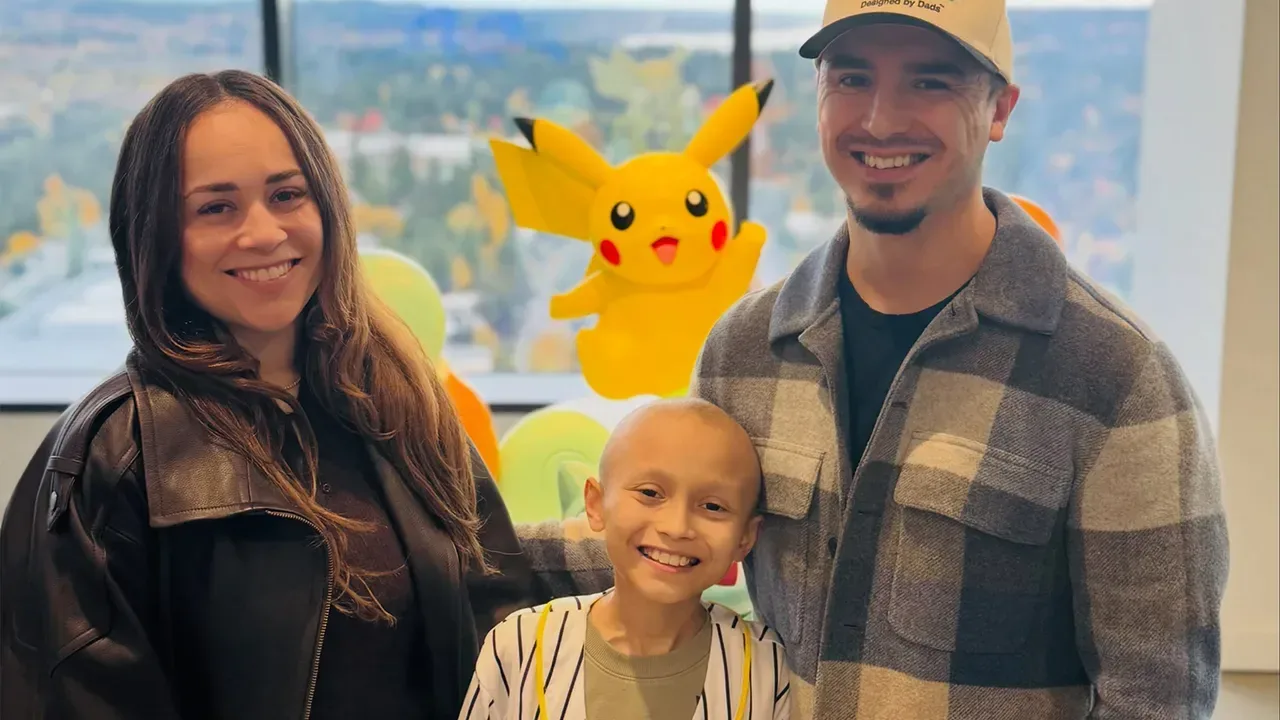

Christian Garcia, the father of Avery the Poké Kid, has made a public appeal for The Pokémon Company to create a special Pokémon Trading Card Game card in his late son’s honor.
Avery died in September 2026 at age 12 following a seven-year battle with pancreatic cancer. He had become a bright, recognizable presence among Pokémon TCG fans, and a video shared by his family after his death brought his enthusiasm for the hobby to a much wider audience. In the clip, Avery opens what became his final card pack and reacts excitedly to pulling a 30th Anniversary Jirachi SIR.
On November 6, Garcia shared a video asking anyone at The Pokémon Company to get in touch about a way to preserve Avery’s legacy through the game and hobby he loved. His request is not framed as a commercial release or a confirmed project. It is a direct, public plea, and there is no indication that The Pokémon Company has responded or committed to making a card.
A request rooted in the ritual of opening packs
Garcia described the difficulty of finding a way to carry Avery’s legacy forward. He said he hoped his son could somehow be “immortalize[d]” in the trading card game and imagined the emotional significance of collectors being able to open a pack and search for a card honoring Avery.
That detail matters because Pokémon cards are not only individual objects. For many collectors, the experience is tied to the ritual around them: picking a pack, opening it, revealing the cards one at a time, and sharing an unexpected pull with friends or family. Avery’s final opening resonated precisely because it showed that joy without the usual collector-market framing. The important moment was a child’s excitement at seeing a card he loved.
Jirachi has consequently become the image most closely associated with the conversation around a potential tribute. Fans have suggested that any commemorative card could feature some version of the Pokémon, connecting the hypothetical card to Avery’s final pull. That is fan discussion, however, not an announced design, product, or plan.
The “SIR” attached to the Jirachi card’s name is part of the card’s supplied product description. Regardless of how collectors classify that card, the central point is clear: it was a specific pull that Avery celebrated, and it became emotionally significant to his family and to people who encountered the video afterward.
The artist’s reaction adds another human connection
The artist behind the Jirachi card also responded publicly after learning why the pull had meant so much. She wrote that she was deeply moved and said that wanting her art to bring people happiness was one reason she continued drawing.
Related coverage includes Avery the Poké Kid's Father Asks for a Pokémon Card Tribute to His Late Son.
It is a small but meaningful connection between the many people involved in a card’s life. A trading card begins as an illustration and a game component, then becomes a product, a collectible, and sometimes a personal memory. In Avery’s case, the same Jirachi image linked an artist’s creative purpose with a family’s moment of joy. That does not create an obligation for a future tribute, but it helps explain why the story has spread beyond the usual day-to-day card discussion.
A reminder that tribute and speculation are not the same thing
Any prospect of a commemorative Avery card also comes with an important boundary. In September, Avery’s family addressed sellers who were raising the price of the 30th Anniversary Jirachi SIR after the video circulated. The family said it was not involved in, did not approve, and did not benefit from cards sold using Avery’s name or likeness. It asked those listings to be removed and asked for space to mourn and care for Avery’s siblings.
That statement remains essential context for collectors. A card can hold personal value, cultural value, and market value at the same time, but those values are not interchangeable. A family’s grief and a child’s legacy should not be treated as a signal to buy, relist, or inflate an existing card’s price.
There is also a crucial distinction between an official memorial product and unofficial items that invoke Avery’s name. At present, Garcia has asked for an official conversation with The Pokémon Company; he has not announced a partnership, authorized private sellers, or endorsed any market activity connected to Avery. Collectors should be especially cautious of claims suggesting otherwise.
- Not confirmed: no Avery tribute card, product set, distribution method, artwork, or release date has been announced.
- Not authorized: the family has said it is not connected to sales using Avery’s name or likeness and has not approved them.
- What is known: Garcia wants a way to honor Avery within the Pokémon TCG, while many fans have proposed a Jirachi-themed approach.
What an official response would need to consider
Garcia’s request is emotionally simple: preserve Avery’s place in the hobby that made him happy. Turning that hope into an official card, if the company chose to pursue it, would necessarily involve decisions that have not been discussed publicly. The company would need to work directly with Avery’s family, determine what form a tribute should take, and decide how to present it respectfully.
Distribution would be particularly consequential. A collectible made difficult to obtain can rapidly become the focus of resale attention, while a widely available card could make the tribute more accessible to the community. Neither route has been proposed by Garcia in the material available, and it would be wrong to assume his preferences. Still, the family’s earlier warning about opportunistic listings shows why the question cannot be separated from the realities of the card market.
The visual and textual approach would matter as well. Fans may associate the tribute with Jirachi because of Avery’s final pull, but only Avery’s family and an official partner could determine whether that is appropriate. A memorial should reflect the person being honored rather than simply the card that gained the most attention after his death.
More broadly, the situation illustrates why the Pokémon TCG community’s response carries weight. Collectors can amplify Garcia’s request without turning it into a commodity. Sharing Avery’s story accurately, avoiding misleading listings, and respecting the family’s explicitly stated wishes are more meaningful than treating Jirachi as a speculative target.
The immediate story is the family’s appeal
For now, there is no product news to analyze. There is only a father asking the company behind a game his son loved to help ensure that Avery is remembered within it. The response from fellow fans has largely centered on the idea of Jirachi, the Pokémon tied to Avery’s final joyful pull, and the response from the card’s artist shows how far that moment traveled.
Garcia’s video puts the next step squarely with The Pokémon Company. Until there is an official statement, collectors should regard any supposed tribute-card details, sales pitches, or claimed partnerships with skepticism. The most respectful reading of the request is not as a chase-card rumor, but as a family seeking a lasting and thoughtful way to honor a child who found real happiness in Pokémon cards.
For a broader look at how companies and creators navigate decisions that shape games and their communities, see this recent industry collaboration report.