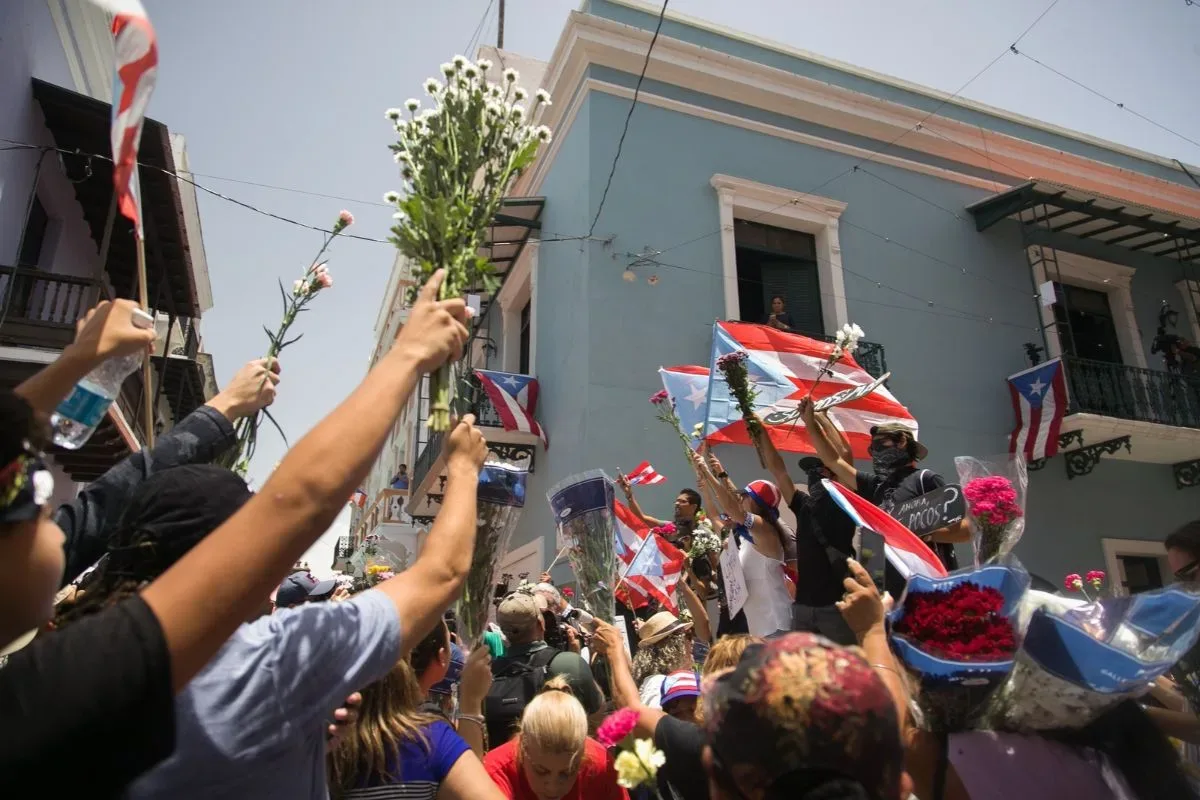
Puerto Rican rapper and physician PJ Sin Suela joined thousands of demonstrators in San Juan during the Day of National Outrage, held on Black Friday, November 27. The protest put the spotlight on the costs that are shaping everyday life across Puerto Rico: electricity, housing, wages, pensions and the condition of public services.
PJ Sin Suela urged Gov. Jenniffer González to hear workers and residents who say they are being pushed beyond what their incomes can sustain. Speaking during the march, he framed the turnout as a collective refusal to accept rising household pressure as normal. “We’re here with the people, with the people of Puerto Rico, because we believe enough is enough,” he said in Spanish.
His participation brought a recognizable music figure to a demonstration whose concerns extend well beyond celebrity involvement. PJ Sin Suela has a distinct perspective on those concerns: alongside his recording career, he is a doctor. He has said that medical work has allowed him to create hip-hop without having to depend on music alone for income, and that his work has brought him directly into homes facing difficult living conditions.
A protest built around cost-of-living pressures
More than 30 organizations took part in the San Juan action. The General Workers Union said the mobilization grew from teachers’ demands for better pay and secure pensions, but the demonstration gathered a broader set of frustrations around household affordability and public policy.
Hundreds of participants traveled by bus from other parts of Puerto Rico to join the crowd near Hiram Bithorn Stadium in Hato Rey. Demonstrators later blocked part of the Las Américas expressway near Plaza Las Américas, an action that emphasized the march’s deliberate Black Friday timing. While shoppers were headed toward one of the island’s most prominent retail areas, protesters focused on what they see as the widening gap between basic costs and what working people can afford.
PJ Sin Suela specifically pointed to rents and electricity bills, arguing that a person earning minimum wage cannot realistically purchase a home under present conditions. That is an affordability argument rather than merely a complaint about individual expenses: when fixed necessities consume a greater share of someone’s pay, less money remains for food, transportation, medical needs, savings or unexpected emergencies.
For many households, utility bills are not a minor monthly variable. They are a core cost of keeping a home livable. Some household electricity bills recently rose from $229 to $271 per month. That is a $42 increase, and it helps explain why power costs remained central to the protest’s message. An increase of that kind can be particularly consequential for workers already facing expensive rent and limited wage growth.
The Luma Energy contract ruling added urgency
The demonstration followed a significant legal development involving Puerto Rico’s electricity system. Two days before the march, Puerto Rico’s Supreme Court ruled that the government’s extension of its contract with Luma Energy was invalid. González praised the decision.
Related coverage includes PJ Sin Suela Joins Puerto Rico’s Black Friday Protest.
The ruling does not, on its own, settle the island’s broader debate over energy reliability, contracts or the level of household bills. But it placed the electricity issue at the center of public discussion just before demonstrators took to the streets. For protesters focused on affordability, the court decision became part of a larger demand for accountable energy policy and relief from monthly costs.
In practical terms, a contract dispute and an electricity bill may sound like separate subjects, but they meet at the kitchen table. The system that manages power delivery, its contractual arrangements and the decisions made by public officials can affect what residents are charged and how confidently they can plan their budgets. The protest connected those institutional questions to the lived reality of workers and families.
That connection also helps explain why the crowd’s concerns were not limited to one sector. Teachers’ calls for compensation and pension security, workers’ concerns about rent and residents’ anger over power costs all reflect the same underlying problem: whether income and public systems can provide stability.
Why PJ Sin Suela’s role carries particular weight
PJ Sin Suela’s public role is unusual because his work reaches both culture and health care. His involvement was not presented as a detached celebrity appearance. He has spoken about treating families after Hurricane Fiona when some residents were still without running water or electricity. Those experiences give context to his insistence that health care and education deserve public attention alongside wages, housing and energy.
When he spoke about public services, he said he would continue to advocate for health care and education as a doctor. His argument was direct: officials need to respond to people’s demands rather than ignore them. In a protest centered on material costs, that emphasis matters because health and education are also parts of household security. A family’s financial position can deteriorate quickly when access to reliable services is uncertain or when essential needs require more out-of-pocket spending.
His presence also reflects a wider pattern in music culture, where artists use public visibility to amplify a local issue rather than redirect attention toward a release or performance. The relevant point here is not that fame changes the demands made by protesters. It is that a recognizable participant can make more people notice the concerns that brought thousands into the street in the first place.
Music figures have increasingly been visible in conversations around public emergencies and civic events; for another recent example of artists responding publicly to a disruptive event, see coverage of musicians reacting after an earthquake in Los Angeles. PJ Sin Suela’s involvement in San Juan, however, was tied to a sustained set of policy and cost-of-living concerns rather than an immediate natural event.
A Latin Grammy win, followed by civic action
The march came in the same month that PJ Sin Suela received his first Latin Grammy. He was a co-writer on Jorge Drexler’s “Ante la duda, baila,” which won Best Alternative Song.
That achievement marks a major professional moment, but the timing also underlines the dual nature of PJ Sin Suela’s public identity. He is an award-winning artist whose music work has earned a Latin Grammy, and he is a physician who has described firsthand encounters with households lacking basic services after Hurricane Fiona. At the protest, those two sides of his career met in a public appeal for government responsiveness.
It is important not to confuse his presence with a claim that he speaks for every organization or participant. The march included many groups and grew from specific labor demands, particularly those involving teachers. PJ Sin Suela added his own concerns about housing, electricity, health care and education to that wider coalition.
What the San Juan demonstration was asking for
The Day of National Outrage was not framed around a single, narrow policy request. Its messages instead converged around several linked priorities:
- Affordable electricity: protest participants challenged power costs that have become increasingly difficult for some households to absorb.
- Housing within reach of workers: PJ Sin Suela argued that homeownership is out of reach for people earning minimum wage, while rent remains another pressing cost.
- Fair wages and protected pensions: teachers’ demands for improved pay and secure retirement benefits helped spark the broader action.
- Responsive public services: health care and education were part of PJ Sin Suela’s call for officials to address residents’ needs.
- Government accountability: demonstrators sought action from the González administration and attention to promises made during the campaign.
The protest’s Black Friday setting made its economic critique especially visible. The date is often associated with consumer spending, but demonstrators used it to challenge the premise that people can simply spend their way through rising costs. Their message was that many residents are facing a more basic question: whether the essentials of housing, power, health and education remain affordable and dependable.
PJ Sin Suela’s participation put a prominent voice behind that message. His comments did not offer a technical blueprint for resolving Puerto Rico’s energy or housing challenges, and the demonstration itself did not erase the complexity of those issues. What it did show was a broad public demand to treat them with urgency—and a call from an artist and doctor for leaders to listen to the people experiencing those pressures directly.