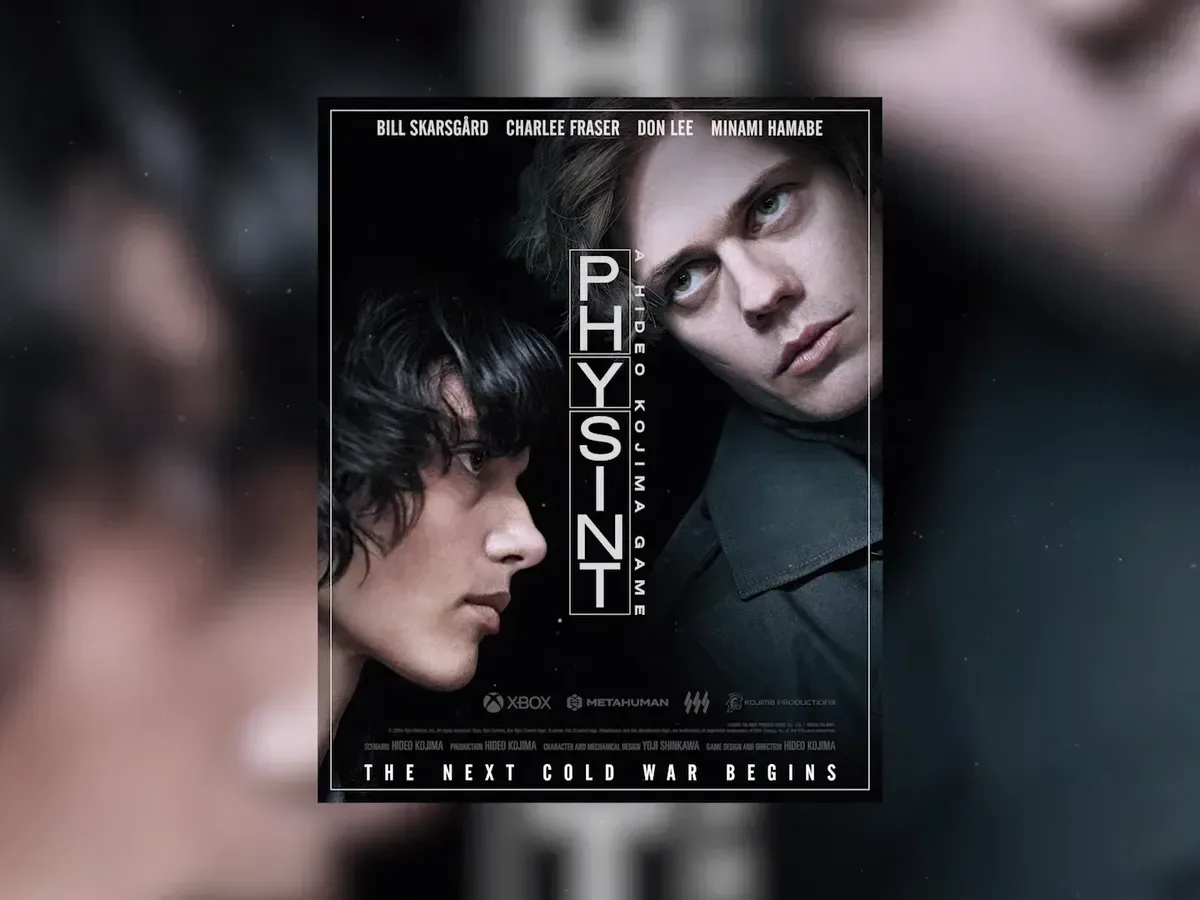
Hideo Kojima’s Physint remains deliberately opaque, but its latest promotional image has supplied one unusually direct piece of story language: “The next Cold War begins.” Paired with the reveal that Bill Skarsgård is involved in the project, the phrase gives the upcoming game a more defined dramatic silhouette than a logo, a cast photo, or an enigmatic social-media post ever could.
It is not a full premise, a setting confirmation, or a list of gameplay features. It is a tagline, and taglines are designed to create a mood before they explain a plot. Even so, the words point plainly toward a world of espionage, geopolitical pressure, secrecy, and the threat of immense escalation. Those ideas naturally recall the spy-fiction territory closely associated with Kojima’s earlier work, especially the Cold War-era entries in the Metal Gear Solid series.
A phrase that does a lot of work
“The next Cold War” is more suggestive than simply saying “the Cold War.” The historical term generally describes prolonged conflict and competition between rival powers without an open, direct war between them. In fictional spy stories, it often signals intelligence operations, covert intervention, military deterrence, political distrust, surveillance, defections, disinformation, and the fear that one miscalculation could become catastrophic.
That does not establish exactly which of those elements Physint will use. The poster provides no confirmed country, organization, protagonist role, year, mission structure, or antagonist. Nor does it say whether the phrase refers to a literal near-future geopolitical conflict, an alternate-history world, or a more metaphorical division. But it is reasonable to read the line as an invitation to expect tension between competing blocs rather than a straightforward battlefield story.
The word “next” is the key modifier. It implies a successor conflict rather than a retelling of the 20th-century Cold War. That could place the game closer to a contemporary or future-adjacent period, where familiar anxieties have been reshaped by new conditions. This is analysis, not confirmation: at present, the available material only establishes the wording of the tease, not the precise era in which the game takes place.
Why the Metal Gear comparison is immediate
Kojima’s history makes comparisons unavoidable, particularly because Physint has been framed as a new espionage-focused project. Metal Gear Solid 3: Snake Eater, Metal Gear Solid: Peace Walker, and Metal Gear Solid V: The Phantom Pain all used Cold War-era material in their narratives. In the first two, the period is not mere wallpaper; the political strain and competing interests help drive the drama around covert operatives and military power.
That background explains why a four-word teaser can produce such a loud reaction. It sounds less like a vague promise of stealth and more like a signal that Physint may revisit a familiar thematic lane: espionage conducted under the shadow of potentially world-changing weapons and state secrets. The possible appeal is not nostalgia alone. A “next” Cold War framing could give a new project room to examine the same basic pressure points through a different fictional moment.
Still, “spiritual successor” should not be mistaken for “new installment.” The current information does not identify Physint as part of the Metal Gear series, and it does not confirm that its play systems will resemble any particular earlier game. Tone, themes, and genre language can overlap without producing the same structure, controls, mission design, or story continuity.
Related coverage includes Physint's First Story Tease Points to a New Cold War Spy Thriller.
That distinction matters for expectations. Spy thrillers can include stealth, close-quarters encounters, social manipulation, investigation, escape sequences, cinematic storytelling, or all of the above. A tagline about a new Cold War tells players more about the likely atmosphere than it does about the moment-to-moment interaction. Until Kojima Productions provides details, any claim about gameplay mechanics would be speculation.
Bill Skarsgård adds a human focal point, not an answered question
Bill Skarsgård’s casting was the prominent part of the latest Physint update. The promotional artwork features a photo taken by Kojima of the pair, but the announcement material discussed here does not identify Skarsgård’s character or specify whether he is playing a protagonist, an adversary, an ally, or someone whose function changes over the course of the game.
That uncertainty is part of why the poster’s wording matters. Casting news tells audiences that a performer has joined a project; a phrase such as “The next Cold War begins” starts to frame the kind of story that performer may inhabit. Together, they move Physint from a broadly named espionage project toward a more recognizable image: an actor attached to a covert political thriller with an ominous era-defining conflict at its center.
It also underlines a useful rule for reading early game marketing. A poster can be meaningful without being comprehensive. It is fair to identify the imagery and language it presents, and to compare their themes with Kojima’s past body of work. It is not fair to turn those clues into unannounced facts about plot, character, release timing, platforms, or specific mechanics.
The song choice reinforces the project’s sense of return
Another recurring piece of Physint marketing is Asia’s “Here Comes the Feeling.” Kojima has used the track in Instagram posts about the project, and it also appears on the original poster. The song’s presence does not explain the game’s narrative, but it gives the campaign a notably different emotional register from the Cold War tagline.
Where the tagline evokes anxiety and confrontation, the song selection can be read as emphasizing recognition and reunion. That reading has encouraged fans to connect Physint with Kojima’s return to a spy-oriented creative space after years spent on the distinct world of Death Stranding. It is a plausible interpretation of the marketing combination, not a stated statement of authorial intent.
For a creator whose projects are often discussed through their themes as much as their plot setups, music can be a powerful signpost. A familiar-feeling song next to a new espionage property creates a small but clear tension: something old seems to be returning, yet it is arriving in a new form. “The next Cold War” works similarly. It borrows the weight of a recognizable historical concept while asserting that this conflict is not simply the old one repeated.
What players can responsibly take from the tease
- Confirmed by the marketing: Physint has been associated with the tagline “The next Cold War begins,” Bill Skarsgård has been revealed as part of the project, and Asia’s “Here Comes the Feeling” has been used in promotional material.
- Strong thematic inference: The project appears to be leaning into espionage and geopolitical suspense, with a conflict that echoes Cold War-style rivalry.
- Not confirmed: Its exact time period, plot, characters, playable systems, platforms, release date, and the specific meaning of “next Cold War.”
That last category is particularly important. The temptation to fill gaps is understandable when a new Kojima project touches a genre so strongly associated with his earlier games. But the most interesting aspect of the tagline may be that it sets a direction while withholding the answer. It promises a world shaped by a looming ideological or strategic struggle, then leaves the audience to wonder how literal, futuristic, personal, or strange that promise will become.
There is also a broader design question waiting behind the story tease. If Physint ultimately pursues espionage gameplay, the challenge will be making tension legible to players: what information matters, which risks can be measured, and how failure communicates its cause. That conversation has come up around action-game feedback in other contexts, including the debate over meaningful feedback in Marvel’s Wolverine. In a spy game, clarity can be as essential as mystery. Players need uncertainty in the fiction, but enough readable cause and effect to understand the consequences of a decision, a detection, or a failed operation.
For now, though, Physint is still a project defined more by carefully placed signals than by concrete disclosure. The latest one is unmistakably loaded: a new Cold War, a major actor, and a song that suggests a familiar feeling returning. It is enough to make the Metal Gear echoes louder, but not enough to say precisely what form this new espionage story will take.
Separately, Kojima has said that OD is progressing smoothly and described it as a completely new kind of game intended to test the limits of fear. The contrast is notable. One Kojima project is being presented through horror and the unknown; the other is beginning to sketch a high-stakes spy-thriller identity. For Physint, “The next Cold War begins” is not the whole briefing. It is simply the first line that sounds like one.