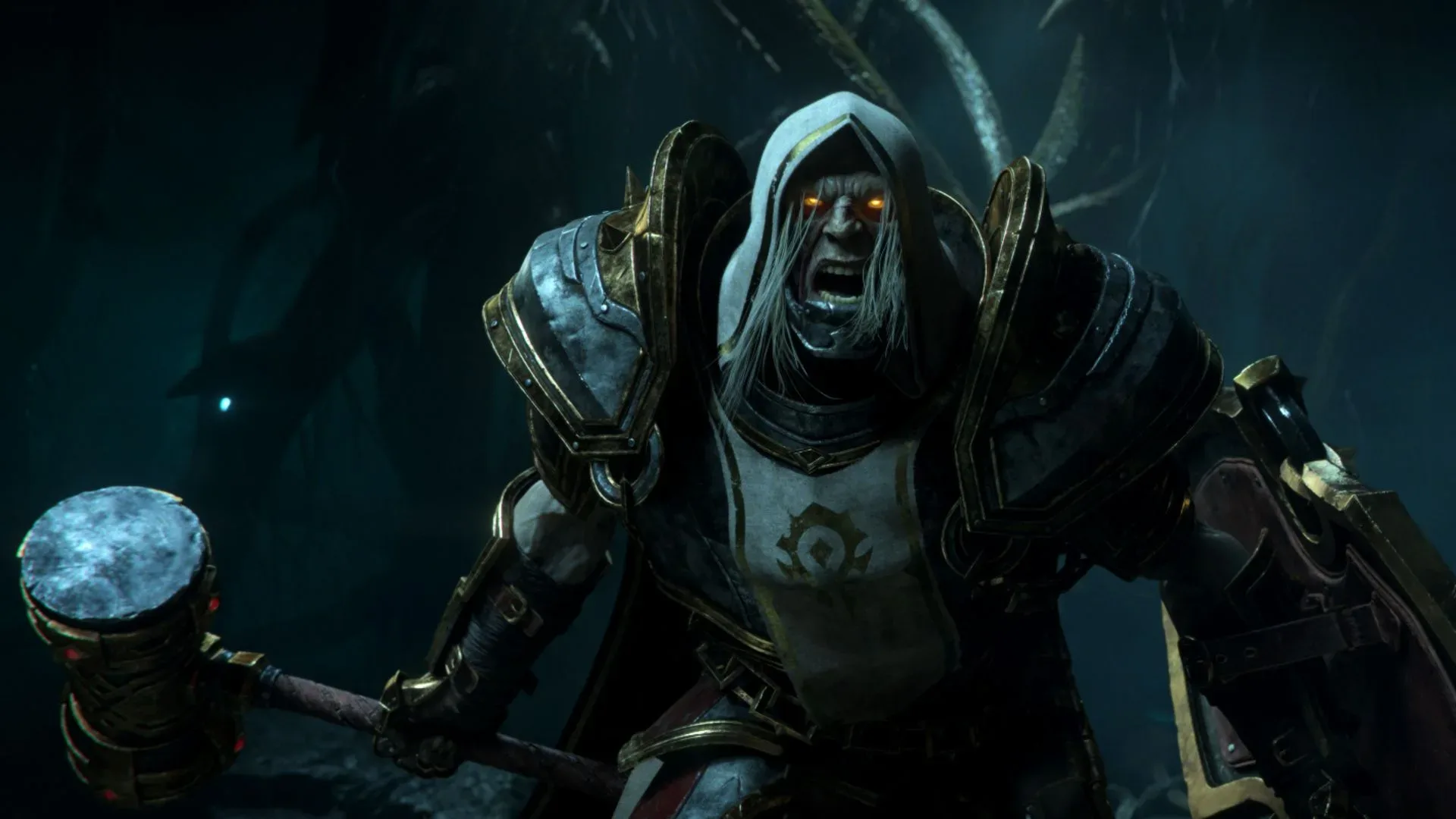
World of Warcraft: Forever will not adopt shared enemy tagging or shared drops from modern World of Warcraft. The decision is deliberate rather than a missing convenience feature: Blizzard developer Josh Greenfield has described the limitation as a line the team “simply must hold” to protect the new mode’s social foundations.
That stance will be immediately familiar to anyone who has arrived at a crowded quest area only to find a cluster of players waiting for the same enemy spawn. In Forever, competition for a target can mean waiting, racing another player to land the first hit, or—crucially—forming a party so everyone involved can receive credit. It can be frustrating when the objective is merely collecting a few mundane quest items. Blizzard’s argument is that the annoyance is also what prompts players to acknowledge one another, coordinate, and sometimes make a temporary group.
Forever is currently in beta and has attracted enough players that those moments of bottlenecked questing are already prominent. The full version is scheduled for November 4 and will be included with a World of Warcraft subscription. Beta access is tied to the $60 Skyborne pack, with play capped at level 20.
What shared tagging changes
Tagging is the basic MMO rule that determines which player or group owns credit for defeating an enemy. Under the older style of system, the player or party that first establishes a valid tag normally receives the quest progress and loot eligibility. Other nearby players may help defeat the monster, but helping does not necessarily mean sharing the reward.
Modern World of Warcraft uses a more generous system in many outdoor situations. Multiple players can tag the same enemy, subject to a limit, and each eligible participant can receive the relevant rewards. That is particularly useful for quests, farming activities, and rare enemies that appear in the open world. A passer-by does not have to interrupt what they are doing to ask for a group invite, and a player who arrives moments late is less likely to be left empty-handed.
Shared drops, in this context, are the companion idea: players who contribute to defeating a commonly tagged target can receive their own rewards rather than fighting over a single player’s claim. Together, shared tagging and drops reduce the downside of playing solo during outdoor content. They also make it far easier for a large crowd to tackle one spawn without turning it into a contest over who touched it first.
That convenience is exactly what Forever is declining. Greenfield acknowledged why the feature looks attractive when someone is stuck at an overpopulated quest objective, but argued that keeping “some of this friction” is extremely important to the game’s social pillar.
“Group up and get it done together.”
Related coverage includes WoW Forever Team Draws a Firm Line Against Shared Tagging.
That is the proposed answer for players caught in a crowd: not a system change that makes everyone independently eligible, but a group that transforms rivals into teammates. It is a compact design philosophy, and one that makes Forever’s intended identity clearer than a broad promise of being Classic+ ever could.
Why a small inconvenience can be a major design choice
MMOs are not social merely because hundreds of characters can occupy the same zone. The important question is what their rules ask those characters to do when their interests overlap. A shared-tagging system permits people to cooperate silently, or simply coexist. That can be efficient and considerate. It also means players have fewer practical reasons to communicate with strangers while progressing through outdoor quests.
A restrictive tag system creates a different sequence. A player sees another person pursuing the same enemy, sends an invite, completes the objective, then chooses whether to remain together for the next objective. No enduring friendship is guaranteed, and plenty of those groups will last only a few minutes. But the system repeatedly creates the opportunity for social contact.
That distinction is at the center of Blizzard’s position. Forever is not treating grouping as something reserved for dungeons, raids, or other high-end organized content. It is trying to make ordinary open-world errands capable of starting a social interaction too. The boars, bones, rare spawns, and other routine targets matter because they are where most players spend the greatest amount of time early on.
There is a meaningful trade-off. Shared tags can reduce resentment, especially when a busy zone means someone repeatedly loses targets to faster players or waits for respawns. They are also friendly to players who have limited time, prefer a solo pace, or simply want to complete a straightforward task without negotiating group membership. Removing that accessibility is not automatically more social in every individual case. A player can be annoyed enough by the contest to disengage rather than start a conversation.
Forever’s team is effectively betting that the benefits of repeated, low-stakes cooperation outweigh those costs. It is also betting that a degree of scarcity and contention makes the world feel more inhabited. When another player can directly affect whether an objective is available, that player becomes a meaningful presence rather than background scenery.
A Classic+ identity built around restraint
The phrase Classic+ generally signals an attempt to build on an older version of an online game without simply importing every convenience and structural change from its current form. The difficult part is deciding what to add and what to preserve. New content or adjustments can be welcome, while a seemingly modest quality-of-life tool can undermine the qualities the project is meant to retain.
Forever’s shared-tagging decision is an unusually direct example of that restraint. The team is not claiming the retail approach fails at its own goal. On the contrary, shared tags solve the exact problem they were designed to solve: allowing many people to complete outdoor objectives efficiently without a forced group. But efficiency is not the sole objective for Forever.
Blizzard’s stated priority is a social world where players are encouraged to work together outside formal group activities. That is why the team views friction not solely as a defect, but as a tool. In design terms, friction is any obstacle that slows the direct route to a reward. It can be a long trip, a difficult encounter, a scarce resource, or, here, another player who wants the same target.
Friction is not inherently good. Too much can turn an MMO’s shared world into an exhausting queue. Too little can make other players functionally irrelevant. The crucial question for Forever will be whether its contested objectives are frequent enough to foster cooperation but manageable enough that players can still make steady progress. The beta’s popularity is already putting that balance under pressure, because high population makes every limited spawn more visible.
In that sense, the current complaints are not merely about one feature. They are an early stress test of the project’s promise. A crowded beta is precisely where shared tagging would feel most helpful—and precisely where Blizzard believes the older approach has its strongest social value.
Community reaction points to a familiar divide
The immediate response highlighted meaningful support for the decision. Some players praised the Classic team’s willingness to retain the limitation, while another response argued that shared tagging taught players to pay less attention to one another and made the experience less social. That reaction aligns closely with the developers’ reasoning: the mechanic changes player behavior, not just reward distribution.
It would be a mistake, though, to frame the choice as a simple split between players who want a social game and players who do not. The case for shared tagging can also be social. It lowers the chance that strangers see each other as enemies racing for a spawn, and it lets players assist one another without first sorting out a party. Modern shared-credit systems can turn a chaotic crowd into a cooperative mass, even if little conversation occurs.
The real disagreement is over what kind of sociability Forever should encourage. Its answer favors intentional, direct cooperation: invites, temporary parties, and the possibility that a quick objective turns into a longer shared session. Shared tagging favors ambient cooperation, where players can help and be helped with minimal coordination. Neither system prevents community from forming, but they create very different rhythms.
For Forever, the chosen rhythm will make leveling feel distinct from the retail game. Players should expect quest zones to involve more attention to nearby characters and more reasons to send or accept group invitations. They should also expect occasional delays and competition, particularly wherever the beta’s active population converges on the same objective.
What players should expect in beta and at launch
Players entering the level-20 beta should approach crowded objectives with Forever’s rules in mind. If several people need the same enemy, grouping is the supported path to shared progress. Waiting for a target alone or trying to tag it first remains possible, but it is the route Blizzard is explicitly declining to smooth out through retail-style sharing.
- Expect contested quest targets: outdoor enemies and rare spawns can become focal points when many players share the same goal.
- Use temporary groups: a short party can let multiple players finish an objective together instead of repeating a race for every spawn.
- Do not assume retail rules apply: being nearby or contributing damage does not necessarily establish individual reward eligibility in Forever’s Classic-oriented approach.
- Watch population pressure: a system that feels manageable in a lightly populated area can feel much harsher when a popular beta funnels players into the same early zones.
There is also a larger practical message in Blizzard’s response: players should not expect every longstanding retail convenience to arrive simply because it would remove a moment of irritation. Forever is defining itself partly by the systems it refuses to modernize. That may appeal to players who want an MMO that regularly asks them to depend on other people, while frustrating those who see shared credit as a basic courtesy in a crowded online space.
As the November 4 launch approaches, the discussion around tags and drops will likely remain a useful measure of whether players accept that bargain. A popular beta can prove demand, but it can also magnify every inconvenience. Blizzard has made clear that, on this point, popularity will not change the intended direction: the crowd at the boar spawn is not a problem to be engineered away. It is part of the social game Forever wants players to play.
For more PC-focused coverage beyond Azeroth, see our report on the Acemagic K1 mini PC listing for indie and retro gaming.