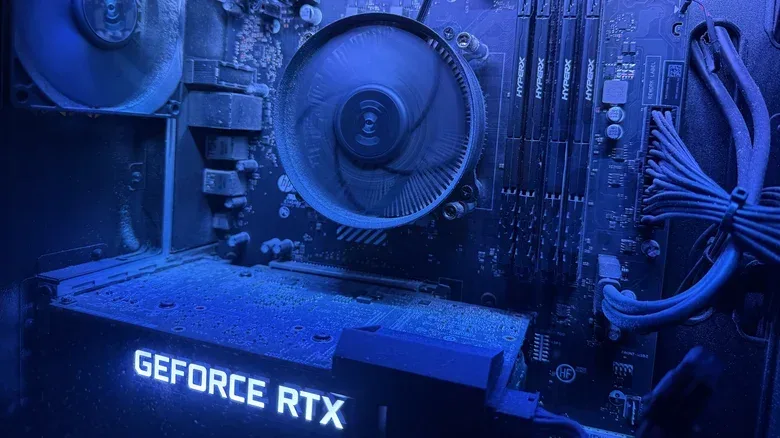
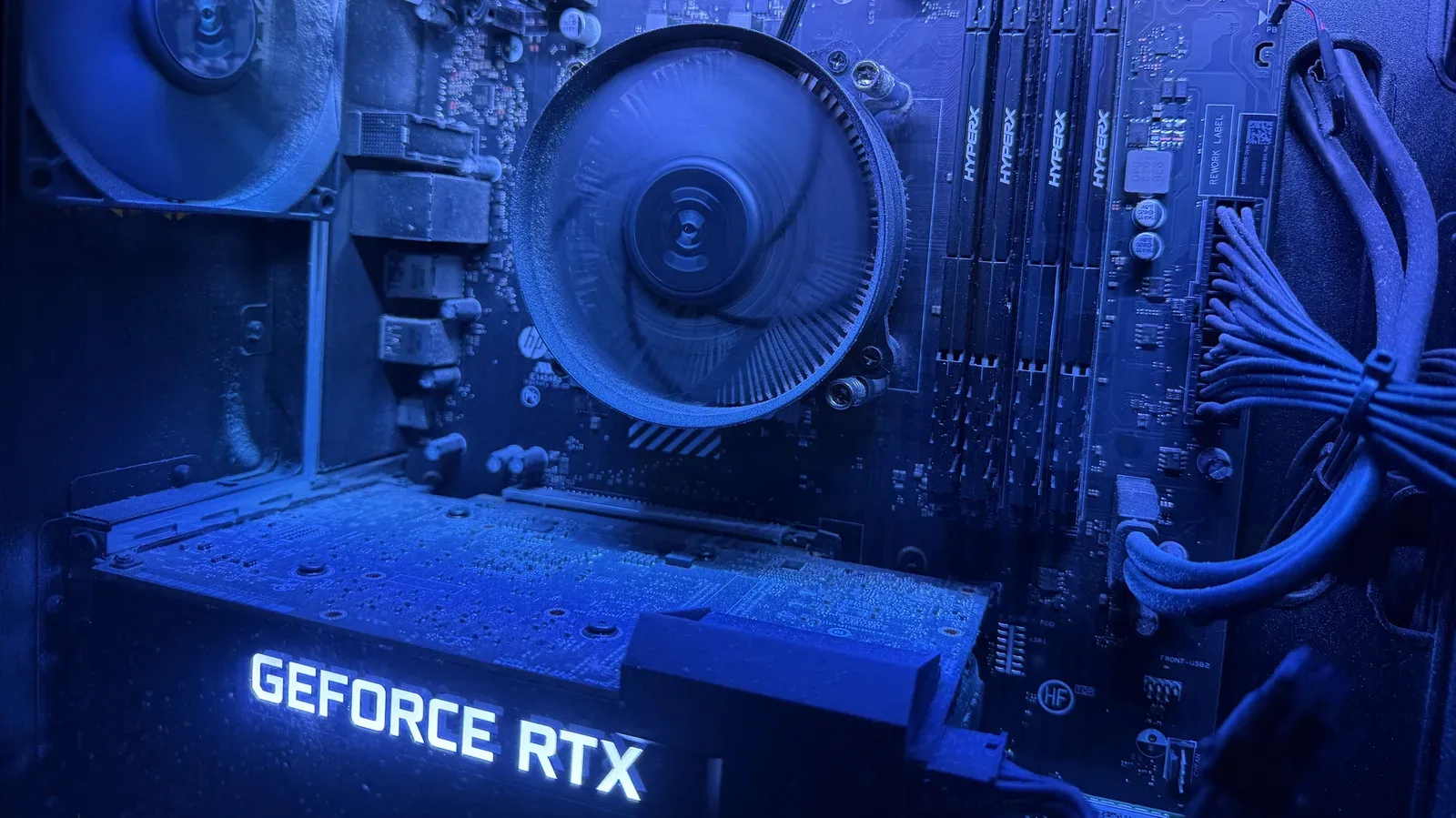
A gaming PC graphics card is deliberately conspicuous: a separate board, its own cooling, and dedicated video memory installed in a motherboard slot. PlayStation 5 and Xbox Series X take a very different physical route. Their graphics work and central processing work live together in a single AMD-designed chip beneath the system’s cooling hardware.
That contrast leads to a common but unhelpful question: what PC graphics card is “the same as” a console? There can be a reasonable approximate answer—AMD’s Radeon RX 6700 is often treated as a near neighbor for the base PS5—but it is never a complete performance verdict. Console and PC hardware share fundamental Radeon technology, yet their memory arrangements, software targets, and upgrade paths are substantially different.
The practical result is that a console may outperform a seemingly comparable PC part in one game, while the PC wins comfortably in another. That does not necessarily mean either platform’s specifications are misleading. It means specifications need context.
The core distinction: a console uses an integrated chip
Xbox Series X combines an eight-core CPU and a graphics processor containing 52 compute units on one 360.45-square-millimeter piece of silicon. This type of integrated design is commonly called an APU, short for Accelerated Processing Unit, or a system on a chip (SoC).
A compute unit is a major block of a Radeon GPU that performs graphics work. More compute units can provide more graphics throughput, but the count alone does not settle how a game will run. Architecture, clock behavior, memory access, rendering features and the game’s own engine all matter.
A conventional gaming PC divides the same broad jobs among separate components. The CPU is installed on the motherboard; the GPU is a separate card. The graphics card also has its own VRAM, or video memory, positioned for rapid access by the GPU. This separation makes a desktop PC modular. A player can replace a graphics card without replacing the CPU, or make other targeted upgrades.
A console’s tightly integrated design trades that modularity for a known, fixed platform. Its graphics hardware is not a part owners can swap out later. But developers know exactly what they are programming for across every standard console of the same model.
Unified memory is flexible, but it is not dedicated VRAM
On Xbox Series X, the CPU and GPU draw from the same 16GB memory pool. The operating system reserves 2.5GB, leaving games 13.5GB to allocate between graphics needs and the rest of the game. Textures, geometry and other visual data must share that budget with CPU-side tasks.
That is known as unified memory. It lets developers decide how much of the available pool should serve graphics at any given point rather than locking the machine into a permanent split between system RAM and VRAM. A game with modest graphics-memory requirements may have more room available for other tasks; a visually demanding scene can be allocated differently.
PC hardware normally works with two separate memory pools. A compact Steam Machine configuration, for example, has 16GB of system RAM and 8GB of VRAM attached to its GPU. The division is straightforward: the GPU has a dedicated 8GB allocation, while the rest of the system uses its main memory.
Dedicated VRAM is important because graphics processors need very fast access to the material used for rendering. If a PC game requires more video memory than its GPU contains, excess data can spill over into ordinary system RAM. The graphics card can access that memory much more slowly, which can show up as texture pop-in, delayed asset loading or stutter.
That does not make unified memory universally superior. It means the platforms confront memory management differently. On a console, developers can plan around the exact shared memory arrangement available in every target unit. On PC, developers must account for machines with widely different VRAM capacities, system-memory capacities, GPUs and drivers.
Semi-custom does not mean off-the-shelf
Modern console chips are built specifically for their platforms. Sony’s PS5 Pro is an especially clear example of why a console GPU cannot be reduced neatly to a retail PC GPU name. Its graphics design has been described as RDNA 2.x: it uses an RDNA 2 base associated with the original 2020 PS5, incorporates elements associated with the subsequent RDNA 3 generation, and includes ray-tracing capabilities that were not present in AMD cards at the time.
The PS5 Pro GPU also has 67% more compute units than the standard PS5 GPU. Even so, its design was not simply replaced wholesale with a newer desktop-oriented architecture.
The compatibility reason is crucial. Shaders are small programs that tell the GPU how to render aspects of an image, including materials, lighting and effects. PS5 games ship with shaders compiled for the original PS5’s precise GPU behavior. A move to an all-RDNA-3 implementation would have run those programs differently, creating a situation in which studios could need separate game versions for the PS5 Pro.
Keeping RDNA 2 as a foundation allows existing PS5 games to run on the Pro without being rebuilt. This is an example of console design priorities extending beyond a raw specification race. Compatibility with the established software library matters as much as adding more graphics resources.
Fixed hardware can reduce shader compilation pain
Every standard PS5 has the same graphics configuration. That uniformity gives studios the opportunity to prepare shaders before release for a known device. A PC release has a much larger matrix to contend with: different GPU models, driver versions and system configurations can require different compiled shader results.
When a PC title compiles shaders on first launch—or while a player is moving through the game—the process can add substantial loading time or produce hitching during play. Shader-compilation stutter is not a measure of the GPU’s theoretical speed; it is a software-delivery and compatibility problem that fixed consoles can often avoid more readily.
Windows is starting to adopt more of that console-like preparation. Microsoft’s Advanced Shader Delivery downloads precompiled shaders alongside compatible games. Microsoft has said that, in its measurement, Forza Horizon 6 loaded in four seconds using the feature, compared with nearly a minute and a half without it. The significance is broader than a single loading figure: getting the correct shader work done before the player reaches a game can reduce a recurring PC friction point.
PC players still benefit from the platform’s flexibility, including adjustable settings and component upgrades. But the cost of that flexibility is that game makers cannot assume a single, immutable hardware target.
Why direct frame-rate comparisons can reverse
Testing has shown the limits of treating an RX 6700 and a PS5 as identical. In Hitman 3, the RX 6700 was reported as up to 44% faster than PS5. In Cyberpunk 2077 with ray tracing enabled, the PS5 was reported as 45% ahead. Similar underlying technology, radically different outcome.
Ray tracing is a rendering technique used to model how light behaves, often improving reflections, shadows and lighting effects. It can be computationally demanding, so its implementation and optimization can shift the balance strongly between systems.
The lesson is not that benchmarks are useless. It is that a benchmark answers a narrowly defined question: how did this game, with these settings and features, perform on these systems? It cannot establish a permanent hierarchy for every game. A high-end PC can exceed consoles in graphics performance, but a console game tailored tightly to its fixed chip can draw unusually strong results from mid-range-class hardware.
Upscaling also illustrates the continuing flow of ideas across platforms. The AI upscaler used to sharpen PS5 Pro games emerged from Project Amethyst, a Sony-AMD partnership. Its related work reached PC players first as FSR 4. Hardware categories are distinct, but their techniques and architecture work do not remain isolated.
What this means when choosing a platform
For a buyer, a console’s appeal is consistency. The machine has a fixed target, games are developed around it, and the system does not require choosing a CPU, GPU, RAM combination or future graphics-card upgrade. A PC’s appeal is optionality: the GPU can be replaced, and the broader system can evolve over time.
The price gap is also less straightforward than the old assumption that consoles are always dramatically cheaper. The PS5 has started at $599.99 since April, while the least expensive Xbox Series X is $749.99. A PC matching the cited Steam Machine configuration has been assembled for just under $900. Memory and storage costs have been cited in Xbox price increases, and the same supply pressure has made affordable GPUs harder to find.
None of those figures converts the decision into a universal equation. They do, however, make it more important to compare a specific console package with a specific PC configuration, rather than comparing a launch-era console price to an arbitrarily expensive enthusiast PC.
Custom console silicon also appears set to continue. AMD chief executive Lisa Su said in February that the next Xbox semi-custom chip was progressing toward a launch the following year. That matters because the central trade-off remains intact: PCs provide separable, upgradeable components; consoles integrate CPU and GPU resources into a purpose-built, stable target.
So the most accurate answer to “console GPU versus PC GPU” is not that one is secretly the other. They are related Radeon-based approaches built around different priorities. PCs reserve a graphics card and VRAM for the GPU, while consoles use a shared chip and shared memory budget. From there, fixed hardware, shader preparation, compatibility decisions and game-specific optimization determine far more than a single compute-unit count ever could. For another approachable look at an easily overlooked piece of PC hardware design, see our explainer on the small locking holes on USB-A plugs.