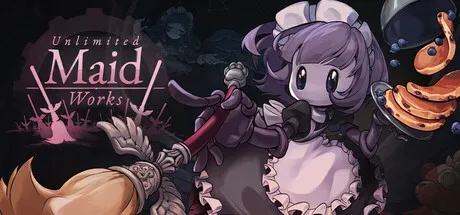
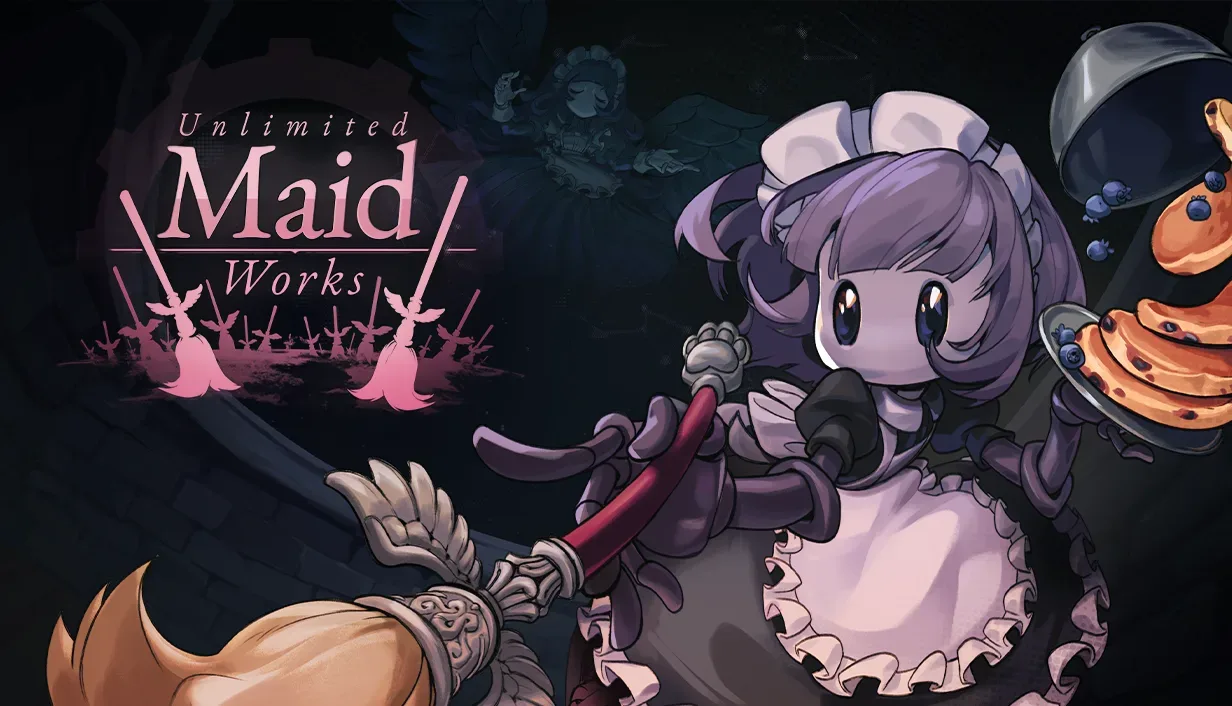
Clumsy Tails has announced Unlimited Maid Works, a roguelike sandbox built around a premise games rarely make central: taking household contracts, keeping homes in order and adapting to the demands of very different employers. The game is planned for Steam wishlists, with its core loop focused on a maid assigned to a house and its Master, then tasked with keeping the place functional, clean and comfortable.
The work itself covers a broad domestic checklist. Players will dust, sweep, vacuum, clean furniture, look after plants and pets, and keep rooms and floors spotless. But Unlimited Maid Works is not presented as a simple chore-by-chore simulator. Each contract pairs the player with a particular household and Master, whose personality and living conditions affect what work is required. That setup suggests the central challenge is not merely finishing a familiar task list, but determining what a particular home needs and responding as circumstances change.
A roguelike built around employment contracts
“Roguelike” can mean many things, but the announced structure gives the term a clear role here. A run appears to be tied to taking a job contract and managing the consequences of performance. Failure is not simply a low score or a reset: repeatedly falling short can result in being fired. After that, the player can move to a new job, take over a contract someone else failed, or return to the Maid’s Hub.
That makes employment status part of the game’s progression structure. Instead of treating a household as a static level to complete once, Unlimited Maid Works frames it as a placement that can succeed, collapse or be replaced. The option to inherit another maid’s unsuccessful contract is especially notable because it implies contracts can carry a sense of ongoing difficulty rather than existing as isolated assignments.
There is also a longer-term alternative to constantly changing employers. Players who remain with one Master across multiple contracts can see that Master’s career and home develop. New rooms and new challenges are added as the household grows. In practical terms, this promises a tension between pursuing fresh contracts and investing in an established relationship with a single home. A familiar house may become easier to understand, but expansion means familiarity does not necessarily mean simplicity.
Cleaning is only one part of running a home
The announcement describes several interconnected systems beyond cleaning. Players can acquire produce and cook meals to keep their Master fed, procure furniture sets for homes, and choose upgrades that improve their maid’s capabilities. Furniture is not solely decorative: sets are said to provide gameplay effects. That is an important distinction in a management game, because arranging a room may become a mechanical decision as well as an aesthetic one.
In other words, a successful household may depend on balancing immediate maintenance against preparation. A floor can be swept, but food supplies may need attention; a room can look tidy, but a furniture choice could influence how the household functions. The available information does not specify the exact effects of furniture, the form upgrades take, or how cooking resources are obtained, so those details remain to be seen. Still, the stated systems point toward a house-management loop with multiple priorities competing for attention.
That broader approach helps explain the game’s “sandbox” label. The household is not described as a single-use stage with a fixed solution. Players will be able to decorate and improve it, develop their character through upgrades, and make choices about contracts and employers. The systems described so far suggest a space where players set goals within the demands of each job rather than simply following one prescribed path.
Related coverage includes Unlimited Maid Works Reveals Roguelike Household Management on Steam.
What the Maid’s Hub and Unions add
Unlimited Maid Works also includes a social layer. The Maid’s Hub is described as a place to check leaderboards and customize a maid, creating a break between jobs where players can assess performance and adjust their character. Global leaderboards will let players compare their results with the wider community.
The game additionally plans Maid Unions, which players can join or lead. The announcement does not yet explain what benefits, responsibilities or cooperative features those groups will have. It would be premature to assume they function as guilds, teams or trading groups. What is confirmed is the ability to form or enter these player-facing organizations, alongside the leaderboard system.
For a game about precarious contracts and the possibility of dismissal, the union theme is a fitting social counterpoint. It may give the game’s otherwise individual household work a communal identity, although its practical role will depend on details Clumsy Tails has not announced.
Why the contract structure matters
The household-management premise has room for a distinct kind of pressure. In combat-focused roguelikes, a run often revolves around survival, enemies and build choices. Here, the stated risks and rewards are domestic and professional: meet the needs of a changing house, maintain a relationship with a Master, make upgrades, and avoid a performance spiral that ends in termination.
That does not make the game low-stakes. Being fired creates a meaningful failure condition, while the ability to take another job or assume a failed contract means a setback is folded into the larger career rather than necessarily ending the whole experience. The game’s progression appears to be designed around adapting after failure as much as excelling within a stable job.
There is a useful comparison point in the broader Steam landscape of games that organize play into repeatable runs and persistent advancement. For another example of a title built around repeatable dungeon runs, see Delve Survivors’ Steam launch. Unlimited Maid Works takes the repeatable-run idea in a markedly different direction: homes, chores, employers and career progression rather than dungeon combat.
What has and has not been confirmed
Clumsy Tails has confirmed the game’s Steam wishlist presence, the contract-based household setup, domestic tasks, furniture effects, cooking, maid upgrades, firing and job changes, household growth, leaderboards, customization and Maid Unions. Those are the clearest foundations for understanding the project at this stage.
However, no release date, price, supported platforms beyond Steam, exact multiplayer details, or detailed breakdown of upgrades and furniture effects has been provided in the announcement. The scope of the roguelike elements is likewise not fully defined: the available information establishes failure and changing contracts, but does not outline every rule governing progression between jobs.
The early pitch is nonetheless unusually specific about its priorities. Unlimited Maid Works is not just using domestic work as a visual theme. Cleaning, cooking, furnishing, career stability and an employer’s expanding household are all positioned as gameplay systems. For players interested in management games with a more intimate setting—and in roguelike progression that treats a lost job as a detour rather than a dead end—that combination is the aspect to watch as more details emerge.