
JOHN GLEEP has launched on Steam, bringing a tiny alien casino operator, a galaxy-sized mob debt and an unusual collision of UFO flying and pachinko-inspired roguelike action to PC. Released by offbrand games and monthbug, the game is priced at $11.99, or the local-currency equivalent, and has a limited-time 20% launch discount.
Its premise is appropriately unruly: John Gleep’s casino is failing, he owes the mob a galaxy, and the proposed solution involves traveling from planet to planet in a UFO and abducting gamblers. Those abducted citizens are intended to help revive the business, creating the basic loop that links planetary action with casino management and the game’s ongoing sci-fi crime-drama narrative.
A Steam demo is available for players who want to establish whether this particular brand of spacefaring casino panic is for them before buying. The release is also accompanied by a launch trailer and press materials.
A two-screen premise built around two kinds of chaos
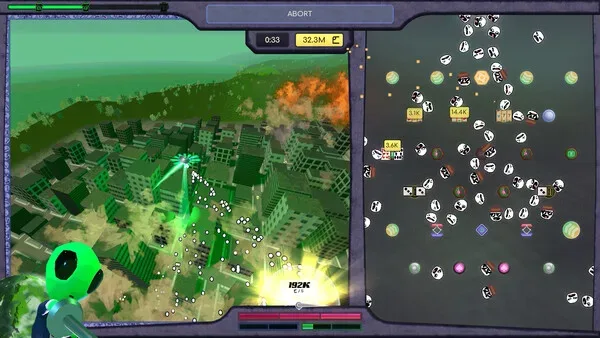
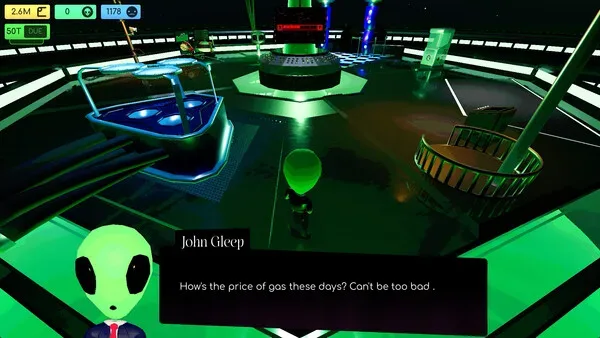
JOHN GLEEP describes itself as a dual-screen blend of UFO piloting and pachinko roguelike play. In practical terms, its concept is not simply “a casino game in space” or “an alien-abduction game with a minigame.” The announcement positions both sides as central parts of the experience: players pilot the UFO across planets, capture citizens and evade attacks, while also handling the casino-oriented pachinko action that fuels the larger operation.
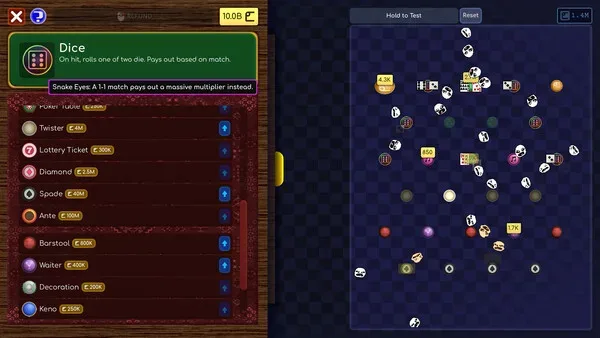
Pachinko is a ball-and-pegs format in which a dropped ball ricochets through an arranged board. Here, the genre reference is important because JOHN GLEEP advertises more than 50 pegs that can be used to personalize a player’s setup. Rather than presenting a fixed board alone, the game is built around adjusting the mechanisms that shape those bouncing-ball outcomes.
The “roguelike” label likewise signals a structure focused on repeated attempts, shifting circumstances and accumulating progression rather than a single unchanging sequence. The announced feature list includes multiple permanent upgrade systems, suggesting that advancement is intended to carry forward as the player works through the game’s volatile combination of piloting, casino maintenance and story developments.
That split personality may be the game’s defining hook. The flight portion is concerned with movement through planetary spaces and the immediate danger of attacks. The casino portion turns attention toward setup, outcomes and the state of the business. JOHN GLEEP also promises distractions including bomb defusal and bug squashing, framing its central objective less as smooth operational management than as an escalating effort to keep several disasters from becoming one large disaster.
What players will be doing
The announced gameplay loop begins with flying between planets in John Gleep’s UFO. On those trips, players abduct gamblers while avoiding hostile attacks. Those recruits support the casino, which in turn is part of the protagonist’s effort to pay down what is described as a debt to the mob measured on a galactic scale.
Beyond the broad objective, the game calls out several activities and systems:
- UFO piloting: Travel across planets, abduct citizens and avoid incoming threats.
- Pachinko-style action: Build and use a board setup centered on pegs and bouncing-ball outcomes.
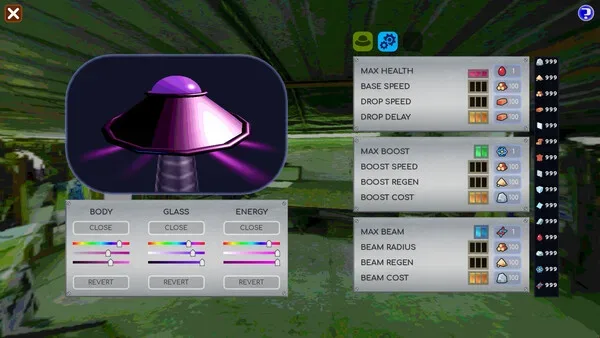
- Permanent upgrades: Several progression systems are intended to unlock and expand over time.
- Gadget unlocks: More than 100 gadgets are advertised.
- Peg customization: More than 50 pegs are listed for personalizing the pachinko setup.
- Casino crises: The game includes management pressures and interruptions such as defusing bombs and squashing bugs.
- Binko Racing: This named activity is included among the announced features, though its specific rules have not been detailed.
The gadget and peg counts point to a game that wants players to experiment with their equipment and board composition, not merely survive one sequence of alien errands. However, the announcement does not specify how individual gadgets work, how the permanent upgrade systems are divided, or exactly how Binko Racing fits into the wider campaign. Those remain details for the demo and the released game to clarify.
A crime drama that is deliberately silly
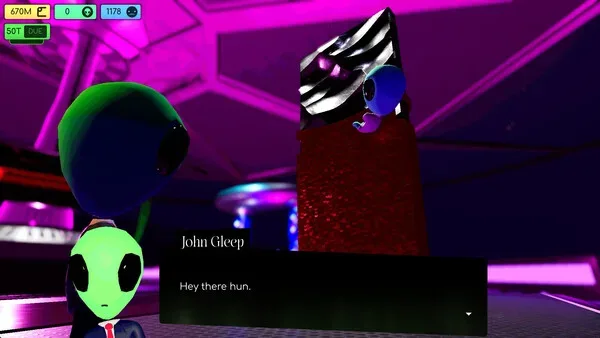
The narrative premise is grounded in a recognizable pressure: a debtor needs money before organized crime comes calling. JOHN GLEEP makes that setup deliberately absurd by turning the debtor into a small alien, the business into a casino and the debt into an entire galaxy. The game promises silly characters alongside unpredictable sci-fi crime-drama twists, so its tone appears to be one where the stakes are technically enormous but the route through them is intentionally comic and strange.
That framing matters for the game’s many jobs. Abducting gamblers, fending off attacks, repairing operational chaos and tinkering with a pachinko board could otherwise read as separate ideas competing for attention. The failing-casino story gives them a common motive: every task exists because John Gleep is trying to keep a business alive long enough to satisfy an impossible obligation.
The title character is also explicitly counted among the game’s features, a tongue-in-cheek inclusion that fits the presentation. For a project named JOHN GLEEP, the presence of John Gleep is perhaps the least surprising news of the launch, but it signals an approach that is comfortable treating its own bizarre premise as part of the joke.
Price, launch discount and bundle details
JOHN GLEEP’s standard Steam price is $11.99, with local pricing where applicable. The launch promotion cuts that price by 20% for a limited time. No end date for the promotion has been specified in the available launch information, so interested players should check the Steam listing for its current status.
There are also “Complete The Set” bundles offering a 10% reduction on the games contained in each bundle. Importantly, the bundle discount can stack with the temporary 20% launch discount. For players who already own a game included in one of those bundles, the stated arrangement is that they pay only the difference rather than being charged again for a title already in their library.
That makes the demo particularly useful for anyone weighing the game alongside a bundle. It offers a lower-commitment route to assess the core mix of piloting and pachinko before deciding whether the base purchase or a discounted set makes sense. For more reporting on PC releases and developments, see our latest PC gaming news.
Ludwig Ahgren’s role and creator outreach
Ludwig Ahgren is supporting JOHN GLEEP’s release through playtesting, feedback and design recommendations, as well as stream and social content intended to market the game. The launch information attributes an overall reach of roughly 18 million to Ahgren.
It is worth separating those roles. Playtesting and feedback concern development input, while streaming and social posts are promotional channels that can introduce a game built around chaotic, readable systems to a broader audience. A title whose activity can shift from UFO escapes to bouncing-ball setups to sudden casino emergencies is naturally suited to clips and live reactions, but the release information does not identify any particular stream schedule, content dates or design changes resulting from the feedback.
Offbrand Games has also announced the Offbrand Games Partner Program, a new program for streamers and content creators. No eligibility criteria, benefits or participation process were included in the launch material, so creators interested in it will need to watch for further details from the company.
Who JOHN GLEEP may appeal to
JOHN GLEEP is aimed at players open to genre mixtures rather than a narrowly defined simulation or action game. Its advertised appeal rests on several connected ideas: immediate UFO maneuvering, repeated roguelike progression, a customizable pachinko system and an offbeat narrative about a casino owner being squeezed by the mob.
Players looking for a fixed, serious space adventure should note that the game’s stated personality is much more mischievous. Bombs, bugs, alien abductions and Binko Racing are not presented as occasional side notes; they are part of the intended texture of the experience. Conversely, players interested in systems that can be expanded with a large set of gadgets and board components may find the combination of permanent progression and customization worth investigating through the demo.
The key unanswered questions are about balance and detail rather than the premise. The launch information establishes the game’s major activities and its broad upgrade totals, but does not lay out the pace of a run, the exact consequences of failure, or the mechanical relationship between every casino and UFO system. What is clear is the guiding fantasy: make a rickety interplanetary gambling enterprise function, one abducted customer and one ricocheting pachinko ball at a time, before the debt collector decides the casino’s closing night has arrived.