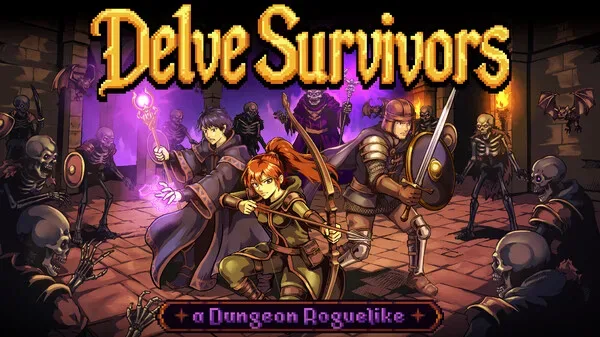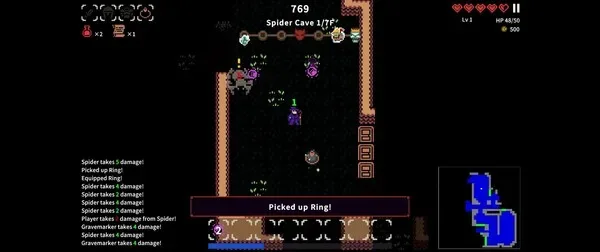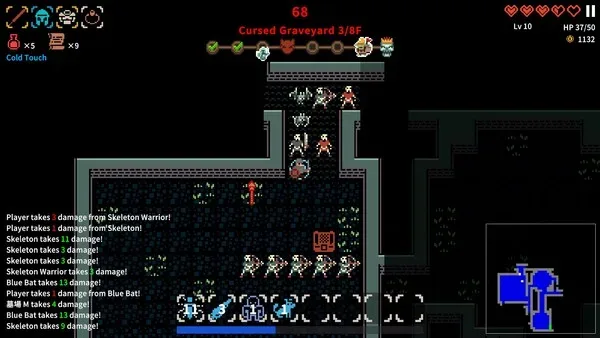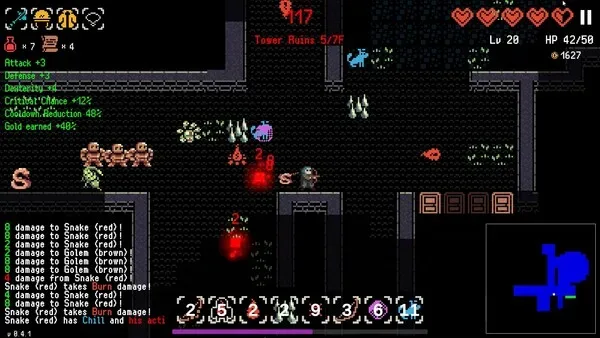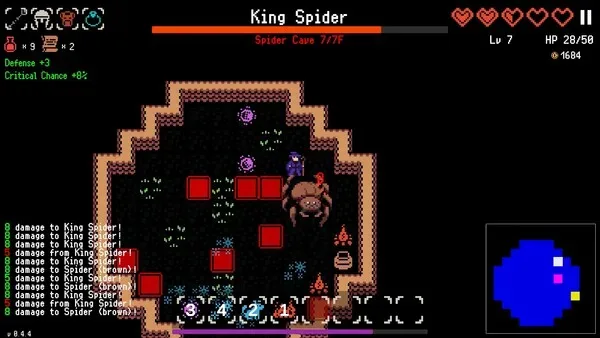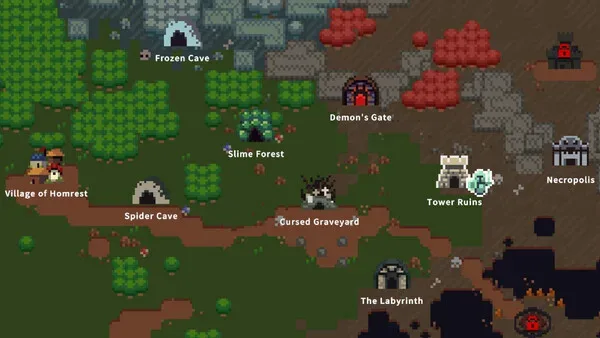

Delve Survivors is now available on Steam. The retro-inspired dungeon roguelike combines turn-based decision-making with the escalating pressure of survivor-style hordes, asking players to think through movement and positioning while facing large groups of enemies.
Its central pitch is an intentionally contrasting one. Traditional turn-based strategy gives players time to assess a battlefield, weigh a route and decide which action is worth taking. Survivor-style games, meanwhile, are usually associated with mounting enemy numbers and a constant need to improve a character’s offensive and defensive options. Delve Survivors brings those ideas into randomly generated dungeons where survival, loot and build choices are closely linked.
The game has drawn comparisons at Tokyo Game Show to Crypt of the NecroDancer and Vampire Survivors. That is a useful shorthand for the kind of experience being described, but it should be read as a player comparison rather than a promise that Delve Survivors duplicates either game’s systems. The confirmed fundamentals are turn-based strategy, enemy hordes, procedural dungeons, loot, and a selection of skills and abilities.
A dungeon run built around deliberate choices
Turn-based combat means that actions are resolved in discrete steps rather than through uninterrupted real-time input. In practical terms, the important question is not merely whether a player can react quickly, but whether they can choose an effective action before committing to it.
That matters more when enemies arrive in numbers. A horde turns a simple movement decision into a tactical problem: advancing may open access to loot, while retreating may create breathing room; a chosen attack may remove an immediate threat, while another choice may better preserve a route through the dungeon. Delve Survivors frames this planning against the danger of being overwhelmed.
The available description does not set out exact combat rules, progression maths, character classes or how individual abilities function. Still, the stated focus on planning every move suggests that positioning and sequencing are core considerations rather than decorative additions around automatic combat. Players looking for a pure action game should take note of that turn-based foundation, while strategy-minded players may find the horde format an appealing source of pressure.
What “roguelike” and random generation mean here
Delve Survivors is described as a dungeon roguelike with dangerous randomly generated dungeons. “Randomly generated” generally refers to game spaces that are assembled differently from one run to another instead of presenting one fixed dungeon layout every time. The confirmed implication here is variation in the dungeons players explore; no further specifics have been provided about the range of layouts or other elements that may vary.
The roguelike label establishes the broad dungeon-run structure, but it does not, by itself, confirm every convention players may associate with the genre. In particular, the supplied details do not establish how a run ends, whether defeat involves permanent loss of a current run, or what long-term progression may exist. Those are important distinctions for players deciding what kind of commitment the game expects, so it is best not to assume them from the genre term alone.
Related coverage includes Delve Survivors Launches on Steam With Turn-Based Roguelike Horde Combat.
What is clear is that danger and discovery are meant to coexist. Each dungeon is a place to fight through enemies, search out useful rewards and try to assemble a stronger set of options before the threats become too difficult to manage.
Loot, skills and abilities are the stated route to stronger runs
Loot is presented as a way to improve a player’s odds. In a run-based dungeon game, this normally makes rewards part of the immediate tactical calculation: an item is valuable not only because it is found, but because it may change the choices available against the next group of enemies. Delve Survivors also promises different skills and abilities to “mix things up,” pointing to room for varied approaches rather than a single fixed combat pattern.
The key word is synergy: the way separate tools can complement each other. Delve Survivors has not detailed particular skill combinations, so there is no basis to identify a best build or specific strategy. But the combination of loot and selectable abilities signals that players will be encouraged to adapt their approach as a dungeon develops.
That is especially relevant in a game marrying turn-based play to survivor-style swarms. A build is not only about dealing more damage. Depending on the systems involved, its value can also lie in helping a player manage space, control the order in which threats are addressed, or make a dangerous route more manageable. Those are analytical possibilities arising from the announced design rather than confirmed feature specifics, but they explain why loot selection and ability choices should be central to the game’s appeal.
The appeal of putting a pause between the panic
Survivor-style design is often defined by a rapidly intensifying screen of enemies and the satisfying power curve that comes from collecting upgrades while trying to stay alive. Delve Survivors preserves the horde-side pressure while adding a turn-based cadence. Rather than treating thoughtfulness and chaos as mutually exclusive, it uses the horde as the consequence of a series of choices.
That setup can make failure feel more legible. If a player becomes trapped or cannot overcome an enemy mass, the question may be less about a missed split-second input and more about earlier positioning, a risky detour for loot, or an ability choice that did not suit the situation. Conversely, a successful escape or clear can feel like the result of planning under stress rather than simply outlasting a wave.
It is also a potentially inviting format for players who enjoy the escalation and experimentation associated with survivor games but prefer time to evaluate the board. The retro presentation and dungeon setting give the concept a familiar frame, while the mix of strategic turns and large enemy groups is the game’s clearest point of distinction.
What Steam players can expect from the launch pitch
Delve Survivors arrives with a concise but clear loop: enter a perilous generated dungeon, fight hordes, take loot that improves survival prospects, and alter a run through skills and abilities. Its success for individual players is likely to come down to how much they enjoy navigating that loop repeatedly and adapting their decisions to changing dungeon conditions.
For anyone browsing recent PC releases, it joins a varied Steam slate that also includes Worst Class Ever’s asymmetric 1v7 classroom mayhem, though the two games pursue very different forms of multiplayer and gameplay pressure. Delve Survivors is focused instead on the single-player-style fantasy of enduring a dungeon full of increasingly difficult opposition through smart choices and a capable build.
The official trailer is available on YouTube for players who want a visual look at its retro dungeon action. Beyond the release confirmation, the announced information does not specify pricing, supported operating systems, modes, controller support or detailed progression systems. Those interested in the exact scope should therefore check the Steam listing before buying.
For now, Delve Survivors’ proposition is straightforward: it is a Steam dungeon roguelike for players who want the excitement of a survivor-style horde, but with the chance to stop, assess the danger and plan the next move.