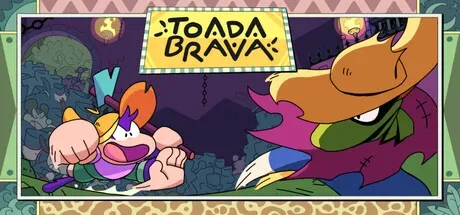
Toada Brava, a hand-drawn turn-based RPG drawing on Brazilian history, folklore, music and wildlife, has moved past the three-quarter mark of its Kickstarter campaign. As of November 9, the campaign had raised more than $26,000 against a $35,000 goal, placing it at approximately 75% funded with four days remaining.
The campaign is due to close on November 13 at 9 AM PT / 11 AM CT / 12 PM ET / 2 PM BRT. That leaves a relatively short runway for the project to cover the remaining portion of its target. Crowdfunding totals can change until a campaign closes, so the current figure is a progress snapshot rather than confirmation that the funding goal will be reached.
For players who would rather inspect the game than rely on a pitch, a free public demo is available on Steam. That is particularly useful for a project whose identity depends on several moving parts at once: an animated visual style, a party-based RPG structure, timing-focused battles and an approach to fantasy rooted in a specific cultural setting.
A Brazilian story at the center of the RPG premise
Toada Brava follows Kako, a friendly young monkey whose mother is imprisoned after opposing the Duke of Santacrúz. The Duke is attempting to take the family’s land in order to mine it for gold. Kako responds by breaking into the Duke’s estate, but he is captured and jailed himself. From there, the central objective is clear: escape, gather allies, build a crew and rescue his mother while confronting the larger dangers in his path.
The setup gives the adventure a conflict over land and extraction rather than an abstract “save the world” opening. The game’s stated thematic territory includes colonization, imperialism, rebellion and popular resistance. Those are substantial subjects for any RPG, and their presence matters because they frame the Duke’s gold-mining ambitions as more than a convenient villain motive. The conflict is tied to who controls land, whose resistance is punished, and how a community can respond.
The game is also described as being rooted in Brazilian history. That wording should not be read as a promise of a literal historical simulation: the announced world includes cartoonish animal characters and fantastical magic. Instead, the premise appears to use history and folklore as creative foundations for an original adventure. The balance between those elements will be important. A playful visual presentation can make a game inviting, but the themes outlined for Toada Brava have real weight.
Classic RPG influence, without stopping at nostalgia
The developers cite Chrono Trigger and Super Mario RPG among the inspirations for Toada Brava. Both names immediately signal a certain kind of role-playing game shorthand: a guided adventure, a cast of companions, menu-driven decisions in battle and a stylized world that can be colorful even when the stakes rise.
But inspiration is not the same as duplication. The material available for Toada Brava identifies turn-based combat and party building, while its most distinct mechanical pitch is the combination of musical magic and timing mechanics. Its visual direction is also explicitly frame-by-frame and hand-drawn, not simply a recreation of a prior generation’s pixel-art language.
“Turn-based” means players and opponents act in an ordered sequence rather than attacking simultaneously in real time. This lets a game put emphasis on choices: which ability to select, which opponent to target, when to defend and how to organize a party around different tools. It can create a deliberative rhythm, though a turn-based system also needs something to keep routine encounters from becoming automatic. Toada Brava’s proposed answer is input timing.
How timing mechanics can change turn-based fights
The game’s battles are said to allow extra hits when players time inputs well, while defensive timing can help block incoming attacks. In practical terms, that adds an action layer to the normal turn-by-turn framework. Selecting an attack is only the first step; the player may then have a brief moment to press at the correct time for an improved result. On defense, attention during an enemy’s turn can reduce damage or prevent part of an attack.
This design can make combat feel more involved than a system in which players only choose commands and wait for animations. It also creates an understandable difference between merely winning and playing efficiently. Extra hits can reward precision on offense; blocks can reward alertness when the enemy acts.
There is a balancing consideration, too. Timing systems work best when their feedback is readable: players need to understand when an input succeeded, what it changed and why a failed attempt happened. The public demo provides the most direct way to learn how Toada Brava handles that challenge, including whether the timing supports the strategic side of the battles rather than overwhelming it.
For the broader PC audience, the campaign arrives alongside a steady stream of projects revisiting and revising familiar role-playing structures. Readers looking beyond crowdfunding can also see how early-game material continues to surface in an unearthed Mass Effect 2 demo reel, a reminder that the road from an initial creative vision to a finished RPG can involve major iteration.
Music is part of the combat language
Music has a more direct gameplay role in Toada Brava than a conventional soundtrack. Each principal playable character uses a musical instrument to cast a different kind of magic. That concept has the potential to join character personality and combat function in a simple, legible way: a new teammate is not just another member of the story cast, but a new instrument and magic specialty for the group.
The developers have not detailed the exact spells, instruments, party size or progression systems, so it would be premature to assume how deep the system goes. Still, the stated design gives the combat a thematic connective thread. Music is not only atmosphere placed around a battle; it is part of what characters do in battle.
That is a useful distinction for an RPG built around folklore and cultural identity. Systems carry a game’s themes through repeated player actions. If magic is cast through instruments, then the game’s musical dimension is continually present in decision-making rather than confined to cutscenes or background tracks. The final implementation will determine whether that idea becomes a mechanical signature, but it is among the clearest elements separating Toada Brava from a generic retro-inspired pitch.
A hand-drawn world of monkeys, rats, cats and police dogs
Toada Brava is presented as a cartoon world in which characters are animated frame by frame. The announced inhabitants include Junk Rats, Krazy Kats and police dogs known as Beleguins. Those names indicate an exaggerated, deliberately playful character vocabulary, while the setting’s larger narrative incorporates oppression, imprisonment and resistance.
Frame-by-frame animation means individual stages of movement are drawn in sequence rather than relying solely on a single static character image being moved across the screen. It is a labor-intensive artistic approach, and it can give motion a strong illustrated quality. Here, it supports the project’s stated hand-drawn identity and should help distinguish the cast from the many RPGs that evoke earlier console eras through pixels alone.
It is worth separating what has been announced from what has not. The game has a free demo on Steam, an active Kickstarter campaign and a stated funding goal. It has also outlined its protagonist, premise, inspirations and core features. The supplied campaign information does not establish a release date, supported console platforms, pricing, the final scope of the party, or the full list of combat abilities. Potential backers and players should keep those boundaries in mind when evaluating the campaign.
What the next four days mean
With more than $26,000 raised, Toada Brava needs to close the remaining gap to its $35,000 Kickstarter target before the November 13 deadline. The late phase of a crowdfunding campaign is consequential because it decides whether a project ends below its stated goal or crosses it. Reaching roughly 75% is meaningful progress, but it is not the same thing as completion.
For now, the clearest case for following Toada Brava is its focused blend of ideas: a Brazilian-rooted adventure about land, power and resistance; a hand-drawn cartoon cast; music-based magic; and turn-based combat that asks players to participate actively in attacks and defense. The Steam demo is the practical next step for anyone wanting to assess the feel of those ideas before the campaign clock reaches its final hour.