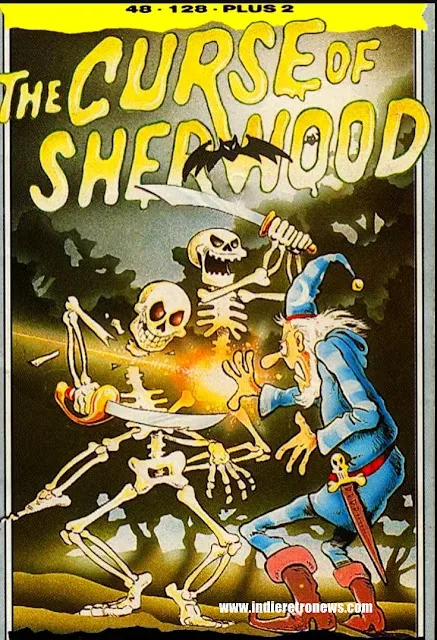
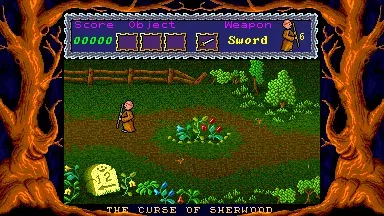
Sunteam has returned to an 8-bit-era arcade adventure with The Curse of Sherwood, a PC remake of the game originally created by Derek Brewster and published by Mastertronic in 1987. The original appeared on ZX Spectrum, Commodore 64 and Amstrad CPC, while the new version takes particular inspiration from the Spectrum edition.
Its premise is knowingly dramatic in the old-school fantasy-adventure tradition: Sherwood Forest is under the control of the Cult of Sagalia, Robin Hood and the Merry Men have already been defeated, and Friar Tuck becomes the remaining figure capable of mounting a response. He first seeks help from the Bishop of Derby for a large-scale exorcism, only to find the bishop dead. A bloodied parchment, carrying a cryptic rhyme, becomes the lead in a mission to discover how the cult can be destroyed.
That setup gives the remake a more specific identity than a general Robin Hood tale. Robin and his band are not the active protagonists here. The player instead controls Friar Tuck, searching a hostile forest for artifacts needed for the holy mission. It is a compact premise built around exploration, object handling and survival rather than an open-ended retelling of the legend.
A PC revival rooted in Spectrum-style design
The Curse of Sherwood is described as a modernisation, but its foundational structure is firmly retro. Its world uses a flick-screen layout and an elevated side-on viewpoint. Flick-screen design means the game world is separated into individual screens: moving past an edge switches the display to the next area rather than smoothly scrolling the camera across a continuous map.
That distinction is important for how players read space. Each screen can function like a small tactical problem, with its own enemies, exits, hazards and possible item decisions. Progress through a forest built this way depends on learning connections between screens and remembering where a useful object was found, where it might be needed, and which route is safest when returning. The approach sits naturally alongside the exploration-and-discovery appeal celebrated in classic NES adventure games, though Sherwood’s identity is shaped by its own Spectrum-era roots.
The stated emphasis on the Spectrum version is also a useful indication of what Sunteam is trying to preserve. This is not simply a Robin Hood game with a retro visual filter. Its core loop retains the constraints associated with the original format: discrete locations, short life reserves, dangerous contact with enemies, and an inventory system that asks the player to make meaningful choices with very little carrying capacity.
Three inventory slots turn artifacts into decisions
Friar Tuck can carry only three items at a time. That is the game’s central strategic restriction. With so few slots, finding an artifact is only the first part of a solution. Players must also decide whether the item is immediately useful, whether it needs to be transported elsewhere, and what to leave behind to make room for it.
In practical terms, a three-item inventory makes route planning matter. A player who takes an object too early may later need to retrace steps after discovering another artifact that is more urgent. Conversely, leaving something in a remembered location can be the better choice if the player expects to come back with the correct combination of items. The forest layout therefore becomes part of the puzzle: knowledge of paths and screen connections is as valuable as any individual pickup.
Related coverage includes The Curse of Sherwood Brings a 1987 8-Bit Adventure Back to PC.
This is a meaningful contrast with games that let players hoard every item until a puzzle conveniently presents itself. The Curse of Sherwood’s limit creates an ongoing trade-off. An item can be valuable yet still be the wrong thing to carry at a given moment. The system encourages attention, memory and deliberate experimentation, all while the player is under pressure from enemies and finite lives.
There is no detailed artifact list in the available information, so the exact nature of every puzzle and the full sequence of objectives remain unclear. What is established is the larger structure: Tuck must locate the items required to complete the mission, and the parchment’s rhyme points toward the secret of defeating the cult. The mystery is therefore not only narrative dressing; it is tied to the game’s object-driven exploration.
Enemies, projectiles and a limited margin for error
Sherwood’s paths are populated by hostile creatures that fire projectiles when they can. Contact with either an enemy or its weapon costs Friar Tuck one life, and he has only three lives. That makes every screen transition and every attempt to collect or deploy an item potentially costly.
The punishment model is straightforward, but it has consequences for how the exploration is likely to feel. A limited life total means scouting an unfamiliar area is not entirely free. Players have reason to observe enemy placement, wait for a safe opening, and avoid treating every encounter as a rushing contest. Since the game also asks them to manage a small inventory, losing a life may interrupt more than combat momentum: it can derail a planned artifact run through the forest.
Friar Tuck is not restricted to evasion. He can throw swords at enemies, and the game allows the player to improve that armament with stronger weapons while progressing deeper into the quest. The available description does not specify the upgrade path, the number of weapon types, or how those improvements are acquired. Still, the combination of thrown attacks and weapon upgrades suggests that combat capability is designed to grow during exploration rather than remain static from the opening screen onward.
It also creates a balance worth watching in a game of this style. Stronger weaponry may offer more confidence in dangerous territory, but it does not erase the importance of navigation or careful item handling. A missed enemy projectile, a careless collision or an inefficient trip across the forest can still cost one of the three lives. The design puts action and planning in the same loop instead of treating them as separate modes.
What “modernised” appears to mean here
The supplied details frame The Curse of Sherwood as a reimagined retro quest rather than a replacement built around a radically different genre. The recognizable elements are all structural: an elevated side view, flick-screen exploration, artifact hunting, a severe inventory cap, projectile threats and expandable offense.
That makes the remake’s appeal relatively clear even without a full feature breakdown. Players interested in old-school adventure design may find its restrictions to be the point, not an obstacle to be engineered away. The game asks for spatial memory and for purposeful use of limited resources. Those are design priorities that can create satisfaction when a previously confusing forest route finally makes sense, or when a player recognizes which object must occupy one of only three precious slots.
For those approaching it as a newer PC game, the important expectation is that “modernised” does not necessarily mean frictionless. The information available points to a game that retains the sharp edges of a compact 8-bit adventure: screens that must be learned, threats that can quickly reduce a small stock of lives, and a carrying limit that prevents indiscriminate collecting. Its charm will likely depend on how well players respond to that intentional pressure.
Sunteam addresses AI-assisted music in the release
Sunteam has also disclosed that music used in the game came from Pixabay and that the team did not realize the chosen tune involved AI until close to release. The developer said it decided to retain the track because it fit the game, while stating that it intends to be more careful in future and to source human-made audio where possible.
The disclosure matters because it distinguishes the game’s authored remake work from a separate licensing and production choice involving its soundtrack. It does not establish further details about the music, such as the extent of its AI involvement or whether other audio assets are affected. What is clear is Sunteam’s acknowledgement of the issue and its stated plan to apply greater scrutiny to audio sourcing going forward.
For The Curse of Sherwood itself, the headline remains a focused revival: a PC version of a 1987 Mastertronic-era adventure that places Friar Tuck in a cursed forest, gives him a cryptic clue and a mission, and leaves him to solve the problem with only three inventory spaces, three lives and whatever stronger swords he can earn along the way.