There is a particular kind of summer memory that games can capture even when the setting is nowhere close to a player’s own hometown. It is not necessarily about a precise street, a specific weather report, or even a familiar culture. It is the feeling of an afternoon with no meaningful schedule: a bike beneath you, a few possible destinations, and enough daylight to turn every detour into an adventure.
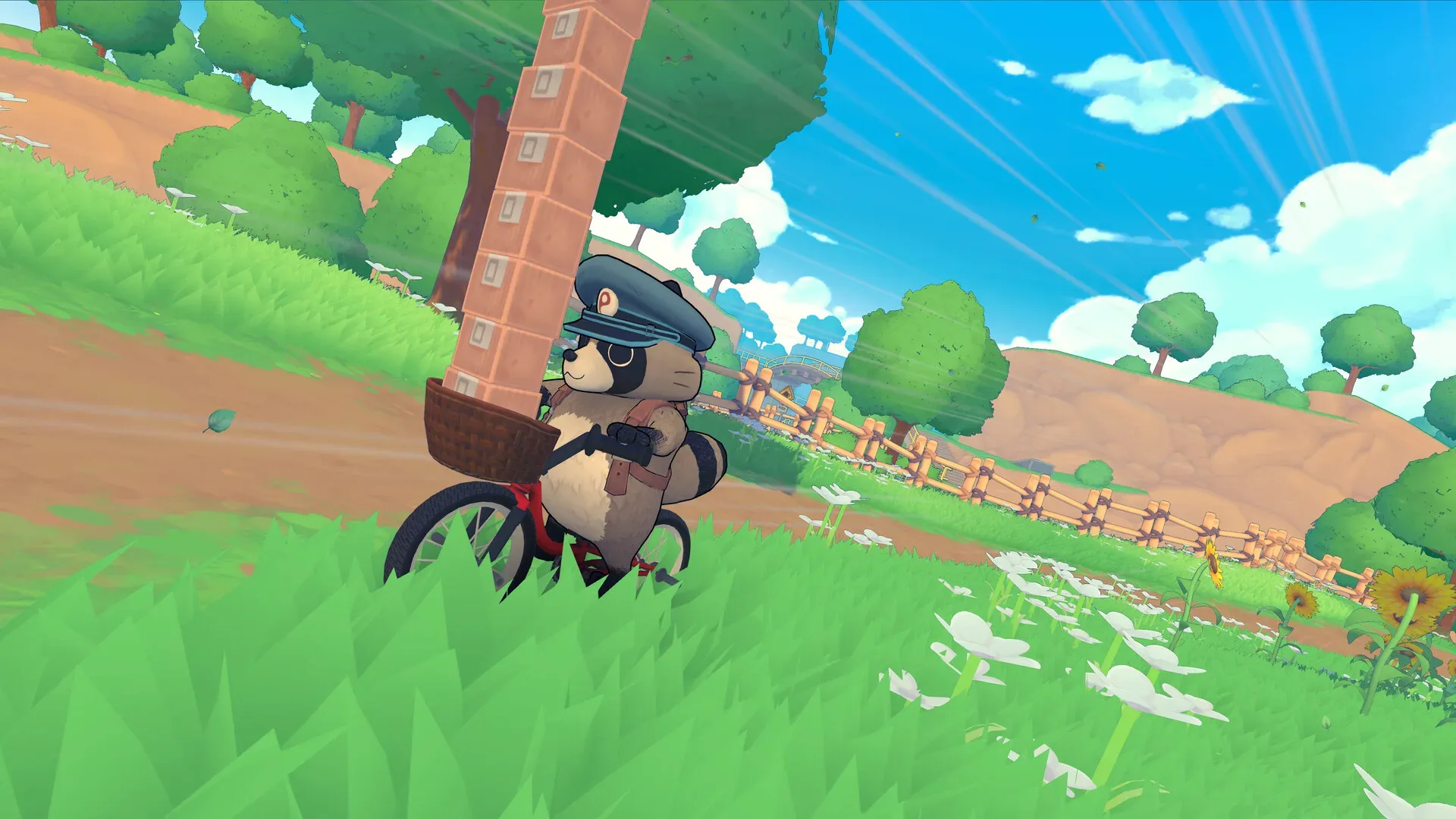
Tanuki: Pon’s Summer seems built around that sensation, albeit with a major and welcome complication: its wandering cyclist is a round raccoon named Pon, and he has a mail route to finish. The upcoming indie game is set in a rural town and gives Pon a seasonal mission to earn enough money to restore a shrine before the end of summer. He is described as a lazy mail carrier, a premise that immediately suggests the eternal struggle between doing one’s assigned work and spotting a ramp that simply has to be jumped.
A free demo is available on Steam now. Its mix of delivery work, compact town exploration, minigames and BMX challenges makes the game sound less like a race toward a checklist and more like an invitation to take the scenic route—eventually remembering that the parcels still need to arrive.
A small town, a big backpack, and a BMX
Pon’s main job begins with the day’s packages. Before he heads out, he sorts their different shapes into his backpack, arranging them efficiently so he can carry the whole load. It is a practical little task, but one that helps sell the rhythm of a neighborhood delivery round: collect the post, organize it, ride out, and discover what the town has been up to since yesterday.
The game does not frame that route as a rigid, joyless obligation. Pon can roam and fool around between deliveries, provided the job gets done in the end. That distinction is central to its appeal. A game can have objectives without making every second feel optimized, and a mail carrier on a BMX has a uniquely persuasive excuse to take a long way around.
Pon’s bicycle is a BMX, which turns ordinary travel into a chance to show off. Rails and ramps are scattered around town, and the raccoon can practice tricks while moving from stop to stop. There are also more focused challenges, including checkpoint runs that demand speed and score targets that ask players to land enough tricks within a time limit. The score-chasing structure evokes the familiar shape of skateboarding-game challenges, translated into a setting where the athlete is a postal worker with fur, a tail, and a backlog of envelopes.
That juxtaposition is doing a lot of work. BMX trick games usually prize control, precision, and bravado. Mail delivery is associated with routine, careful handling, and knowing where everything goes. Tanuki: Pon’s Summer puts those impulses together: first pack a bag neatly, then see whether the route to the next address includes a rail worth grinding.
Odd jobs give the route a human shape
The mail is not Pon’s only responsibility. To protect the good name of the local post office, he also lends a hand with whatever residents need. The demo’s reported activities include assisting a photographer who has run out of creative momentum and working behind the counter at a pub, where Pon pours drinks for customers.
Related coverage includes Tanuki: Pon's Summer Turns BMX Deliveries Into a Warm Childhood-Summer Escape.
The pub task is more involved than simply filling glasses. Players need to angle each pour and manage the foam to meet the barkeep’s requirements for different patrons. It is the sort of deliberately mundane minigame that can make a town feel inhabited. Rather than existing only as a track between mission markers, the setting has people with jobs, preferences and small problems that a passing raccoon can somehow be recruited to solve.
There is a comic edge to all of it. A BMX-riding raccoon helping with a photo session or attempting the ideal beer pour is inherently a little absurd, especially in a town populated by humans who appear willing to treat Pon as a functioning member of the local workforce. But the silliness does not cancel out the cozy tone. It makes the setting friendlier: a place where strange requests are met with a shrug and where a chaotic delivery employee remains part of the community.
Why the summer mood travels so well
Games set during a Japanese summer often resonate outside Japan because their details are specific while their emotional logic is widely recognizable. Cicadas, evening fireflies, hot streets, bicycles, a small local shop, and days that seem to stretch forever can feel familiar to anyone who remembers childhood summers as a period of semi-supervised exploration.
That shared feeling does not require pretending all childhoods are identical. A rural Japanese town and an American suburb are not interchangeable, and a game about a raccoon restoring a shrine is not a documentary of anyone’s adolescence. Yet the emotional connection can come from the overlap: riding in circles until someone calls you home, examining a patch of woods as if it were uncharted territory, or treating a creek, a field, and a few backyards as a whole world.
Tanuki: Pon’s Summer appears to approach that mood through activity rather than simply scenery. Pon does not just stand near a picturesque shrine while summer sounds play in the background. He rides, delivers, tumbles, helps neighbors, and tackles challenges. In other words, the town is something to move through and make a mess in. The seasonal atmosphere is tied to the permission to be a little aimless.
That is why the bike matters so much. For a child, a bicycle can represent a first taste of genuine range. It reaches farther than walking, but it is still personal and precarious. You can feel fast, attempt an ill-advised wheelie, scrape a knee, and head back out five minutes later. Adult cycling can become exercise, transport, training data, errands, or all four at once. In a game such as this, it can go back to being an excuse to see what is around the next bend.
The value of low-stakes mischief
There is a useful tension in Pon’s goal. Restoring the shrine before summer finishes gives the game a clear purpose, but its day-to-day play sounds intentionally softer than a high-pressure rescue operation. Packages must be delivered, money must be earned, and challenges can be demanding. Still, the underlying promise is not that players must execute a flawless schedule. It is that they can inhabit a town where taking a breather, attempting a trick, or stopping to assist someone is part of the experience.
That low-stakes freedom can be especially attractive because it is hard to recreate outside a game. Childhood’s unstructured wandering is often remembered less for a single dramatic event than for its abundance of small ones: a fruit found growing near a fence, a new route through tall grass, a rock worth pocketing, or a tree that looked climbable until it did not. Those moments are unremarkable in isolation. Together, they become the texture of a summer.
Pon’s adventures will naturally be more whimsical than a real childhood memory. Most children were not trusted to run a pub, and most did not have a shrine-restoration deadline hanging over their school break. But the game’s fantasy is grounded in an understandable wish: to have room for mistakes that do not define the day, side paths that do not count as wasted time, and responsibilities that can coexist with play.
The wider gaming calendar is full of huge worlds, urgent prophecies and protagonists asked to save everything. There is room for that scale, just as there is room for the strange questions raised by Nintendo’s evolving Zelda timeline. But a game about putting packages in a backpack and trying to stick a BMX trick offers a different kind of fantasy. It makes a small place feel important precisely because it does not need to become the center of the universe.
What the demo suggests
The currently available Steam demo offers a chance to see how that combination works in motion: the delivery packing, the town errands, the drink-pouring task and the BMX systems all belong to the same seasonal routine. The challenge will be balancing them so that tricks and side activities enhance the relaxed atmosphere without turning a supposedly carefree summer into another demanding to-do list.
Based on the setup, though, Tanuki: Pon’s Summer has a strong identity. It is not relying on nostalgia merely by displaying sunlit greenery and adding insects to the soundscape. Its core idea is playful and tangible: a raccoon has mail to deliver, a shrine needs funding, and there is always another ramp on the way to the next house. For players missing the sensation of wandering without a destination, that may be enough reason to hop on Pon’s BMX and take one more lap around town.