NVIDIA is extending DLSS 5 to RTX Remix, its free PC modding platform for bringing newer rendering techniques to older games. The move puts the company’s controversial Neural Rendering approach into a tool designed for community-made remasters, potentially widening the number of games in which players can experiment with dramatically altered character lighting and other image changes.
DLSS 5 is scheduled to arrive in RTX Remix on October 23. It is also due for RTX Spark, NVIDIA’s system-on-a-chip platform, on October 16, while Hogwarts Legacy is slated to receive official support on November 5. The expansion is notable not simply because it makes a new visual option more accessible, but because DLSS 5 is being discussed very differently from earlier DLSS generations: rather than being associated with a frame-rate uplift, it carries a substantial performance penalty.
That trade-off is the center of the debate. The technology’s advocates see a way to reshape faces, illumination and presentation in games that otherwise could not receive official visual revisions. Its critics see an intrusive, AI-led filter that can compromise an original game’s look while demanding an unusually powerful GPU. RTX Remix will make that disagreement especially visible, since it is built around revisiting games from earlier technical eras.
What RTX Remix changes for DLSS 5
RTX Remix has been available free since early 2024. It gives modders tools to add ray tracing and AI-upscaled textures to older titles. Ray tracing is a rendering technique intended to simulate the behavior of light, including reflections and shadows, while AI-upscaled textures use machine-learning methods to produce higher-resolution-looking artwork from existing material.
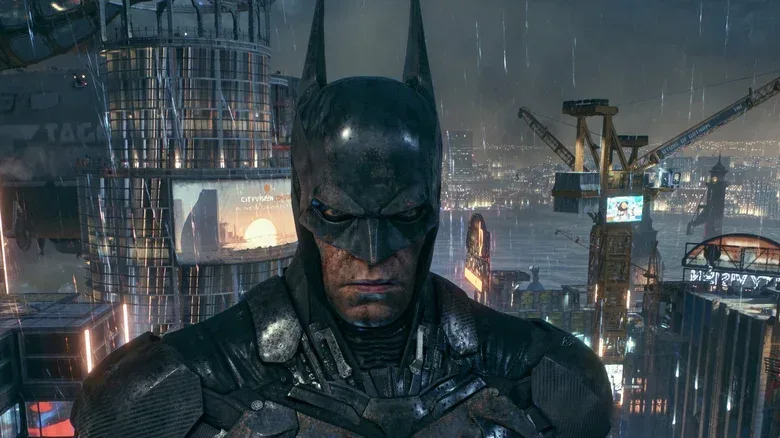
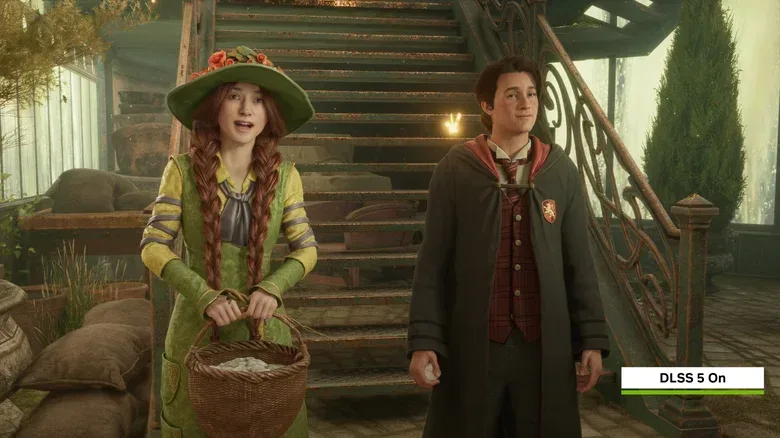
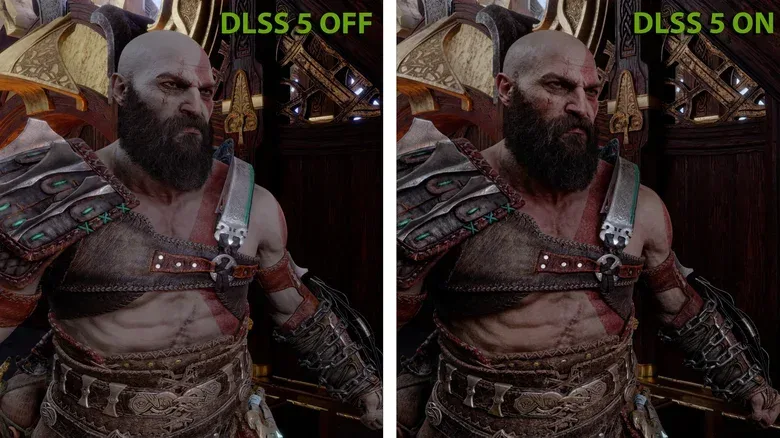
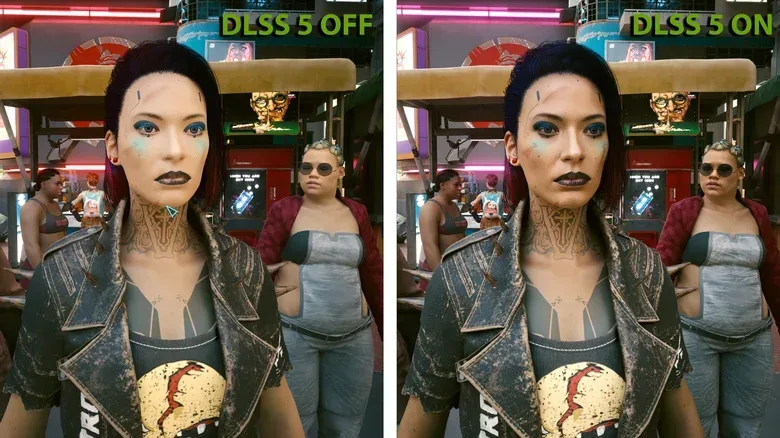
DLSS 5 adds another layer to that proposition. NVIDIA describes its approach as 3D-Guided Neural Rendering. In practical terms, the reported effect is most pronounced on characters: their facial lighting and overall appearance can change considerably. Environmental changes, by contrast, have been described as more restrained, sometimes amounting to deeper shadows rather than a wholesale transformation of a scene.
That distinction matters for a modding platform. A user considering a visual overhaul of an older game should not assume the benefit will be uniform across every type of scene. In a game where the camera spends considerable time on a protagonist or cinematic close-ups, the character-focused effect may be the main attraction. In a game dominated by distant views, busy environments or first-person play, the visual return may be less obvious relative to the hardware cost.
It also sharpens a broader preservation question. A remaster mod is inherently interpretive: new textures, new lighting and ray-traced effects can all move a title away from its original presentation. Neural Rendering intensifies that tension because the change is not merely a higher-resolution asset or a more accurate reflection. Players may find the revised faces appealing, or they may feel that a recognizable visual identity has been replaced with an unwanted, polished look. Neither reaction is a technical error; it is an aesthetic judgment.
Why performance is the decisive issue
Earlier DLSS releases have generally been associated with improving performance through image reconstruction techniques. The key wrinkle with DLSS 5 is that its Neural Rendering effect reportedly reduces frame rates instead. Reports from early third-party implementations put the hit in the range of roughly 30% to 60% in some cases when used through ReShade, a post-processing framework. A later update improved results in NBA 2K27, where the reported decline was about 25% at 1440p, but that is still a large sacrifice for a visual option.
Related coverage includes DLSS 5 Heads to RTX Remix, With Modders Facing a Heavy Performance Cost.
FPS, or frames per second, measures how many complete images a game produces every second. A higher number can make motion appear smoother and may improve responsiveness. The importance of a 25% loss therefore depends on where a game begins. A title that has considerable spare performance may remain comfortable to play after the effect is enabled. One already operating near a player’s preferred frame-rate target may become noticeably less smooth.
Examples on a high-end RTX 5090 underline the gap. In Control at 4K with maximum settings, reported DLSS 5 performance improved from around 80 FPS to nearly 100 FPS after an update. Yet the same game without DLSS 5 could exceed 120 FPS. A remastered Metal Gear Solid 4 reportedly rose from below 55 FPS to an average of 70 FPS at 4K following the update, while still performing above 120 FPS without the feature. The update helped, but it did not remove the fundamental cost.
Those figures should not be treated as universal benchmarks. They are examples from particular games, settings, resolutions and exceptionally capable hardware. They do show, however, why DLSS 5 should be judged as an optional, expensive rendering effect—not as a conventional performance setting to turn on automatically.
Official support and community experimentation are not the same thing
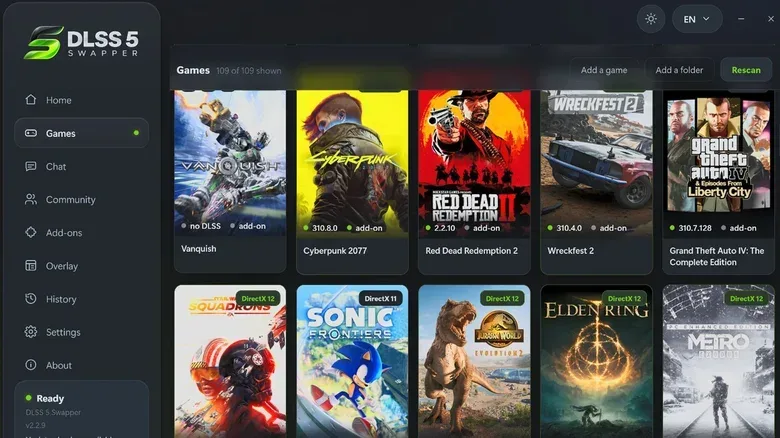
Community tools have emerged that claim to inject DLSS 5 techniques into a broad set of DirectX and Vulkan games on NVIDIA RTX hardware. They can identify rendering APIs across DirectX 9, 10, 11 and 12, add needed files and ReShade components, and offer a way to restore original files afterward. That makes the prospect of experimentation sound uncomplicated, but compatibility is not guaranteed simply because a game appears in a scan.
The largest practical warning concerns anti-cheat systems. Modifications of this sort may conflict with software intended to detect altered game files or unexpected behavior. One attempted use in Grand Theft Auto V: Enhanced Edition reportedly failed to launch because its required BattlEye anti-cheat software blocked the process. Players should not assume that a visual mod will work with online-enabled games, and they should be cautious with any modification around anti-cheat protections.
There is a second, separate issue: community methods reportedly drew on access to an early leaked build of NBA 2K27. That is not a sound basis for ordinary players looking to try a visual feature. Officially supported implementations are the clearer route when available, because they can be tailored to a game, updated by the relevant developers and less likely to clash with its systems.
The current moment also sits inside a wider conversation about AI in mods. Mod users increasingly need to know what a download changes, how it was made and whether it introduces machine-generated material. For a related development in the PC modding space, Nexus Mods’ AI disclosure and filtering plans show why clear labeling is becoming more important. Neural Rendering is not identical to every kind of AI-generated mod content, but players still benefit when a mod’s scope and visual consequences are made explicit.
Who should consider using it?
For now, DLSS 5 appears suited to a narrow audience: PC players with substantial GPU headroom who actively prefer its look in a particular game. The reported recommendation threshold is at least an RTX 5070 or AMD Radeon RX 9070, and even that is not a promise of satisfactory results. Resolution, base settings, the game itself and an individual’s desired frame rate all affect whether the compromise makes sense.
A sensible decision process is straightforward:
- Start with the game’s unmodified performance. If frame rate is already marginal, a major additional rendering cost is unlikely to be worthwhile.
- Judge the result in the kinds of scenes you actually play. Because faces and character lighting are the major reported change, close-up-heavy games may offer more visible benefit than games focused on environments.
- Prefer official implementations when possible. They avoid treating a broadly compatible mod injection as equivalent to game-specific support.
- Avoid assumptions around anti-cheat. A game launching successfully without modifications does not mean it will tolerate altered rendering components.
- Keep reversibility in mind. Any visual experiment should have a clear route back to unmodified files if the new look or performance is not satisfactory.
RTX Remix is a natural home for ambitious graphics experiments, and DLSS 5 gives modders one more way to reinterpret old games. But the technology’s arrival does not settle the argument around it. The strongest case for it is not that it is an across-the-board enhancement. It is that some players may value its distinctive changes to characters enough to accept a considerable FPS reduction. For everyone else, the older game, its original art direction and a much higher frame rate remain a perfectly persuasive alternative.