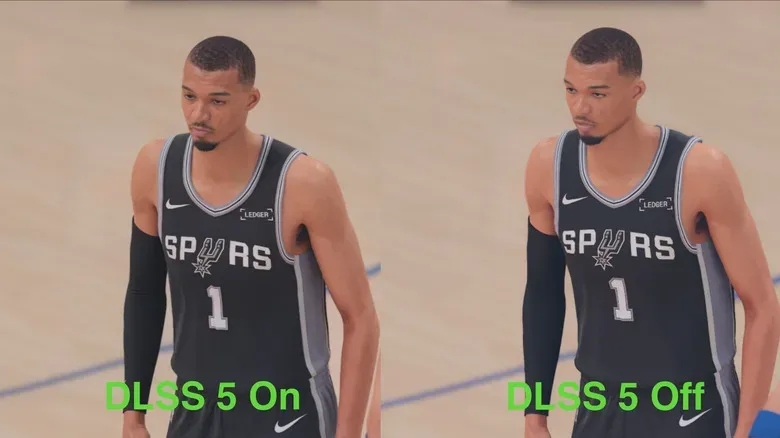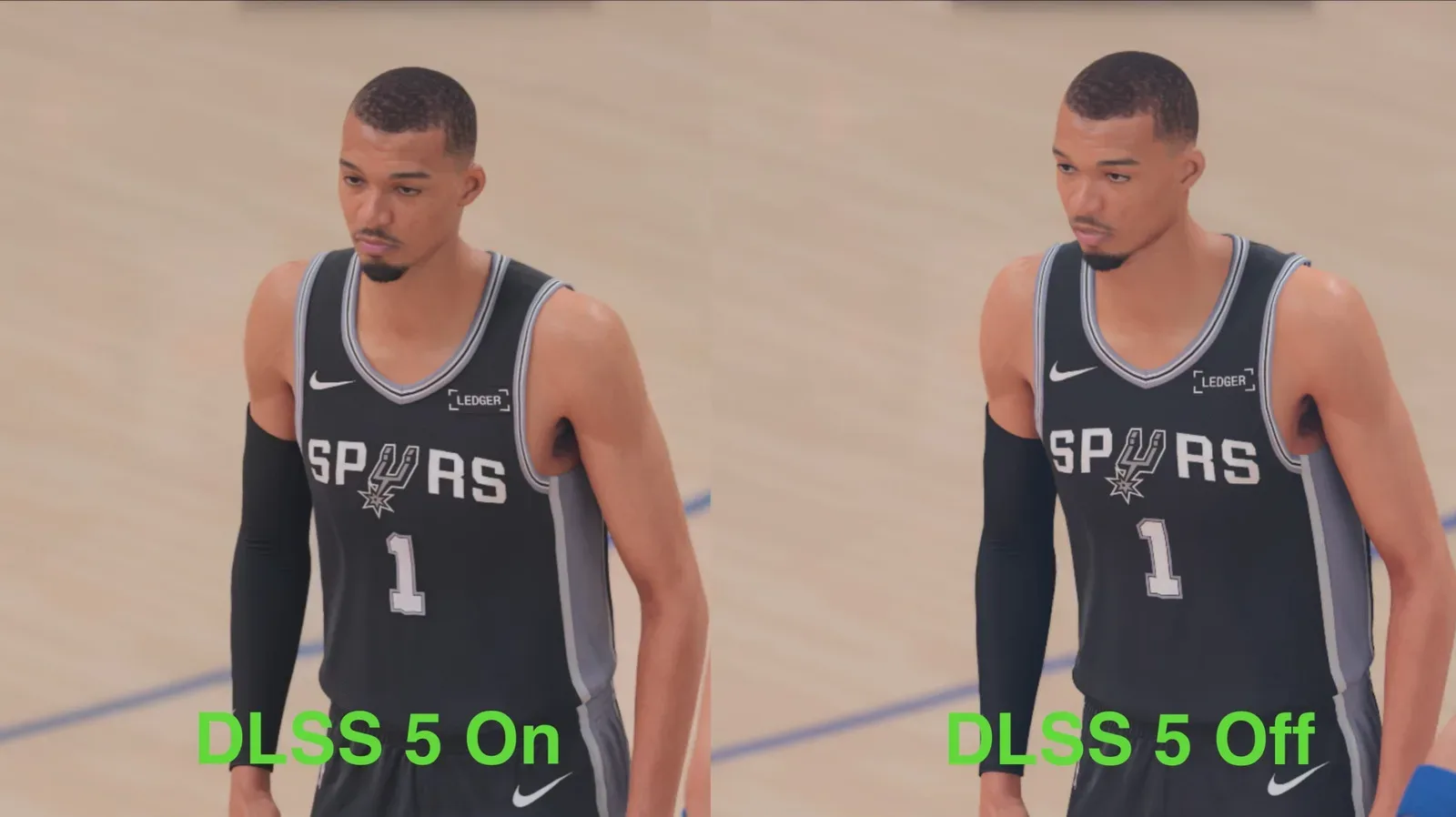
NVIDIA’s DLSS 5 has arrived in NBA 2K27, putting its neural-rendering ambitions into a very visible, very demanding kind of game: televised basketball, where close-ups of athletes, sweat, skin, arena lighting and a packed crowd are all expected to survive scrutiny. The early picture is not one of a miraculous generational leap. Instead, DLSS 5 appears to add carefully restrained refinements to the game’s character rendering while asking an RTX 5090-class system for substantially more power and accepting a meaningful frame-rate hit in return.
That makes NBA 2K27 an intriguing but complicated launch point for the technology. Its improvements are most apparent where viewers are nearest to player faces, arms and spectators. In the typical elevated gameplay camera, where athletes are much smaller on screen, the visual advantage reportedly becomes harder to spot. For a feature that has been positioned as a route toward more lifelike imagery through AI-driven neural rendering, that difference in visibility matters enormously.
The short version is simple: DLSS 5 can make portions of NBA 2K27 look better, but its first outing seems to invite a very familiar PC-gaming question. How much performance, electricity and hardware stress is reasonable to spend on an effect that may be largely invisible during the action most players spend their time watching?
What DLSS 5 is trying to change
DLSS has long been associated with using AI techniques to help games achieve an image that resembles a higher-resolution render without requiring the GPU to do all that work natively. NVIDIA’s DLSS 5 pitch expands that basic idea into neural rendering models intended to help deliver more natural-looking graphics rather than leaning exclusively on brute-force graphics processing.
In theory, it is an appealing direction. Game visuals are filled with difficult details: subtle texture variation in skin, soft transitions inside shadows, complex lighting across faces and clothing, and the visual noise of thousands of people in a stadium. Those areas can be expensive to render convincingly. A neural approach promises to help fill in the gap between what conventional rendering can accomplish within a performance budget and what artists want a scene to communicate.
But a technology’s promise and its implementation in a particular game are separate things. NBA 2K27 is the first title with official DLSS 5 support, so it should be viewed as an opening example rather than a final verdict on where the feature can go. Early demonstrations and leaks involving modified DLSS 5 use in titles including Control and Final Fantasy VII Remake also raised concern that the effect could be pushed far enough to create imagery that clashes with the developers’ original art direction.
NBA 2K27, by comparison, reportedly takes a far less aggressive approach. That restraint is probably sensible. Sports games already aim to make recognizable human faces, uniforms and broadcast-like arena presentation feel plausible. A heavy-handed AI layer that made players look strange would be an immediate own goal.
Where the visual gains show up
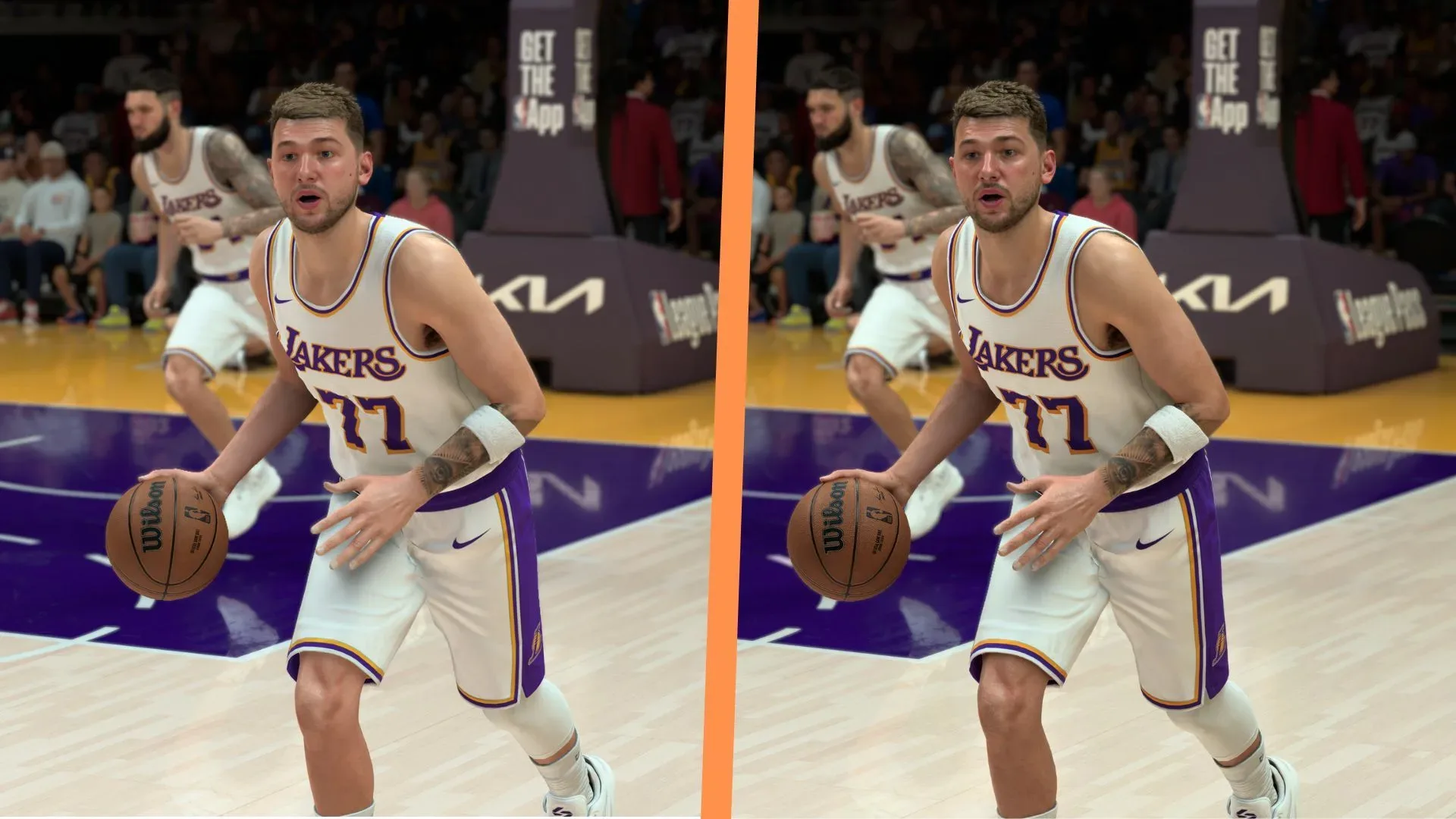
The reported benefits in NBA 2K27 center on texture and lighting rather than a dramatic shift in the game’s entire look. Player skin—especially faces and arms—has more apparent surface detail with DLSS 5 active. Shadows also look a little more realistic. Crowd models receive some extra attention as well, which is useful in a game built around the visual atmosphere of a full arena.
Related coverage includes NBA 2K27’s DLSS 5 Debut Shows Subtle Gains and Heavy GPU Demands.
Those refinements address a common issue in digital sports presentation. Without enough small-scale variation, human models can appear unnaturally smooth or plastic-like, even when a game has other visual settings turned up. DLSS 5 seems capable of reducing that mannequin effect. Once someone knows the precise areas to inspect, the difference can reportedly be seen.
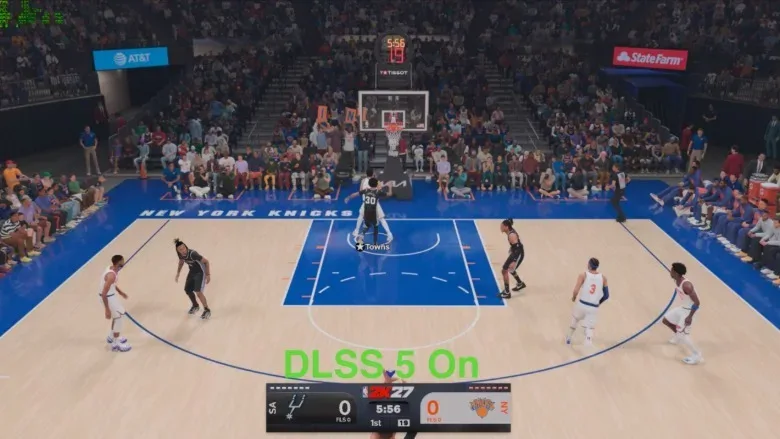
Still, the camera is crucial. During close shots, replays and other moments where the game emphasizes individual athletes or nearby fans, additional detail has room to register. The court action usually unfolds from farther away, however. In those wider overhead perspectives, DLSS 5 reportedly does not create a major visual change. Distant crowd lighting may appear more nuanced, including darker seating areas away from the court’s brightest lights, but the overall gain is slight.
That does not mean a subtle feature is automatically a failed feature. Understatement can be an advantage when a game needs to maintain its intended aesthetic. Yet subtlety changes the value calculation. If an enhancement mainly stands out in cinematic shots and close-up inspection, players will naturally compare it with features that have a clearer impact on moment-to-moment play, such as a higher frame rate, lower latency or sharper base image quality.
A question for annual sports games
There is also an awkward aesthetic possibility around the debut. The standard NBA 2K27 models have been described as comparatively under-detailed, which makes DLSS 5’s texture work more noticeable. It is impossible to establish intent from the available information, but it raises a fair question: is the feature elevating an already polished visual foundation, or is it receiving extra credit because the non-DLSS comparison leaves room for improvement?
Annual sports releases operate under unusual expectations. Roster changes, player ratings and current-season presentation remain central reasons people return each year, even when graphics evolve in smaller steps. That can make a new rendering feature a useful showcase, but it also means players should judge its impact against the baseline game they are actually getting—not merely against what an AI-driven setting can add after the fact.
The performance and power trade-off
The most striking numbers attached to NBA 2K27’s DLSS 5 implementation are not visual at all. At 4K on an RTX 5090, the reported frame rate dropped from 240 frames per second to 150 fps when DLSS 5 was enabled. A 150 fps result remains high in absolute terms, especially for many display setups, but the loss is still large. In a basketball game, where movement, animation and response all benefit from smooth presentation, surrendering 90 fps for a modest image change is difficult to ignore.
Reported power draw was similarly notable. With DLSS 5 disabled, the RTX 5090 system was said to sit around 400 watts while running NBA 2K27 at 4K. Enabling the feature reportedly pushed that figure to roughly 525 watts. That is an increase of approximately 125 watts for a visual upgrade concentrated mostly in close views.
Power consumption is not just a line item on an electricity bill. More power often means more heat, louder cooling, and greater demand on a PC’s case airflow, power supply and cabling. The hardware risk cannot be assessed from a single account, and no general conclusion about DLSS 5 causing damage should be drawn from it. However, a HardOCP forum user reportedly said an RTX 5090 exceeded 600 watts in NBA 2K27 with DLSS 5 active and that the GPU power cable later melted. That anecdote is a warning sign worth treating cautiously, not proof of a universal failure mode.
For owners of exceptionally expensive graphics hardware, the practical response is straightforward: monitor real power behavior, ensure the system’s power delivery and cable installation meet the GPU maker’s guidance, and do not assume a new graphics option is free simply because it is presented as an image-quality upgrade. Chasing a finer facial texture is a poor reason to be casual about power limits or connector health.
Not essential—at least not yet
At launch, DLSS 5 looks less essential than other demanding graphics options, including ray tracing. Ray tracing can also be costly, but its effects on reflections, shadows and lighting are often easier to recognize across a whole scene. NBA 2K27’s DLSS 5 usage currently seems narrower: valuable in specific visual moments, but not a transformational upgrade across the default basketball camera.
There is some reason to expect the feature’s hardware reach will expand. NVIDIA has said DLSS 5 will eventually come to RTX 4000 GPUs after initially being positioned for RTX 5000-series hardware. That matters because a technology with only a small installed base has limited opportunity to become a standard game-development target.
NBA 2K27 is currently the only identified upcoming game with official DLSS 5 support. Capcom, Tencent and Ubisoft have indicated plans to support the technology in future projects, though specific games have not yet been named. Players with recent NVIDIA GPUs who are determined to experiment can also look to mods for existing DLSS titles such as Control and Cyberpunk 2077, although unofficial modifications come with their own stability, compatibility and visual-quality unknowns.
For now, the sensible posture is curiosity rather than urgency. PC features often improve dramatically after their first implementation, as developers learn where they enhance a game’s art rather than simply add computational cost. NBA 2K27 shows that DLSS 5 can supply finer human detail without turning a sports game into an AI-rendered uncanny valley exhibit. It also shows that the current expense—in watts and frames—may be hard to justify for players who would rather keep the scoreboard, rather than their GPU’s power meter, moving at maximum speed.
Those weighing technical features against actual playability may also find a useful contrast in our look at a budget 60Hz gaming display setup. High-end rendering is exciting, but the best setting is ultimately the one that fits the screen, the hardware and the way a person actually plays.