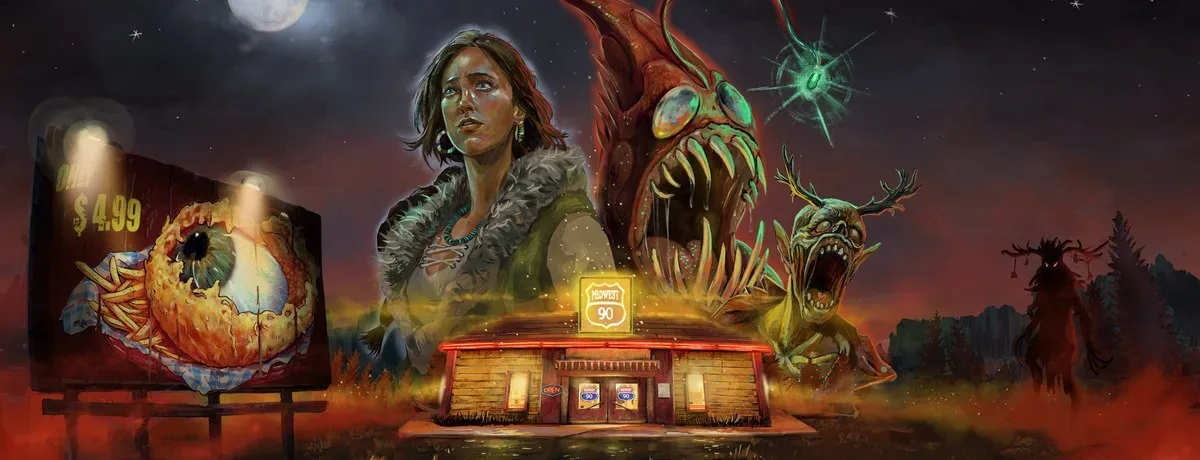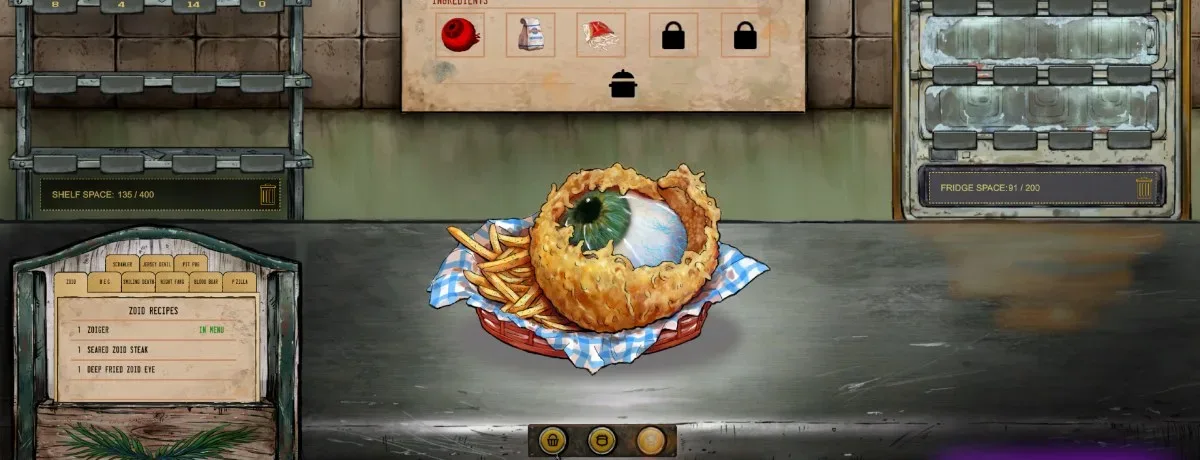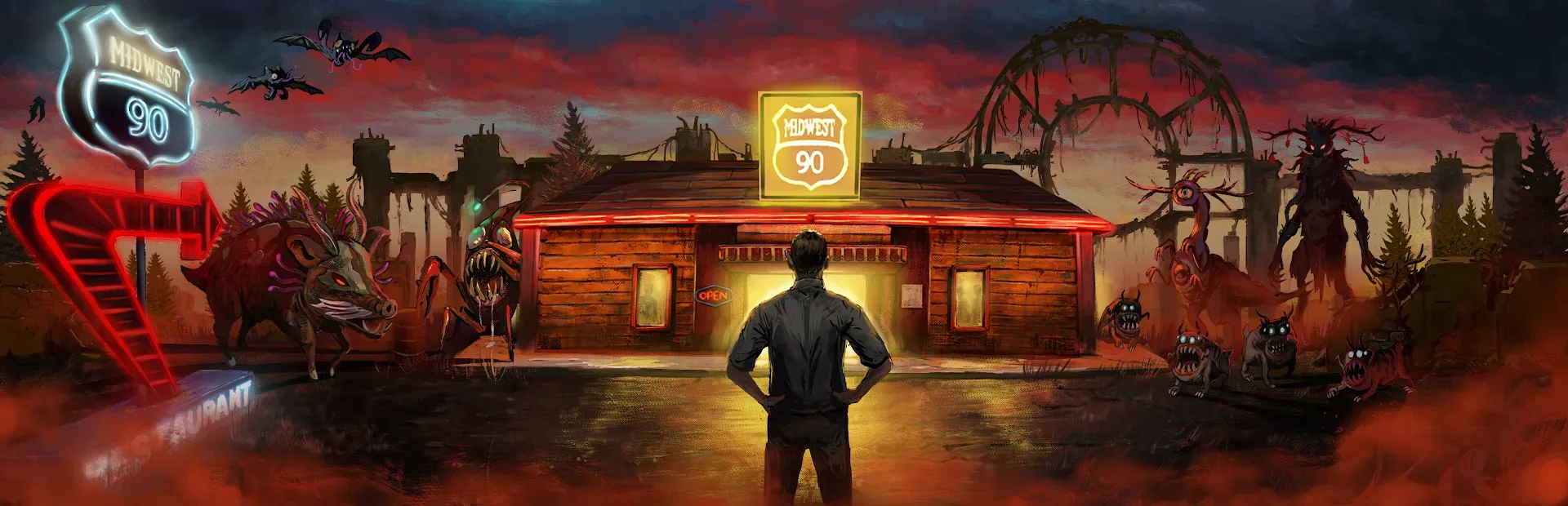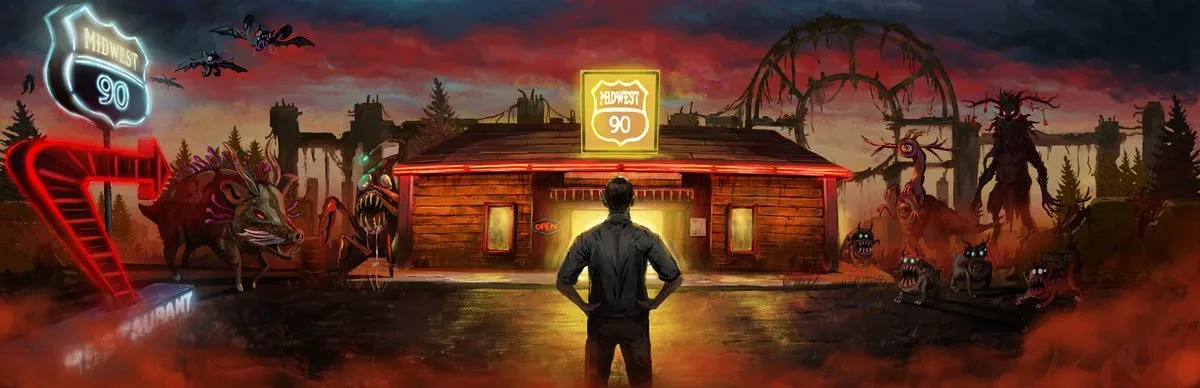
Midwest 90: Rapid City is scheduled to enter Steam Early Access on November 10, 2026. Hidden Chest Studios and Rising Tide Publishing have positioned the game as a remarkably busy take on apocalypse survival: players operate a highway diner, but the supply chain begins with trapping monsters and turning their harvested parts into food.
The premise links several familiar game structures into one potentially hectic loop. Players will collect monster-derived ingredients, prepare recipes, manage employees, pursue research and upgrades, and defend the diner from attacking monster waves. The developer’s Early Access plan says the launch build will contain the Prologue, Chapter 1, and a complete Endless Mode rather than only a small introductory slice.
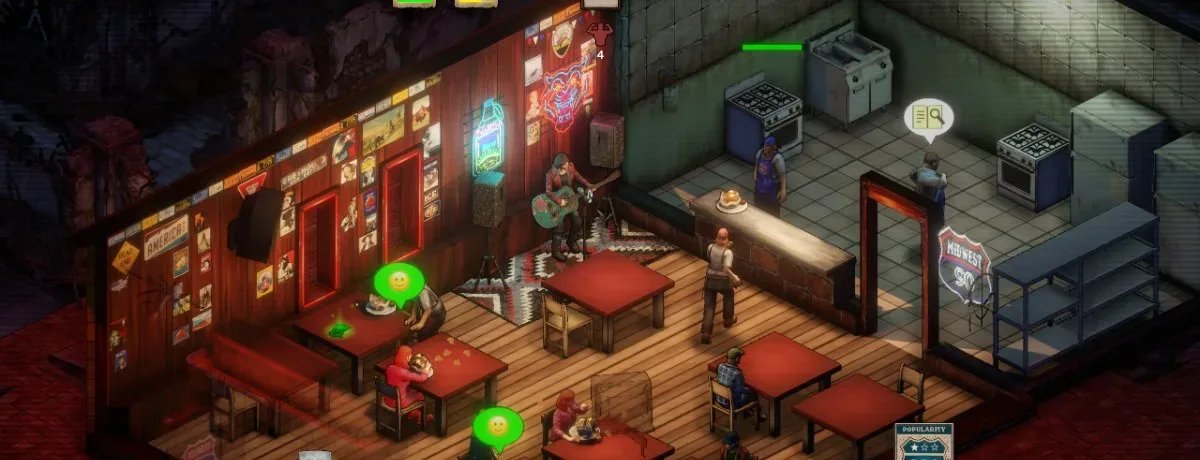
A new release trailer accompanies the date announcement and gives prospective players another look at the game’s 1990s-inspired isometric presentation. Its visual direction is said to evoke early Fallout, pairing an elevated, angled viewpoint with an alternate-Americana monster scenario rather than a clean, contemporary restaurant-management setting.
A diner where the ingredients fight back
The core hook is not merely that monsters threaten the business. They are also part of the kitchen’s resource flow. In practical terms, the player’s actions outside the cooking process—trapping and harvesting creatures—feed directly into the menu. That makes Midwest 90: Rapid City more than a standard restaurant sim with occasional combat interruptions. The game’s stated design connects acquisition, food preparation, business operation and defensive survival.
Restaurant management simulation generally refers to systems that ask players to keep an operation functioning: balancing staff, improvements and production decisions as demands change. Here, research and upgrades are specifically part of that management layer. The details of individual research paths, recipes and staffing rules have not yet been outlined, so it remains unclear how much of the game’s challenge will come from financial optimization, customer service, production timing, or the pressure created by monster incursions.
What is established is the intended chain of responsibilities:
- Trap monsters and harvest them for usable ingredients.
- Cook those ingredients into recipes for the diner.
- Manage staff and upgrades around the operation.
- Defend the diner as monsters arrive in waves.
That sequence gives the setting its particular identity. The roadside diner is not simply a safe hub between missions; it is the point where the game’s management systems and combat systems meet. A strong defense matters because the kitchen and its upgrades need protecting. Gathering monsters matters because cooking depends on the materials they provide. The announced concept therefore suggests that each activity has a stated relationship to the next rather than existing as a detached minigame.
What tower defense means in Rapid City
The defensive half of Midwest 90: Rapid City is described as tower defense around the diner. Tower defense is a strategy format built around holding a position against successive enemy waves, commonly through placements, improvements and decisions about where defensive resources are most valuable. The announcement does not specify individual tower types, placement rules, or whether players can directly fight alongside the diner’s defenses. Those are important unknowns for anyone looking for a more precise read on the combat.
Still, the use of tower defense creates a clear contrast with the diner’s service and cooking duties. Management games typically reward planning, efficient use of resources and a well-developed operation. Wave defense places an emphasis on preparing for threats that arrive in escalating groups. Combining them means the diner’s growth is likely intended to carry a defensive consequence: investments in the business exist in a world where the business can be put under siege.
The game’s monster attacks are therefore not just decorative apocalypse flavor. They are one of the stated pillars of play, alongside cooking and management. Players interested in the project should expect a hybrid rather than a pure restaurant sim or pure defense game, with the eventual balance between those pieces still to be demonstrated as Early Access begins.
Early Access launch content and the path to 1.0
On November 10, the Early Access build is planned to arrive with its Prologue and Chapter 1, plus what the developers describe as a deep and complete Endless Mode. The distinction matters. Story content will begin at an early point in the narrative, while the Endless component is being presented as a fully formed replayable option from day one.
Endless Mode generally means a mode designed around repeat play without the fixed endpoint of a story campaign. For Midwest 90: Rapid City, the announced version includes difficulty and progression options, while a subsequent update is set to expand it with customized settings. The exact nature of its progression has not been specified, but the mode is clearly meant to serve players who want to engage with the diner-management and defense loop repeatedly while adjusting the level of challenge.
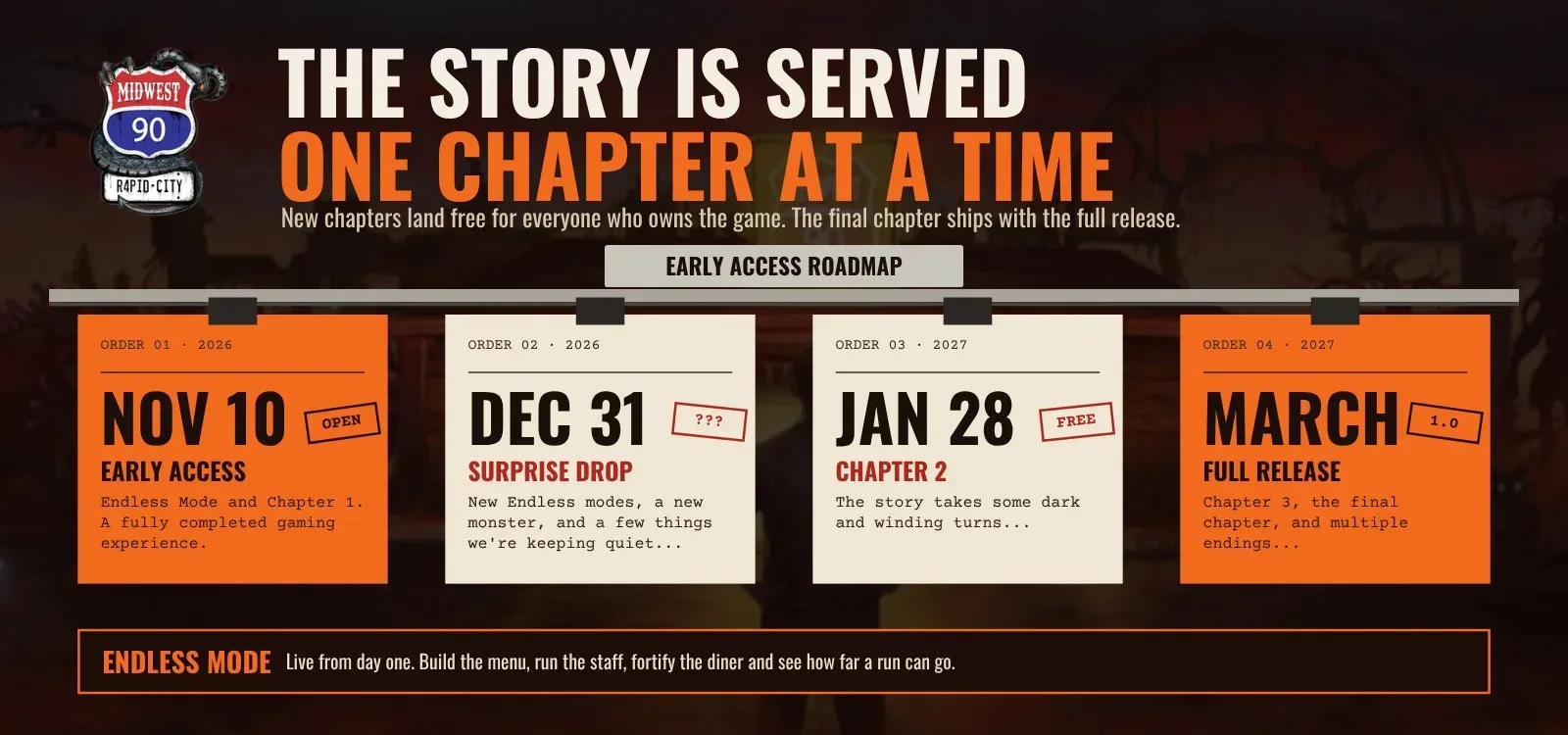
The currently shared schedule is as follows:
- November 10, 2026: Steam Early Access launch with Endless Mode, the Prologue and Chapter 1.
- December 31, 2026: Additional content, including customized Endless Mode options and new monsters.
- January 28, 2027: Chapter 2 as a free update for Early Access owners.
- March 2027: Planned 1.0 release with the final chapter and branching outcomes.
The December update is especially relevant to the long-term appeal of Endless Mode. Difficulty and progression options are already expected at launch, but customization is marked for the end-of-year content drop. New monsters are also scheduled for that update, potentially affecting both the ingredient-harvesting premise and the diner-defense side. The announcement does not say how those creatures will alter recipes, strategies, or wave composition, so those practical effects will need to wait for further details.
Story chapters and branching outcomes
The campaign plan currently spreads the story over the Early Access period. Players will receive the Prologue and Chapter 1 at launch, Chapter 2 in January, and the final chapter at the planned full release in March 2027. The March version is also set to introduce branching outcomes.
Branching outcomes describe endings or narrative results that can differ based on decisions, progress, or other player actions. The announcement confirms that this structure is intended for the final chapter, but does not explain what choices govern those outcomes or how many paths will be available. It would be premature to assume that restaurant decisions, monster handling, upgrades or performance in Endless Mode will affect the narrative. For now, the solid takeaway is that the 1.0 version is planned to complete the story with more than one possible result.
For Early Access buyers, the developer’s stated plan is that all updates will be included with the purchase. That means the December additions, the Chapter 2 update, and the eventual 1.0 content are intended to arrive without a separate charge for those owners. It is a straightforward roadmap, although—as with any development schedule—the listed dates and features represent the plan shared ahead of launch rather than a guarantee that implementation will remain unchanged.
Why the launch structure is notable
Early Access can mean very different things depending on the project. Some games debut with a narrow proof of concept and build outward over time; others arrive with a robust repeatable mode while their scripted campaign remains incomplete. Midwest 90: Rapid City falls into the latter category based on the announced content. Its first version is expected to offer one early stretch of the story and an Endless Mode characterized as complete and substantial.
That approach could be useful for two different audiences. Players primarily interested in a crafted campaign will need to account for the staggered chapter rollout. Players more interested in repeatable management-and-defense runs are being offered an immediate route through Endless Mode, with later customization promised. Neither group has enough information yet to judge run length, progression depth or the final rhythm of the game, but the roadmap makes the intended priorities easier to understand.
The timing also places Midwest 90: Rapid City among a continuing flow of PC projects using staged development to add modes and chapters after an initial Steam release. For another recent example of a PC game laying out a focused multiplayer testing phase, see NightRunner’s announced co-op train-defense playtest. The two projects have very different structures, but each highlights how developers can define an early public build around a distinct gameplay core.
The aesthetic: isometric and deliberately 1990s-inspired
Midwest 90: Rapid City’s look is described as 1990s-inspired and isometric. Isometric commonly refers to a perspective that shows an environment from an angled overhead view, allowing players to see sections of a location’s layout while retaining a sense of buildings and objects as three-dimensional space. It is a natural fit for a game built around running and defending a diner, because it can make the business, its surroundings and approaching threats legible within the same frame.
The cited early-Fallout influence supplies a useful reference point for the atmosphere being targeted, but it should not be mistaken for a claim that Midwest 90: Rapid City replicates that series’ mechanics or setting. The announced game is specifically about a monster-apocalypse diner and combines restaurant systems with tower defense. The comparison identifies an aesthetic inspiration, not a list of shared features.
That visual frame also supports the project’s odd premise. A highway diner, a monster harvest, kitchen operations and defensive waves could easily feel disconnected in another presentation. The 1990s-inspired isometric approach gives the game a common visual language for its roadside setting and systems-heavy design.
What remains to be seen
The available information establishes the date, platform, release roadmap and the major systems, but it leaves several meaningful specifics open. There is no announced price, no detailed breakdown of staff management, and no explanation of the exact research tree. The available outline also does not define the recipe system, the breadth of monster harvesting, the structure of defensive construction, or how branching outcomes are determined.
Those omissions are normal for an announcement focused on a release date and roadmap. They simply draw a line between what is currently confirmed and what players may want to investigate once the Steam Early Access build becomes available. The new trailer and released visual materials offer a closer presentation of the game’s tone, while the November build is expected to reveal how successfully its monster-catching kitchen, business management and diner defense fit together.
For now, Midwest 90: Rapid City’s pitch is unusually clear: run a roadside restaurant at the end of the world, turn the local monsters into the menu, and make sure the next wave does not tear down the place before dinner service is over.