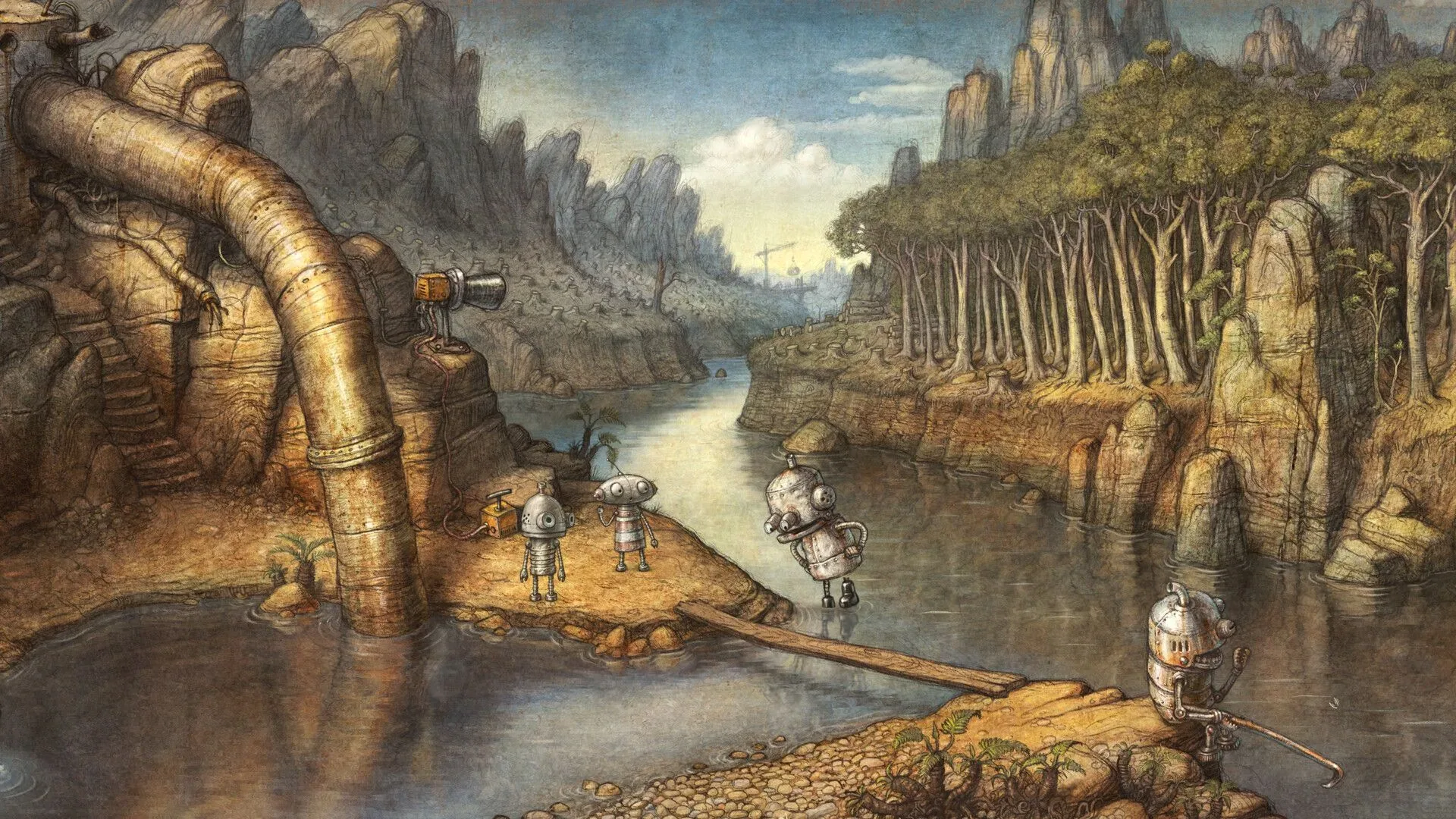
Josef is heading back to the workbench. Amanita Design has announced Machinarium 2, a sequel to its hand-drawn robot point-and-click adventure arriving 17 years after the original game. The newly revealed project continues Josef’s story after the events of Machinarium, but it also makes a meaningful mechanical change: Berta, Josef’s friend, will be playable alongside him.
The announcement was accompanied by a short video that shows the studio’s familiar illustrated environments and animation style. A Steam page for Machinarium 2 is also live, although Amanita has not provided a release date.
Josef and Berta leave the city behind
The original Machinarium centered on Josef, a small robot attempting to save the city of Machinarium from the Black Cap Brotherhood. The sequel begins after Josef and Berta escape the city, only to crash-land in the Barrens.
That new setting contains a concealed green valley inhabited by two unusual robot communities. One tribe occupies a monastery high above, while the other lives below in the valley. Both groups are said to be suffering from a lack of power, establishing the central problem that Josef and Berta will encounter.
For more context, explore MrBeast’s Early Logo Sketch Heads to Auction With a $20,000-Plus Estimate.
It is a notable shift in scale and geography. Rather than immediately returning players to the city named in the first game, Machinarium 2 moves its characters into a new landscape with its own communities and apparent infrastructure problem. The announcement does not yet explain what caused the power shortage, how the two tribes relate to each other, or how the pair’s crash connects to the wider plot. Those are story details for Amanita to reveal later.
What the two-character setup means for puzzles
The headline design addition is the ability to play as both Josef and Berta and switch between them at will. The pair will need to cooperate to overcome the game’s puzzles.
In a point-and-click adventure, players generally explore illustrated scenes, inspect objects, gather useful items and work out how separate clues or mechanisms fit together. Puzzle solving is typically driven by observation and experimentation rather than combat or reflexes. Giving players two controllable characters can broaden that structure: a problem may require actions from two locations, distinct character positions, or a sequence in which one robot enables the other to proceed.
Related coverage includes Machinarium 2 Announced as Amanita Design Returns to Its Beloved Robot Adventure.
That is an explanation of the format rather than a confirmation of specific puzzle types. Amanita has not detailed individual challenges, inventory systems, interface changes or the exact limits of the switching mechanic. What is confirmed is the foundational idea: Josef and Berta are not simply traveling together in the story; players can directly control each of them and use their partnership to solve obstacles.
For returning players, that makes the sequel more than a visual revisit. The original’s protagonist was alone for the player’s direct interactions. A second playable robot introduces the prospect of more collaborative reasoning while preserving the series’ focus on environmental puzzles.
A wordless adventure, again
Machinarium 2 will communicate without conventional written dialogue. Josef and Berta will use thought-bubble pictographs, keeping the sequel aligned with a long-running Amanita approach.
A pictograph is an image used to convey an idea rather than a written word. In this case, thought bubbles can show what a character is thinking, needs or intends through visual symbols. The approach matters especially in an adventure game, where dialogue often delivers explicit directions. Visual communication instead asks players to read gestures, illustrations and contextual imagery.
The absence of written language can also make the game easier to approach across language boundaries, since players are not dependent on blocks of localized text to follow character intent. At the same time, it can make a scene feel more open to interpretation. A symbol or animation can invite players to infer a joke, a motive or a solution from the environment.
The announcement identifies hand-drawn artwork, animation and music as core parts of Amanita’s identity. Tomáš “Floex” Dvořák, a longtime collaborator with the studio, is associated with the soundtracks of its games. No specific soundtrack information for Machinarium 2 was detailed in the announcement, but the game’s reveal footage points back toward the studio’s distinctive cartoon-like visual language.
A return from a studio with a history of long gaps
Amanita Design is the Czech developer behind Samorost, Botanicula, Chuchel, Creaks and this year’s Phonopolis, in addition to Machinarium. The sequel is a surprise in part because it arrives so long after a game that has remained a defining work for the studio.
The developer has made a delayed return to one of its earlier series before. Samorost 3 appeared in 2016, 11 years after the prior entry. That history does not establish a plan for any other sequel, but it does show that a large gap has not prevented Amanita from revisiting an older world when it has a new idea worth pursuing.
For Machinarium, that idea appears to be continuity without simple repetition. Josef remains at the center, Berta is elevated into a player-controlled co-lead, and the setting begins beyond the city rather than inside it. The known premise retains the original’s mechanical world while giving the sequel a separate location, two new tribes and a shared crisis to explore.
What has and has not been announced
The early reveal establishes the premise and several important creative pillars, but much remains unconfirmed. Players should be careful not to treat the Steam listing or teaser as confirmation of a timetable, full platform lineup or detailed feature set beyond what Amanita has actually presented.
- Confirmed: Machinarium 2 is in development and has a Steam page.
- Confirmed: Josef and Berta escape Machinarium, crash in the Barrens and discover a hidden valley occupied by two robot tribes with dwindling power.
- Confirmed: Both Josef and Berta are playable, and players can switch between them to solve puzzles cooperatively.
- Confirmed: The game uses wordless communication through thought-bubble pictographs.
- Not announced: a release date.
- Not detailed: additional platforms, individual puzzle systems, the length of the game or the cause and outcome of the valley’s energy problem.
That is still a substantial first look for a sequel that had not previously been expected. Seventeen years on, the little robot is no longer taking on his next adventure alone—and the Barrens seem to have plenty of circuitry, society and possibly existential battery anxiety waiting for him.