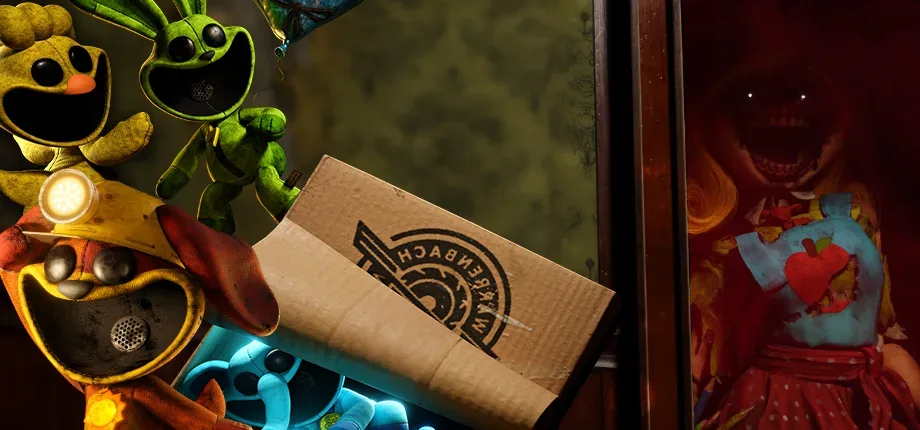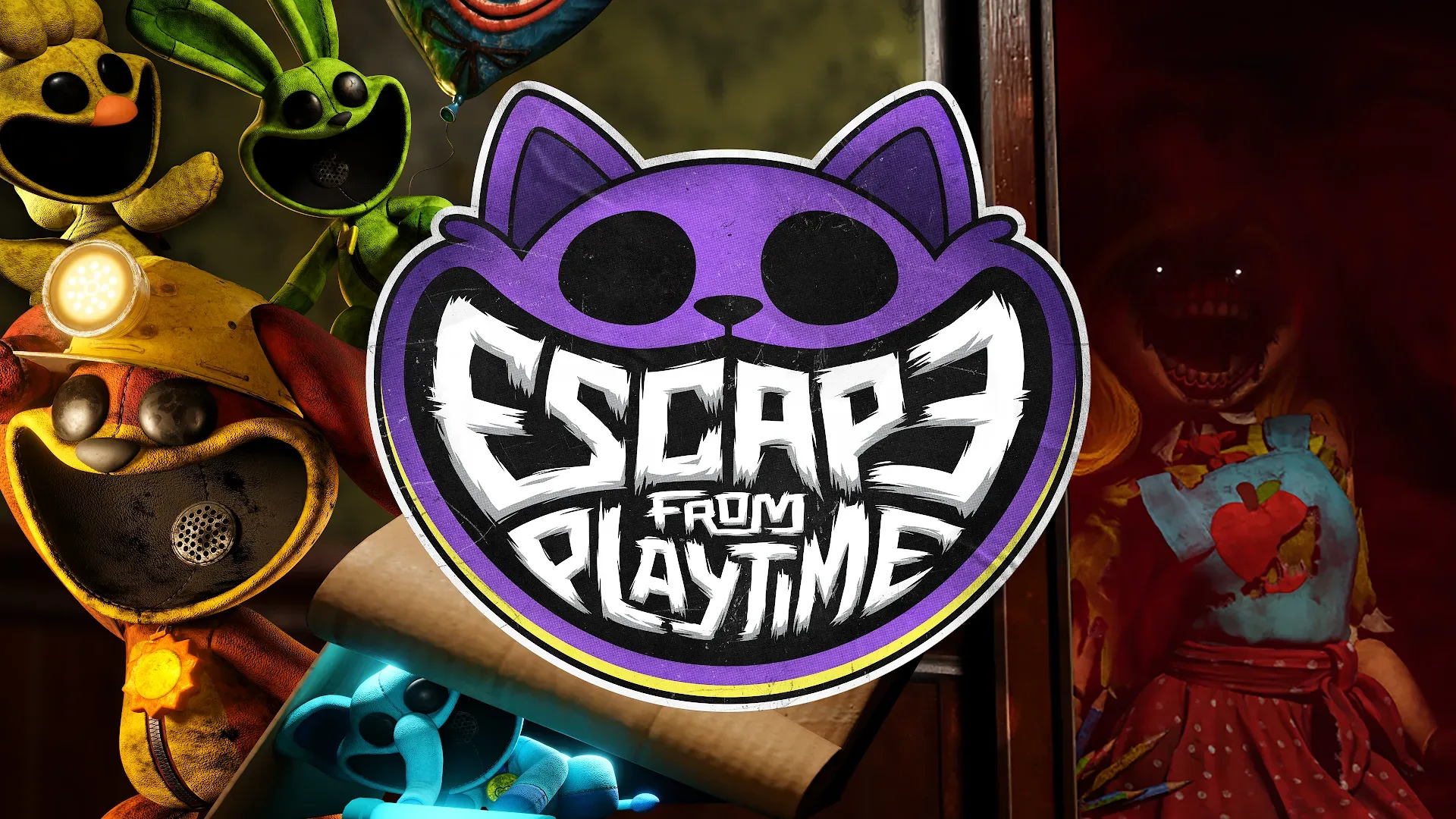
Escape From Playtime has received its first week-one update after launching on October 21, and the biggest change is social rather than spooky: public lobbies are now available. Mob Entertainment has replaced the previous requirement for group play and lobby codes with a more direct way to queue for other players, find an existing party, or create a lobby of your own. Public groups can contain from two to eight players.
That is a consequential early adjustment for a cooperative game. A lobby system is the layer that connects players before the match or session begins. Requiring players to exchange a code can work well for friends who have already arranged a group, but it creates friction for anyone arriving alone. Public lobbies remove that extra organizational step, making the route from launching the game to joining a team much clearer.
The update also expands the factory’s environmental storytelling with 12 newly scattered mysterious notes, unusual posters placed on walls, and VHS tapes that can be found around the facility. Alongside those additions, Mob Entertainment has altered session and shift timing in response to player feedback. The stated goal is to better balance difficulty and improve the odds that smaller groups can complete full shifts.
Public lobbies replace the code-first approach
Before this update, forming a group meant dealing with mandated group play and lobby codes. The new public-lobby model changes that structure into three basic options: players can queue, seek out a group, or host one themselves. Although those functions sound routine, their inclusion matters most in a game built around group participation.
For players arriving with friends, creating a lobby should provide a more straightforward starting point than organizing around a code. For solo players, a public queue gives them a route into the cooperative experience without first having to bring their own team. And for partial groups—two or three friends who do not have a full party—the ability to find additional players could be particularly useful.
The supported party range is also broad enough to cover different kinds of sessions. A two-person lobby supports a smaller, more intimate attempt, while an eight-player group allows for a much larger team. The update does not spell out how players are matched, whether teams can alter their size during a session, or which party size is ideal for a particular challenge. Those are details players will need to learn through the game and later patch notes. What is confirmed is that the game now recognizes a substantially wider range of public group configurations.
There is an important distinction between a lobby-size limit and a difficulty setting. The two-to-eight-player range tells players how many people a public lobby can hold; it does not by itself guarantee that every team size will face identical conditions. That is why the separate timing changes are notable. Mob Entertainment is addressing both access to groups and the balance of actually playing in groups of varying sizes.
Timing changes are aimed at smaller teams
The update changes session and shift timing based on feedback, with a specific emphasis on helping smaller groups finish complete shifts. In practical terms, timing is one of the levers developers can use to tune a cooperative challenge. Time windows affect how much a team can accomplish before a shift ends, how much room there is for recovery after an error, and whether a party has enough people available to divide responsibilities.
A large group can potentially spread tasks across more people. A small group has fewer hands, which can make the same timed objective more demanding even when its rules have not changed. The revised timing is therefore an attempt to make full-shift completion more realistic for teams at the lower end of the public-lobby range.
Players should not read the wording as a promise that smaller groups will become easy mode. The stated intent is to balance the experience so that those groups have a better chance, not to remove the challenge. Nor has a complete numerical breakdown of the altered timings been provided here. The useful takeaway is narrower but meaningful: group size is now an explicit consideration in the game’s ongoing balance work.
That work is not finished. Continued balancing of group size and timing difficulty is included among the team’s planned and incoming updates. In a newly launched multiplayer game, that signals an iterative approach: public-lobby behavior and player feedback can reveal where the pressure points remain, and further changes are expected rather than ruled out.
Twelve notes, posters and VHS tapes expand the factory’s mysteries
The other major part of the update concerns lore. Twelve additional mysterious notes have been placed throughout the factory. Strange posters on walls and VHS tapes discoverable around the facility join them as further artifacts for players to encounter.
“Discoverable lore” means story material that players find within the game world rather than receiving solely through a mandatory scene or a direct mission prompt. Notes are written clues; posters turn the environment itself into a place that may carry narrative detail; VHS tapes are physical-looking media objects that fit the facility’s unsettling atmosphere. The update does not disclose the content of the notes, what the posters depict, or what players will see or hear on the tapes. It is best to treat all of that as material to uncover rather than pre-explain.
The distinction matters because these additions create reasons to look beyond the most obvious route through a location. They are not described as quest requirements, unlocks, or a checklist with a reward attached. They are lore artifacts: optional-looking narrative signals distributed through the factory. Players interested in the setting can keep an eye on their surroundings without assuming every discovery changes a shift’s objectives.
More such material is already on the roadmap. Mob Entertainment lists additional discoverable lore artifacts among its future plans, so the 12 new notes are not presented as the final expansion of the game’s environmental storytelling. The team has also identified new items, cosmetics, emotes, puzzles, challenges, gameplay updates, and enemy enhancements as planned or incoming work.
It is worth separating those plans from content available now. Public lobbies, the 12 notes, posters, VHS tapes, and timing adjustments are part of this week-one update. The tutorial changes, guided beginner shift, further lore, continuing balance work, new items, cosmetics, emotes, additional puzzles and challenges, and gameplay or enemy improvements are listed as future work. No schedule or specific feature details for those incoming elements are provided.
A guided shift is planned for newcomers
Among the planned additions, tutorial updates and a guided shift for beginners stand out because they address another part of the new-player journey. A tutorial is designed to explain systems and expectations, while a guided shift suggests a more structured way for newcomers to experience a core activity. The available information does not define exactly how that shift will work, what it will teach, or when it will arrive.
Even so, it lines up with the public-lobby change. Easier group formation helps players get into a session; clearer onboarding can help them understand what to do once they are there. Those are different problems, and the roadmap indicates that Mob Entertainment is targeting both. The game’s difficulty and enemy behavior are also set for future updates, so the onboarding plans should be viewed as one part of a wider post-launch effort rather than an isolated feature.
Steam availability and the current discount
Escape From Playtime is available on Steam. It is also taking part in Steam Scream V Fest with a limited-time 10% discount. Players who have already downloaded Poppy Playtime: Chapter 1 can stack an additional 10% discount.
“Stack” is the key term in that offer: the information provided describes the Chapter 1 benefit as an extra discount on top of the festival reduction. However, no final price, end date, regional terms, or other purchase conditions are specified here. Prospective players should check the Steam store listing directly for the live price and eligibility details before buying.
For readers tracking horror releases and related gaming projects, Joking Joystick is also following three officially planned Hellraiser tabletop games. Escape From Playtime, meanwhile, is centered on its immediate post-launch update cycle: opening up groups, adjusting the timed structure for smaller teams, and planting more story clues around its factory setting.
What players can act on now
- Use public lobbies: Groups of two to eight can now be formed through public lobbies rather than relying on mandated group play and lobby codes.
- Look around the factory: The update adds 12 mysterious notes, plus posters and VHS tapes to discover.
- Expect timing to feel different: Session and shift timing has been adjusted with smaller groups in mind.
- Watch for future patches: A beginner-focused guided shift, tutorial changes, more lore, items, cosmetics, emotes, puzzles, challenges, enemy updates, and additional balancing are planned, but not yet dated.
- Verify the Steam promotion: The current festival discount is limited-time, and an eligible Chapter 1 download can add a further 10% discount.
Further update and patch information will be posted through the game’s Steam news hub.