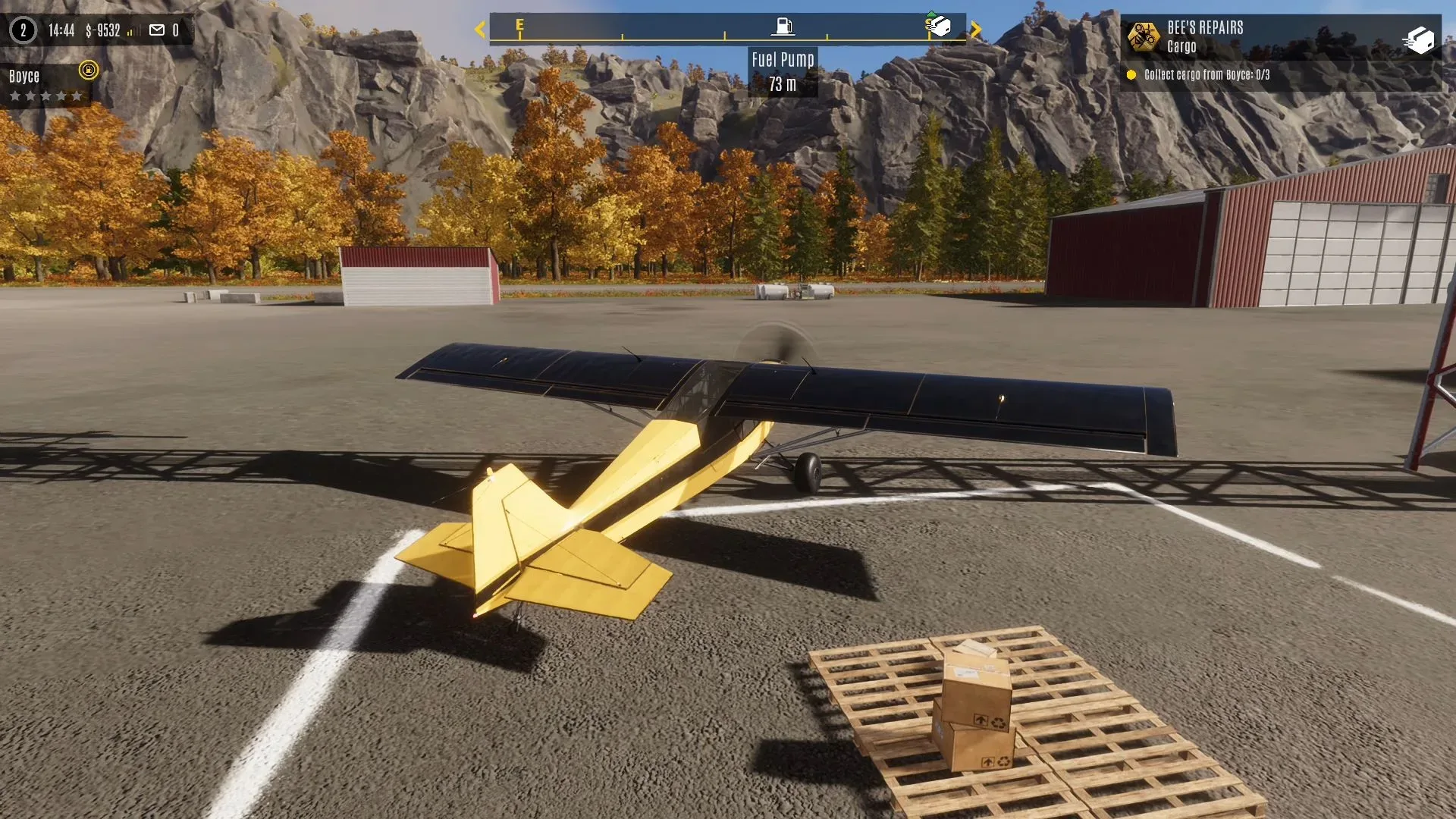
Deadstick: Bush Pilot Simulator will be playable at Flight Simulator UK LIVE at Aerospace Bristol this weekend. The public demo is scheduled for stand 12, giving flight-simulation fans an early opportunity to see the career-focused bush-flying game before its planned Steam launch later this year.
Published by Mythwright and developed by Spiral House, Deadstick is built around the working life of a flight courier in remote wilderness. Rather than treating flying as a sequence of isolated challenges, its central premise is a business and piloting loop: take jobs, complete demanding trips, earn money and reputation, then use those returns to maintain and expand an aviation operation.
A simulator about operating, not simply taking off
The word bush flying generally describes aviation work in remote regions where terrain, weather and limited facilities place a greater burden on the pilot. That concept is fundamental to Deadstick’s setup. Players run a courier service across rugged wilderness, accepting flights that must contend with difficult terrain and extreme weather rather than relying on a frictionless route from one airport to the next.
The important distinction is that the game’s flights are tied to a wider career simulation. Money and reputation are earned through completed work. Those resources can then go toward aircraft upgrades, hangars, maintenance and repairs. Players can also invest in rural airports, improving runways and facilities to open up additional jobs and opportunities.
That creates a chain of decisions with practical stakes. A flight is not only a test of landing safely; it also feeds the health and capability of the operation. Maintenance and repair costs mean aircraft care is part of the career rather than a background detail. Airport investment, meanwhile, suggests that progress is connected to strengthening the infrastructure that supports future work.
What the flight model is aiming to simulate
Deadstick’s flight model is described as authentic, with aircraft systems intended to behave realistically. The announced examples are battery drain, weight distribution, stall behaviour and crosswind correction. Each concerns a different part of operating an aircraft, and together they point to a game that expects players to understand more than throttle, steering and a landing checklist.
Battery drain
Battery drain refers to the gradual loss of electrical charge. In a simulation context, it means electrical power is not an unlimited abstraction. Players may need to account for the condition and use of a system rather than assuming it will remain available throughout every trip. It is a small phrase with a larger implication: pre-flight awareness and aircraft management matter alongside stick-and-rudder inputs.
Weight distribution
Weight distribution concerns where load is placed in the aircraft, not merely the total quantity being carried. The stated inclusion suggests cargo and operating choices can influence how an aircraft handles. For a courier premise, that connection is especially relevant: the work being transported is part of the flying problem, rather than only a line item attached to the mission reward.
Related coverage includes Deadstick: Bush Pilot Simulator Demo Set for Flight Simulator UK LIVE.
Stall behaviour
A stall is an aerodynamic condition in which a wing no longer produces lift as intended because its angle to the airflow has become too great. It should not be confused with an engine simply shutting down. By including stall behaviour, Deadstick signals that pilots will need to manage the aircraft’s limits carefully, particularly when conditions or terrain make a controlled approach more demanding.
Crosswind correction
Crosswind correction is the adjustment a pilot makes when wind blows across, rather than directly along, the path of travel. The goal is to keep the aircraft tracking where it needs to go despite the sideways effect of the wind. In a game centred on remote flights and severe weather, modelling this behaviour makes weather a direct handling consideration rather than just scenery.
These systems do not, on their own, define every aspect of the eventual release. They do establish the design direction, though: the simulator is asking players to use aircraft knowledge and piloting technique while running the commercial side of a small aviation career.
Why the career structure matters
Deadstick’s progression has two currencies of consequence: income and reputation. Income pays for tangible operational needs and improvements, including maintenance, repairs, hangars and upgrades. Reputation represents professional standing within the game’s job structure, with both forms of progress contributing to access and advancement.
The rural-airport investment system adds another layer beyond the player’s own aircraft. Improving runways and facilities can unlock more work, tying advancement to the places that make a regional courier network viable. This gives the game a potentially useful rhythm: fly jobs to build resources, use those resources to improve capacity, and pursue the opportunities created by those improvements.
For players considering the game, that structure is likely to be as significant as the simulation detail. A highly involved flight model rewards technique, but a career framework gives those technical demands a reason to persist from job to job. The result, based on the announced features, is positioned less as a collection of disconnected scenic flights and more as an operation that must be kept functional and developed over time.
What visitors can expect at Aerospace Bristol
The confirmed event detail is straightforward: Flight Simulator UK LIVE is being held at Aerospace Bristol this weekend, and Deadstick will be on stand 12. The demo provides a chance to engage with the game before launch, although no specific demo content, aircraft list, controls or build version has been detailed.
That uncertainty is worth keeping in mind. A show-floor demonstration can indicate the broad feel and priorities of a project, but it should not be read as a complete inventory of the final game. The announced facts support expectations of bush-flying courier work, challenging conditions, aircraft-system simulation and business progression. They do not establish exactly which missions, upgrades or airport-development options will be included in the playable demo.
The venue is a fitting place for a project built around aviation systems and piloting decisions. More importantly, the event puts Deadstick directly in front of an audience likely to recognize the difference between visual spectacle and handling detail. The inclusion of weight distribution, stalls and crosswind correction gives visitors clear areas to watch for when they take the controls.
Steam release remains planned for later this year
Deadstick: Bush Pilot Simulator is planned to launch on Steam later this year. No precise release date has been provided in the available information. Players who want to track its progress can add it to their Steam Wishlist.
The project arrives as another PC-focused game to keep an eye on; for broader platform-release coverage, see Star Wars: Galactic Racer’s launch across consoles, PC and Luna.
For now, the key takeaway is clear: Deadstick is presenting a version of bush flying in which careful control inputs, aircraft condition, cargo-related considerations and business planning all belong to the same loop. Flight Simulator UK LIVE attendees can find the demo on stand 12 at Aerospace Bristol this weekend, while the wider Steam release is still set for later in the year.