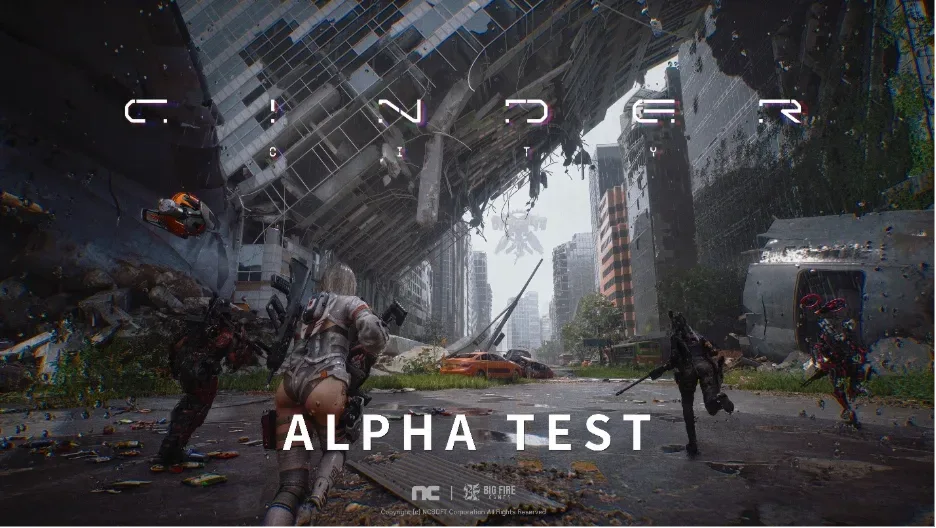
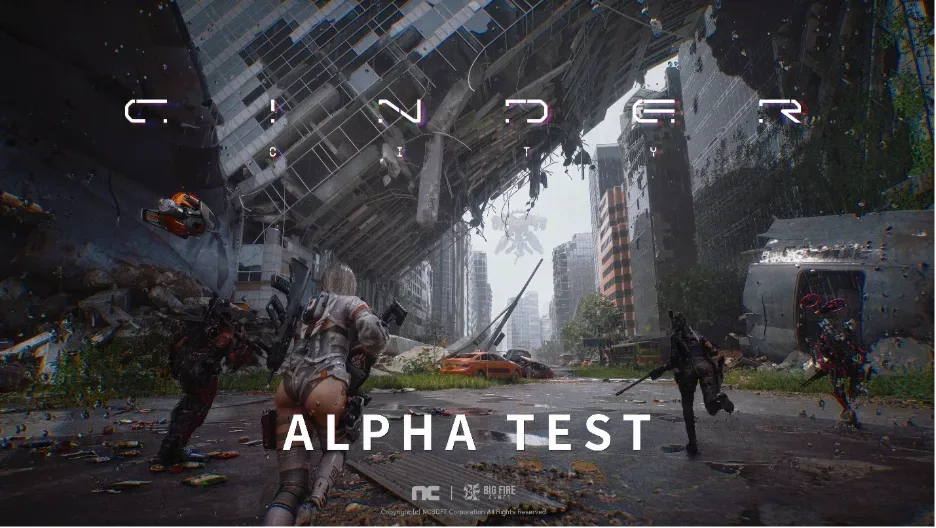
CINDER CITY will hold its expanded Closed Alpha Test II on Steam from December 4 through December 6, 2026. Developed by Bigfire Games and published by NC, formerly NCSOFT, the limited test is positioned as a substantially revised build following the August Pre-Alpha Test. It adds story and world content while addressing onboarding, ammunition availability, enemy behavior, movement and melee clarity.
The test is planned for players in North America, Europe and Asia. Registration opened November 12 at 6:00 a.m. PDT and remains open through November 30 through the Firstlook.gg waitlist. Test access is not described as guaranteed, so interested players should treat registration as an application rather than a confirmation.
Closed Alpha II will run in relatively concentrated sessions:
- Friday, December 4: 5:00 p.m. to 11:00 p.m. PST
- Saturday, December 5: 2:00 p.m. to 6:00 p.m. PST
- Sunday, December 6: 2:00 p.m. to 6:00 p.m. PST
Those windows matter for prospective participants: this is a short playtest, not a continuously available weekend build. Players hoping to explore the new areas, complete squad activities and offer meaningful feedback will likely need to plan around the specified hours.
A build shaped by Pre-Alpha feedback
The studio says the December version incorporates nearly 3,000 pieces of feedback from the Pre-Alpha. That does not mean every item requested by players has necessarily been changed, but the stated update list identifies several areas where the team is directly adjusting the moment-to-moment loop.
One major addition is a set of guide missions covering foundational survival systems: crafting ammunition, repairing guns and producing gear. These are especially notable because the game’s progression and combat systems appear tightly connected. A player who does not understand how to replenish ammunition or maintain a weapon can struggle long before a difficult enemy encounter becomes the issue. Making those mechanics explicit through missions, rather than expecting players to discover them unaided, should give the test a clearer opening path.
The prologue has also received a revised difficulty curve after A/B testing. In game development, A/B testing generally means comparing alternate versions of an experience to determine which produces stronger results against selected measures, such as completion, comprehension or player response. Here, the practical takeaway is modest but important: the earliest part of CINDER CITY has been deliberately retuned rather than merely expanded.
That approach pairs with the new tutorials. A survival-action game can challenge players through enemies and resource decisions, but difficulty becomes less useful when it is caused by unclear systems. The changes described for the prologue, guide missions and melee interface all point toward making the intended decisions easier to read, even as the world itself becomes more demanding.
Related coverage includes CINDER CITY Closed Alpha II Brings Bigger Map, New Dungeons and Combat Changes.
Ammo economy is being made less restrictive
The most detailed systemic adjustment concerns ammunition. The updated build increases average ammo drops by more than 30% and raises the frequency of gunpowder drops. Gunpowder matters because players can craft ammunition directly from the inventory, including during combat.
That last detail distinguishes ammo crafting from a purely between-missions preparation system. If a squad has the materials, crafting in the inventory can turn a tense encounter into a resource-management decision made under pressure. It does not eliminate scarcity; players still need the appropriate resources. But it provides an alternative to simply running out of bullets and retreating from a fight.
Additional ammo can be earned by executing enemies or using melee against opponents while they reload, with those actions yielding carried ammunition. This creates an intentional risk-and-reward layer. Rather than treating every reload window as only a chance to resume shooting, players can close distance and attempt to recover supplies. The danger, naturally, is that moving into melee range exposes players to threats that a ranged position may have avoided.
Major hubs will also receive new supply missions. Alongside the higher drop rates, these missions suggest more ways to keep a run supplied without relying exclusively on random combat drops. For players entering the alpha, the useful lesson is to engage with the full resource loop: collect gunpowder, learn mid-combat crafting, watch for enemy reload windows, and investigate supply opportunities at hubs.
Harder encounters, but more readable combat tools
More generous ammunition does not mean the December build is simply becoming easier. The open world is receiving tougher encounters, improved enemy artificial intelligence and stronger flanking behavior. Flanking refers to enemies attacking from side angles or otherwise forcing a player to deal with threats beyond the direction they were originally facing. In a squad game, it can reward communication and positioning; for a solo-minded player, it increases the importance of awareness and mobility.
To answer those pressures, CINDER CITY is refining action and movement. The changes include an added shoulder swap and improved slides. A shoulder swap is a third-person camera control that moves the camera view from one side of the character to the other. It can be valuable when shooting around cover, since the player can choose the angle that better exposes an enemy while reducing unwanted obstruction from the environment.
The build also includes clearer melee behavior and user-experience, or UX, feedback. UX in this context concerns how well the game communicates what an action does and when it can be used. This is significant because melee is not only an emergency option in the stated systems. It intersects with reloading enemies, ammunition recovery, shielding and parrying.
Shielding and parrying are identified as melee tools. A parry is typically a precisely timed defensive response that interrupts, deflects or otherwise counters an incoming attack. The alpha’s boss systems give it added relevance: successful parries can help fill a boss’s separate stagger gauge faster, depending on equipment. A stagger gauge is a meter distinct from ordinary health that tracks an enemy’s susceptibility to being disrupted. Filling it generally signals an opening or weakened state, though the specific result of staggering a boss has not been detailed.
Players are also encouraged to target enemy weak points for high damage. Taken together, those systems imply that combat efficiency will not be solely about firing the strongest available weapon. Accurate targeting, defensive timing, equipment choices and knowledge of enemy states can all matter. That makes the new onboarding missions useful beyond the first hour: understanding the systems may be central to surviving the harder world encounters.
A larger Yeoksam, Seonjeongneung and Nonhyeon play space
Closed Alpha II expands the open world covering Yeoksam, Seonjeongneung and Nonhyeon from 1.2 by 1.2 kilometers to 2.4 by 2.4 kilometers. Because both dimensions double, the total playable area is four times larger than in the earlier configuration. The larger map is paired with more than three times as many side missions.
The distinction between a doubled map measurement and a fourfold area increase is worth making. A map that grows from 1.2 km wide to 2.4 km wide does not merely add another 1.2 km of space in a single direction; it expands across both length and width. For testers, this should make exploration, travel routes and activity selection a more meaningful part of the session than before.
The new field boss is the Rampage Mech. It arrives alongside the broader open-world expansion, while the story now continues into Chapter 3, beyond Chapter 2, Episode 2. The available details do not establish how the field boss is accessed or what its rewards are, so players should avoid assuming it is tied to a particular mission chain. Its presence does, however, add another activity likely to put the game’s weak-point targeting, stagger systems and squad coordination under scrutiny.
For more on recent Steam-focused releases and updates, see our coverage of Delve Survivors’ launch with dungeon runs and horde combat.
Two new squad dungeons and a less punishing return trip
The alpha adds two squad dungeons: Yeoksam Grand Building, which features Hydes, and Chamber Zero. Dungeons can be approached through icons on the map, squad invitations or Auto Matchmaking. The latter is a matchmaking option intended to assemble a group automatically, rather than requiring players to arrive with a pre-made squad.
New in-dungeon save points are also part of the update. This is a practical quality-of-life addition for a game with squad content. A save point allows progress to be resumed rather than requiring an entire dungeon sequence to be repeated after an interruption or unsuccessful attempt. The announcement does not spell out the limits of this system, including how it interacts with groups, so it should not be mistaken for a promise of unrestricted saves. Still, its inclusion suggests that longer dungeon runs are expected to be a meaningful part of the alpha experience.
Higher-tier gear requires Blueprints obtained from dungeons or repeatable missions. A Blueprint is a required crafting or progression item used to unlock access to better equipment. This gives squad dungeons a direct role in power progression, rather than making them only optional combat challenges. Repeatable missions offer another stated route to those Blueprints, which may be useful for players who cannot consistently assemble a group or who want to revisit activities during the short test period.
What new testers should prioritize
The December alpha offers enough interlocking systems that jumping immediately into the biggest fight may not be the best way to evaluate it. Players new to CINDER CITY may benefit from taking the guide missions seriously, especially the lessons on ammo creation, weapon repairs and gear crafting. Those mechanics underpin the rest of the progression loop.
- Learn the inventory loop early. Understand how ammunition is crafted and which materials are required before a combat emergency makes that knowledge urgent.
- Use reload windows deliberately. Reloading opponents create a potential opening for executions or melee actions that can return carried ammo.
- Practice shoulder swapping and slides. With tougher enemy behavior and flanking, camera-side control and movement options can be as important as raw damage.
- Watch for weak points and boss stagger opportunities. High-damage weak-point shots and gear- or parry-assisted stagger build-up may help squads handle more durable threats efficiently.
- Check dungeon and repeatable-mission routes for Blueprints. Better gear is tied to these activities, so they are relevant to progression rather than merely extra content.
Ultimately, Closed Alpha II looks designed to test a clearer and more expansive version of CINDER CITY, not just a larger one. The map, Chapter 3 continuation, Rampage Mech and added dungeons increase the amount to do. Meanwhile, the new guide missions, altered ammo economy, movement work and melee UX changes aim to make the game’s intended survival-action decisions more understandable. The remaining question for the December sessions will be how those changes hold together when players navigate a much larger world, face smarter opposition and take on activities with a squad.