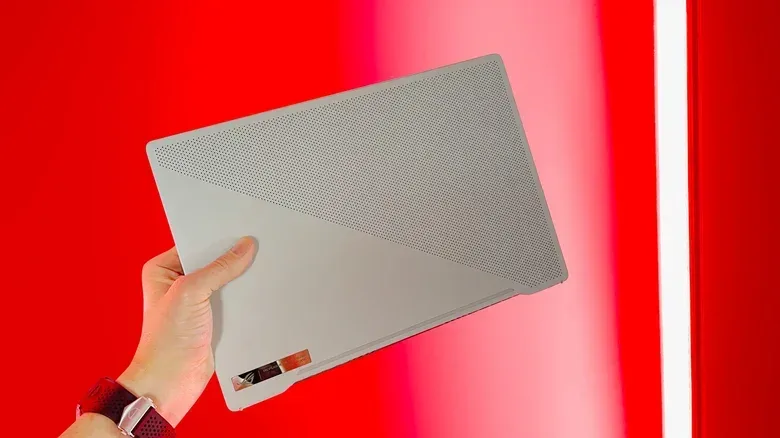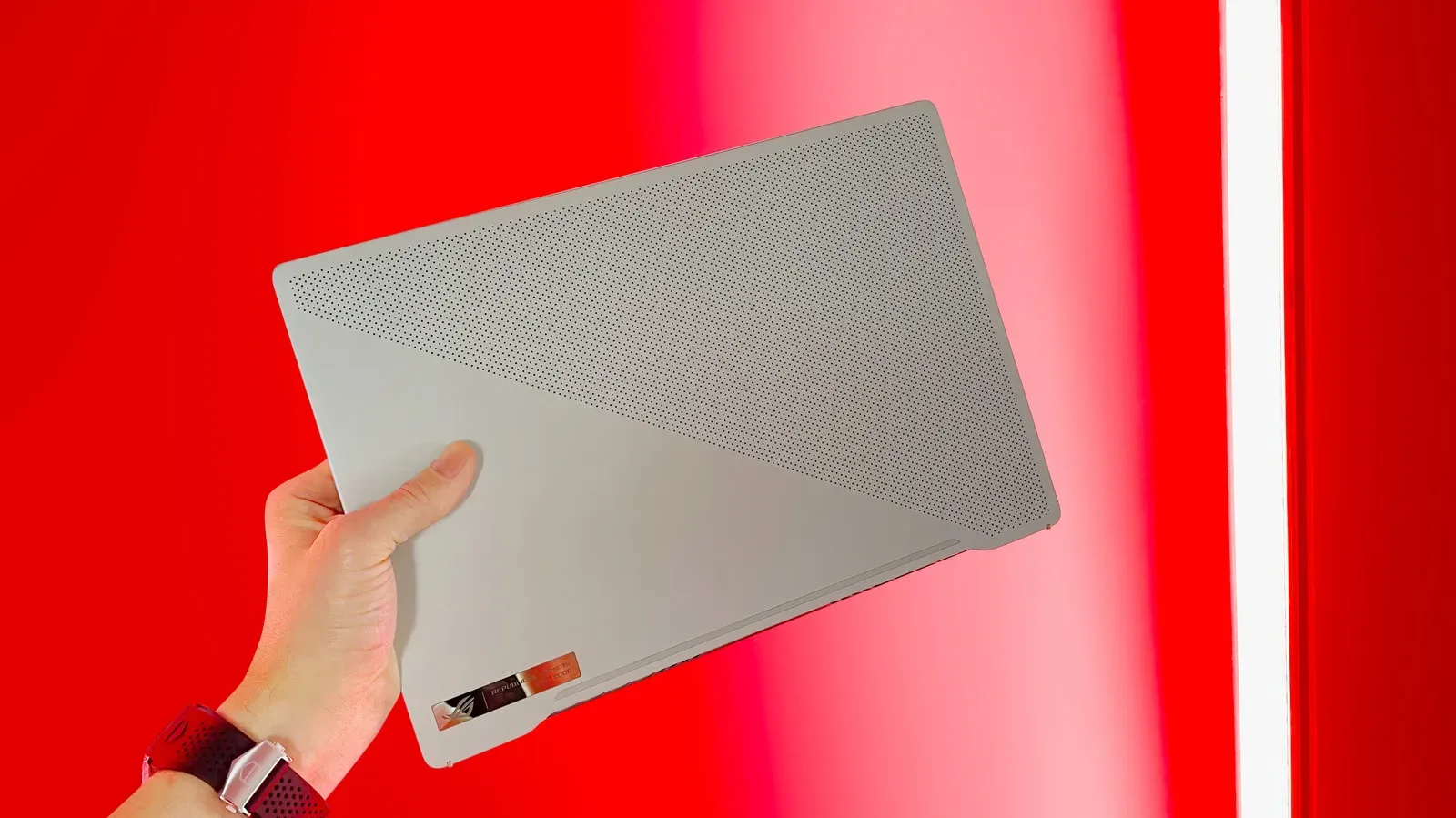
The ASUS ROG Zephyrus G14 has travelled a remarkable distance from its 2020 pitch: a compact gaming laptop that made high-performance hardware feel unusually attainable. The original base model launched at $1,050. In 2026, the least expensive model currently sold through the U.S. ASUS store costs $3,200, while a 32GB-memory version is listed at $3,600 directly from ASUS.
That is more than a straightforward story of annual upgrades. The G14 is still broadly in the same portability class it occupied at launch, with thickness and weight described as almost identical to the original machine. What has changed is the component tier of the configurations available to U.S. buyers, the display technology, graphics hardware, memory capacity in higher-end editions, and the cost of the memory and storage parts that modern thin gaming notebooks depend on.
Even allowing for inflation, the price gulf is hard to miss. The 2020 $1,050 launch price would be roughly $1,370 today. No currently listed G14 reaches that inflation-adjusted neighborhood. The situation is less about one laptop quietly getting a little more expensive each year and more about a former value-oriented entry configuration disappearing from the U.S. lineup.
From accessible 14-inch gaming machine to premium-only U.S. proposition
The 2020 base Zephyrus G14 combined an AMD Ryzen 7 4800HS processor, 8GB of RAM, Nvidia’s GTX 1650 graphics and a 60Hz 1080p display. Those specifications establish what the $1,050 figure represented: an entry-level gaming configuration, not a compromise-free flagship. A stronger version at $1,450 stepped up to a Ryzen 9 4900HS, RTX 2060 Max-Q graphics, 16GB of memory and a 120Hz screen.
That original G14 weighed about 3.5 pounds and measured 0.7 inches thick. Its significance was not simply that it was small. ASUS had introduced the Zephyrus brand only three years earlier with the 15-inch GX501, a $2,699 machine. The 14-inch G14 took the line into a dramatically lower price bracket without abandoning the central idea of a thin gaming laptop.
Subsequent generations did not move in a straight line, but they did progressively change the hardware and price expectations:
- 2022: A redesign centered on AMD Radeon graphics brought the starting point to about $1,650 for an RX 6700S model.
- 2023: Nvidia graphics returned. An RTX 4060 configuration was around $1,600, while an RTX 4090 version with a mini-LED display carried a $3,299 price tag.
- 2024: Another redesign added a 3K, 120Hz OLED panel and reduced weight to 3.31 pounds. It began at $1,600 with a Ryzen 9 8945HS, 16GB of RAM and an RTX 4060.
- 2025: Launch pricing started at $2,499 for an RTX 5070 Ti model with 32GB of RAM, rising to $3,200 for an RTX 5080 edition. ASUS had referenced a $2,199 starting point at CES 2025, but no configuration at that price arrived at launch.
The important wrinkle is that 2025 eventually did have a less costly option. An RTX 5060 G14 announced in May 2025 was priced at $1,800. That was still $750 above the original G14’s unadjusted price, but it included a 16GB memory allocation and OLED display technology that were not part of the 2020 base package. It remains the closest thing to a budget-conscious G14 choice while stock remains available at Best Buy.
What the $3,200 2026 G14 actually includes
For $3,200, the 2026 G14 sold in the U.S. is not configured like the original base model. It pairs an Intel Core Ultra 9 386H processor with an RTX 5070 Ti laptop GPU, 16GB of RAM, a 1TB SSD and a 2880 x 1800 OLED panel. The $3,600 direct-from-ASUS version increases memory to 32GB.
Several of those terms deserve separating from the price tag. OLED, or organic light-emitting diode display technology, means each pixel produces its own light rather than relying on a conventional backlight. The key practical point here is not an abstract resolution race: buyers are receiving a substantially more premium screen category than the 60Hz 1080p panel in the original entry G14. The 2880 x 1800 resolution is also far denser than 1080p, which increases available desktop space and image detail, though it can ask more of a graphics processor when games are run at native resolution.
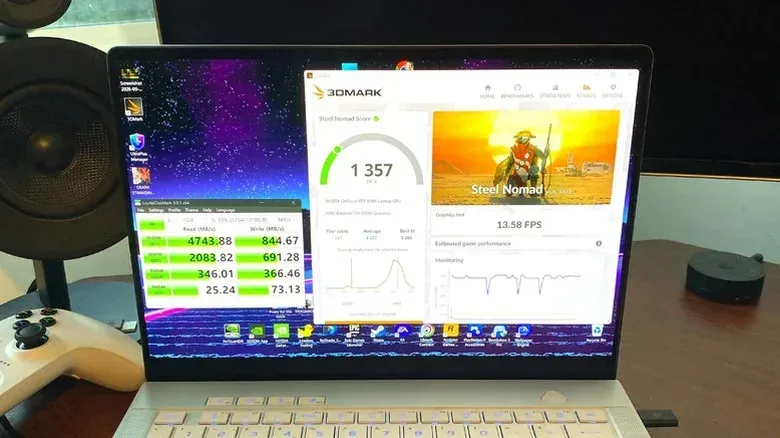
The RTX 5070 Ti is likewise a much different graphics tier from 2020’s GTX 1650 base option. Yet buyers should not read the model number alone as a complete measure of a laptop’s speed. Processor limits, cooling and the power available to the GPU can influence results. In benchmark testing, the 2026 RTX 5070 Ti G14 sometimes outperformed the preceding G14 model with an RTX 5080. That result is a useful reminder that a newer laptop platform can shift performance outcomes even when its graphics badge appears lower in the product stack.
At the extreme end of this design philosophy, ASUS also offers the dual-screen ROG Zephyrus Duo with the same processor and GPU combination for $4,500. The G14’s $3,200 price therefore does not make it the most expensive expression of this hardware; it does show how decisively the compact G14 itself has moved into premium territory.
The memory problem is central, not a side note
The most acute jump came between 2025 and 2026. ASUS had told partners in January 2025 that it would raise pricing on some products because memory costs were increasing amid AI-driven demand. That pressure matters especially to a thin gaming laptop because it relies on both DRAM and flash storage.
DRAM is the working memory used by the processor while applications and games are running. The 2026 G14 comes with either 16GB or 32GB. Flash storage is the non-volatile storage technology used in the 1TB SSD, retaining files and installed games when the laptop is powered down. A rise in either component category can affect notebook pricing; a rise in both affects a machine that includes a meaningful allocation of each.
AI demand has become relevant here because computing infrastructure built around AI workloads needs substantial memory capacity. The result described for the G14 is a market problem flowing all the way down to a gaming laptop’s bill of materials. It is not merely a case of ASUS choosing to add a luxury finish or a higher-resolution panel, although display, chassis and graphics upgrades added an estimated $750 to the sticker price from 2020 through 2025.
The scale is stark: inflation explains about $320 of the difference between the 2020 base G14 and the 2026 entry point. Hardware upgrades through 2025 account for another roughly $750. The remaining leap was concentrated in a single generation, alongside higher memory costs and the absence of cheaper configurations from the U.S. lineup. Almost two-thirds of the overall increase arrived in the latest year alone.
Soldered RAM raises the stakes of the configuration choice
There is an important practical consequence to the 2026 pricing structure: the G14’s RAM is soldered. Soldered memory is physically attached to the motherboard rather than seated in removable modules. The upside for a manufacturer can include helping fit components into an extremely thin chassis. The downside for the buyer is simple: the 16GB purchased at checkout remains 16GB. It cannot be upgraded later by swapping in more memory.
That makes the $400 gap between the $3,200 16GB version and the $3,600 32GB version more consequential than a conventional configuration menu might suggest. A purchaser is not choosing an easy future upgrade versus a larger upfront payment. They are choosing a fixed memory ceiling for the lifetime of the laptop.
That does not make 16GB automatically insufficient for every player, and the available information does not establish which specific games or workloads will require 32GB. It does mean shoppers should treat memory as a long-term specification rather than an accessory. The machine already carries a premium price, so a buyer whose work or play routinely needs more memory has little flexibility after purchase.
Why the nominal starting price can mislead
The G14’s recent history also illustrates why headline launch prices should be read alongside regional configuration availability. ASUS quoted a $2,199 G14 starting price at CES 2025, but that version was not sold when the line launched. A lower-cost RTX 5060 machine was later announced at $1,800, creating a more approachable option after the fact.
The 2026 story is similarly shaped by availability. ASUS makes a less expensive G14 with an AMD Ryzen AI 9 465 processor and RTX 5060 graphics, but it is not currently available from the U.S. store. For U.S. shoppers buying the current lineup, the RTX 5070 Ti model becomes the practical entry point at $3,200. In other words, the most relevant price is not the least expensive configuration that exists somewhere in a product family; it is the least expensive one a buyer can actually purchase in their region.
This also helps explain why the year-over-year comparison feels especially severe. At launch, the top-spec 2025 RTX 5080 G14 cost $3,200. One generation later, that same figure is the threshold for the U.S. G14 range, not the ceiling.
What prospective buyers can take from the comparison
The 2026 G14 is technologically far removed from the $1,050 machine of 2020. It has a much more ambitious screen, a 1TB SSD, a modern Core Ultra processor and RTX 5070 Ti graphics. It is also competing in a component market in which fast memory and storage have become notably more expensive. Treating the two prices as though they represent identical classes of computer would miss those meaningful changes.
But the comparison remains valuable because the physical premise has barely changed. The G14 is still a slim, lightweight 14-inch gaming laptop, not a radically larger or fundamentally different category of device. Its original strength was packing respectable gaming capability into that portable format at a low enough price to broaden the Zephyrus audience. The current U.S. range preserves the portable premium design but no longer preserves the accessible entry tier.
For buyers focused on the lowest G14 price rather than the newest generation, the 2025 RTX 5060 configuration at $1,800 is the meaningful alternative while it can still be found. It is not comparable with 2020 pricing after inflation, but it is dramatically less expensive than the $3,200 current U.S. starting point. Anyone weighing the 2026 models should also factor the fixed soldered-memory choice into their budget instead of assuming an upgrade can be deferred.
The G14’s evolution is ultimately a useful warning against reducing laptop value to a single model-year GPU label. Screen technology, memory capacity, storage, portability, component-market conditions and regional SKU availability all determine what an “entry-level” price really means. In 2026, the label has changed: the U.S. Zephyrus G14 entry model is a premium machine with a premium bill, even though its compact proportions still echo the affordable 2020 original.
The broader AI hardware boom is one of the pressures behind that shift, a connection that also fits the wider expansion of consumer-facing AI features, including Google’s latest Pixel AI tools. For gaming-laptop shoppers, though, the immediate effect is less abstract: memory and storage costs are now part of the price of admission.