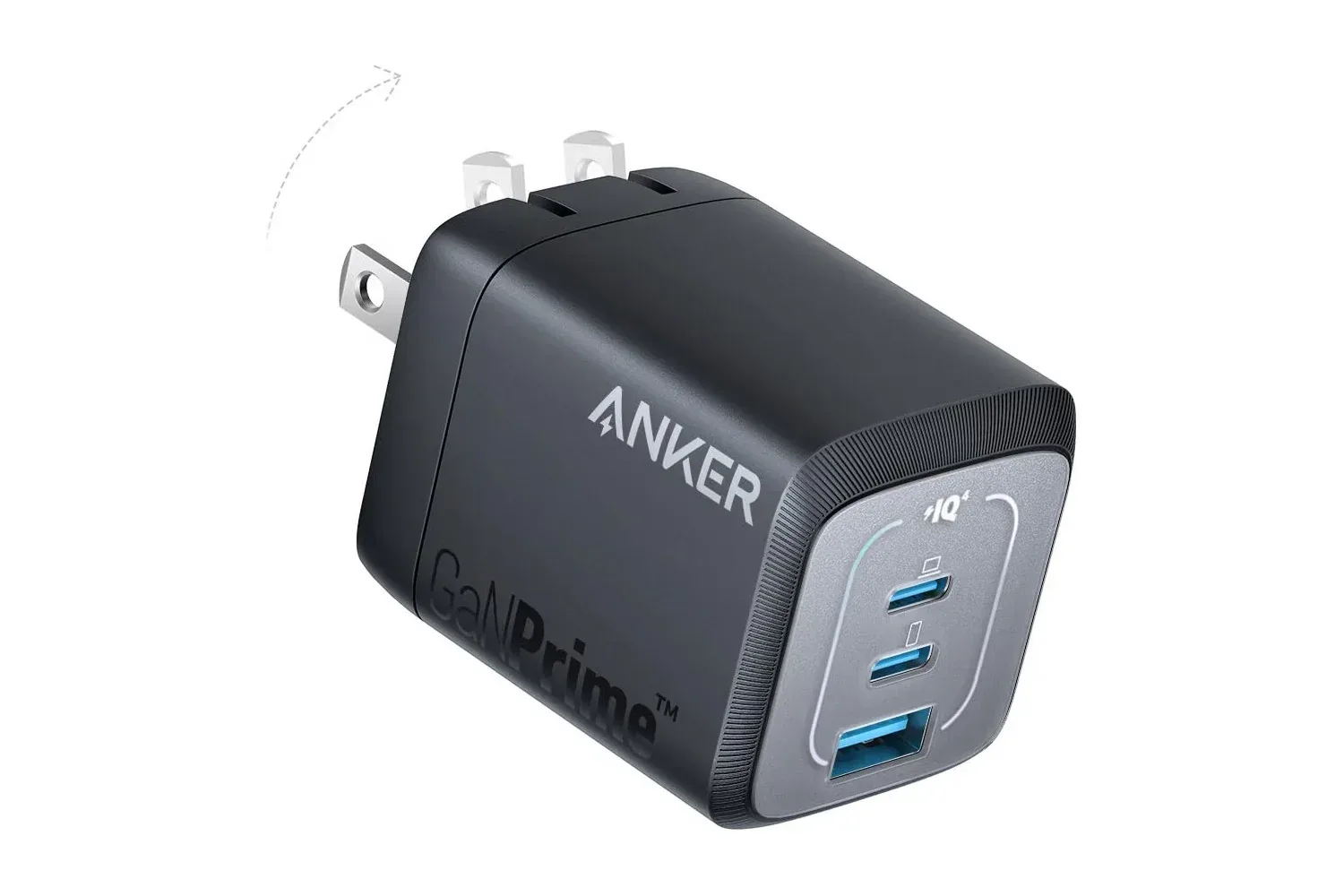
There is a particular kind of travel-bag chaos that begins with good intentions: one cable for a phone, another for a tablet, a separate plug for a watch, and then perhaps a gaming handheld or controller that would also appreciate some electricity before the train leaves. Anker’s three-port USB charger is intended to reduce that pile into a single wall outlet solution, and it is currently listed at $35, down from its usual $50 price.
The headline specification is 67W of total output shared across three ports. That distinction matters. This is not a claim that three connected devices each receive 67W simultaneously. Rather, the charger has 67 watts available to distribute among them. For someone charging a phone, tablet and smartwatch—or swapping one of those for another small device—the appeal is less about turning every port into a maximum-speed lane and more about replacing multiple charging blocks with one compact unit.
Its plug folds away for transport, and the charger includes real-time monitoring intended to track power use and device status while helping manage temperature. Anker also includes a 24-month warranty. Those points make the deal relevant not just to desk setups, but to people who routinely pack their hardware, cables and portable accessories together.
A $15 reduction on a charger designed for consolidation
The math is straightforward: the listed discount cuts $15 from the $50 usual price, bringing the charger to $35. Deals can change, and the lower price is described as available only for a limited time, so it should be treated as a live listing rather than a permanent new price.
At its core, this is a convenience purchase. A three-port charger can simplify a power strip, a bedside outlet, a hotel socket, or the one wall plug that somehow has to support an entire collection of modern electronics. The benefit becomes especially clear when the devices are ones that normally travel together. A phone and tablet are the obvious pairing; a smartwatch, wireless accessory, controller, or handheld can occupy the remaining spot depending on the user’s own kit.
One important limitation is equally straightforward: this is a wall charger, not a power bank. It needs an outlet and does not store power for charging devices on the move. The foldable design helps it occupy less awkward space in a bag, but it does not replace a battery pack for a long journey, a venue queue, or any other time away from mains power.
What “67W shared output” means in daily use
Watts are a measure of power. In charger shopping, the number is useful because it describes the total amount of power a charger can deliver under its supported charging arrangements. Here, 67W is the charger’s overall budget, not a separate budget attached to every port.
That shared-budget design has a practical consequence: adding devices can change how much power is available to each connected device. The charger is described as splitting its 67W output between ports to support fast charging when needed. That makes it a flexible choice for mixed charging rather than a product to judge solely by the biggest number on its box.
For example, a single connected device may have access to more of the charger’s available output than it would when two or three devices are connected. Once several items are drawing power, the charger has to divide its capacity. The devices themselves also influence the result, because they determine how much power they request and can accept. In other words, a high total wattage rating does not guarantee identical charging behavior for every phone, tablet, wearable or gaming accessory.
That is not a drawback unique to this charger; it is the fundamental trade-off behind multipoint charging. A buyer choosing a three-port block is choosing flexibility and outlet consolidation. Someone who needs maximum charging speed for one specific device at all times may instead prefer to keep that device on its own dedicated charger. The Anker block is better understood as a central charging point for several everyday devices.
Fast charging is a device-and-setup question
“Fast charge” is often used as if it were a universal mode a charger can impose on anything plugged into it. It is more conditional than that. A compatible device needs to request a supported charging level, and the cable and port arrangement also need to suit the job. The available information identifies this as a USB charger with three ports and says it offers wide compatibility, but it does not provide a port-by-port power table or specify the connector mix. Shoppers who need a particular port type or a guaranteed allocation for a particular device should check the current product listing before buying.
That verification matters even more when assembling a gaming travel setup. A handheld system, phone, tablet, wireless headset case and controller do not necessarily have the same charging needs. The best use of a three-port charger may simply be putting the most urgent devices on it together, then rotating less urgent accessories onto it later. That is a more realistic plan than assuming every device will charge at its individual maximum at the same moment.
Why one charger can be useful for a gaming setup
Gaming gear tends to accumulate peripheral charging requirements. Even a relatively simple setup can include a phone used for companion apps or messaging, a tablet, a watch, a controller, and a portable system or accessory. The three-port design offers a way to create a smaller charging station without claiming to solve every power need in a household.
For a desk, the immediate advantage is reducing competition for outlets. One charging block can sit in a central location while cables run to the devices most commonly used there. For travel, the foldable plug is the more meaningful feature. It can make the block less likely to snag against other belongings and easier to place in a small tech pouch. The ability to charge several devices through one outlet can also be useful where sockets are scarce.
It is worth separating portability from self-sufficiency. Foldable hardware is easier to carry, but an outlet remains essential. Users who expect to spend much of a trip without access to wall power will still need a separate battery solution. Likewise, buyers should not assume that the charger comes with every cable required for their own devices; the supplied details do not establish cable contents.
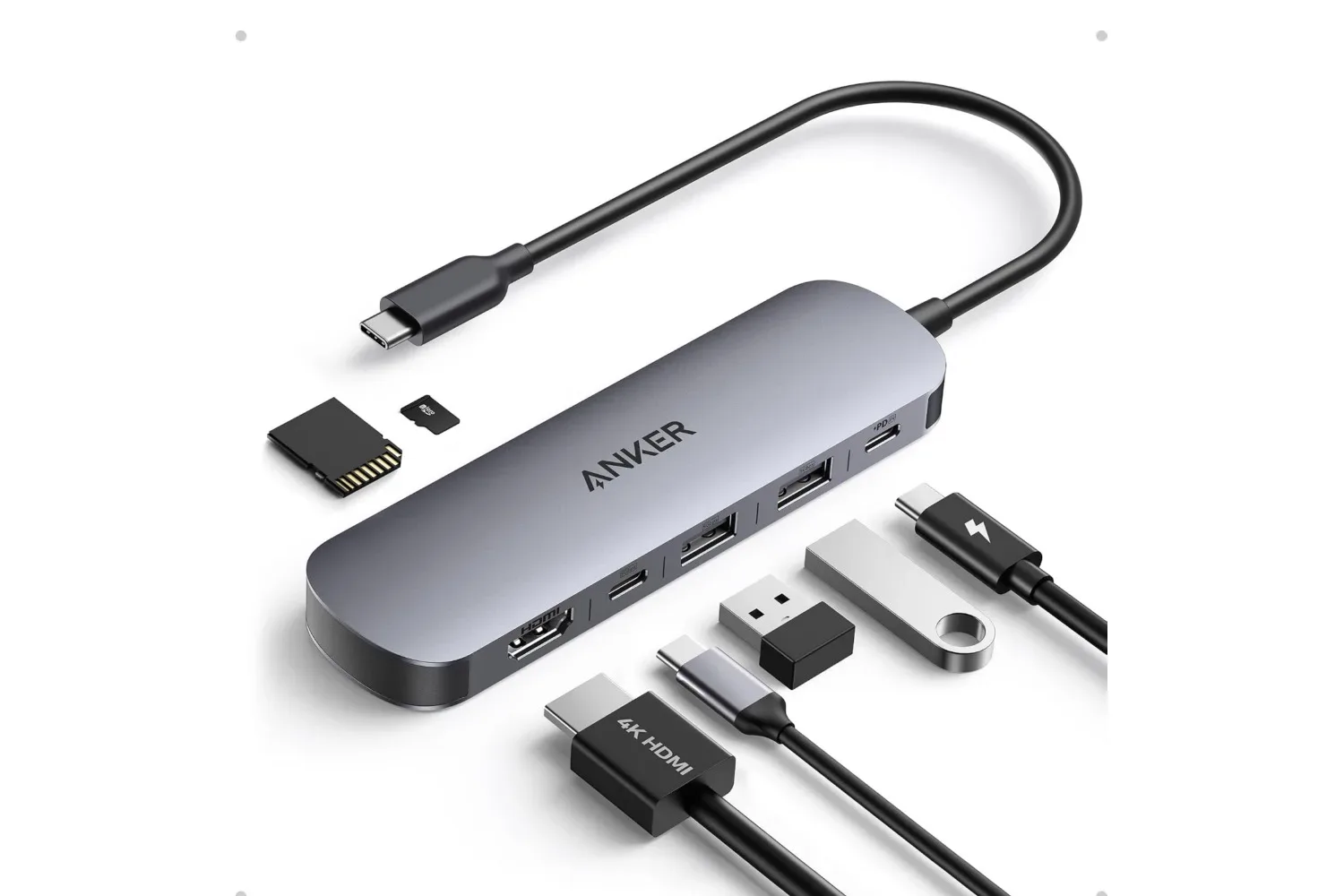
For another example of how a compact desk or travel setup can be expanded, Anker’s discounted 7-in-1 USB-C hub with HDMI, card readers and power delivery addresses connectivity rather than simply charging. The distinction is useful: a charger’s job is providing power, while a hub can add ports and display connectivity. They may complement each other, but they are not interchangeable purchases.
Monitoring and temperature management: what the listed safety features address
The charger’s real-time monitoring is described as checking power usage and device status while keeping temperatures lower. In plain terms, monitoring is the charger watching the charging conditions rather than treating power delivery as a fixed, unobserved process. Temperature management is important because electrical charging produces heat, and a charger has to work within safe operating conditions while devices draw power.
That does not make it sensible to disregard ordinary charging care. A charger should be used with appropriate cables and kept where it can operate normally rather than buried beneath items that retain heat. The product’s monitoring is a built-in feature intended to support safer operation; it is not a reason to assume every setup or accessory combination is equivalent.
The available details also characterize the charger as suitable for overnight use. That is a useful reassurance for people whose routine is to plug in a phone, tablet, or wearable at the end of the day. Still, the real value is arguably simpler: a multi-device charger reduces the ritual of deciding which item gets the lone available outlet. The monitoring and temperature-related functionality support that convenience by making the all-in-one approach more practical.
Who should consider the deal—and who should check the fine print first
This is most compelling for someone who regularly charges multiple small devices in the same place and wants one wall block rather than a cluster of single-device adapters. It also fits a traveler who values a folding plug and wants to make one outlet serve several parts of a personal tech kit. At $35, the price reduction makes that consolidation easier to justify than at the usual $50.
It is less clearly suited to shoppers who need portable stored power, require a known connector arrangement, or need exact power distribution information across all three ports. None of those requirements are unreasonable; they simply call for confirming the listing’s specifications before ordering. The stated 67W total is meaningful, but it should be evaluated as a shared pool of power.
- Consider it if one outlet often has to charge a phone, tablet and wearable or similar mix of devices.
- Consider it if a foldable plug would make a wall charger easier to pack.
- Check the product details first if a specific port type, cable arrangement or power split is essential to your setup.
- Look elsewhere as well if the priority is a power bank that can charge devices away from an outlet.
The deal is ultimately about making charging less scattered. A 67W total budget, three ports, a folding design, monitoring features and a 24-month warranty form a practical package, while the $35 limited-time price supplies the reason to consider it now rather than later. Just remember the central technical point before adding it to a cart: three ports provide flexibility, and the 67W output is shared among the devices connected to them.
Shop the products
Check current price, model and availability at the retailer.