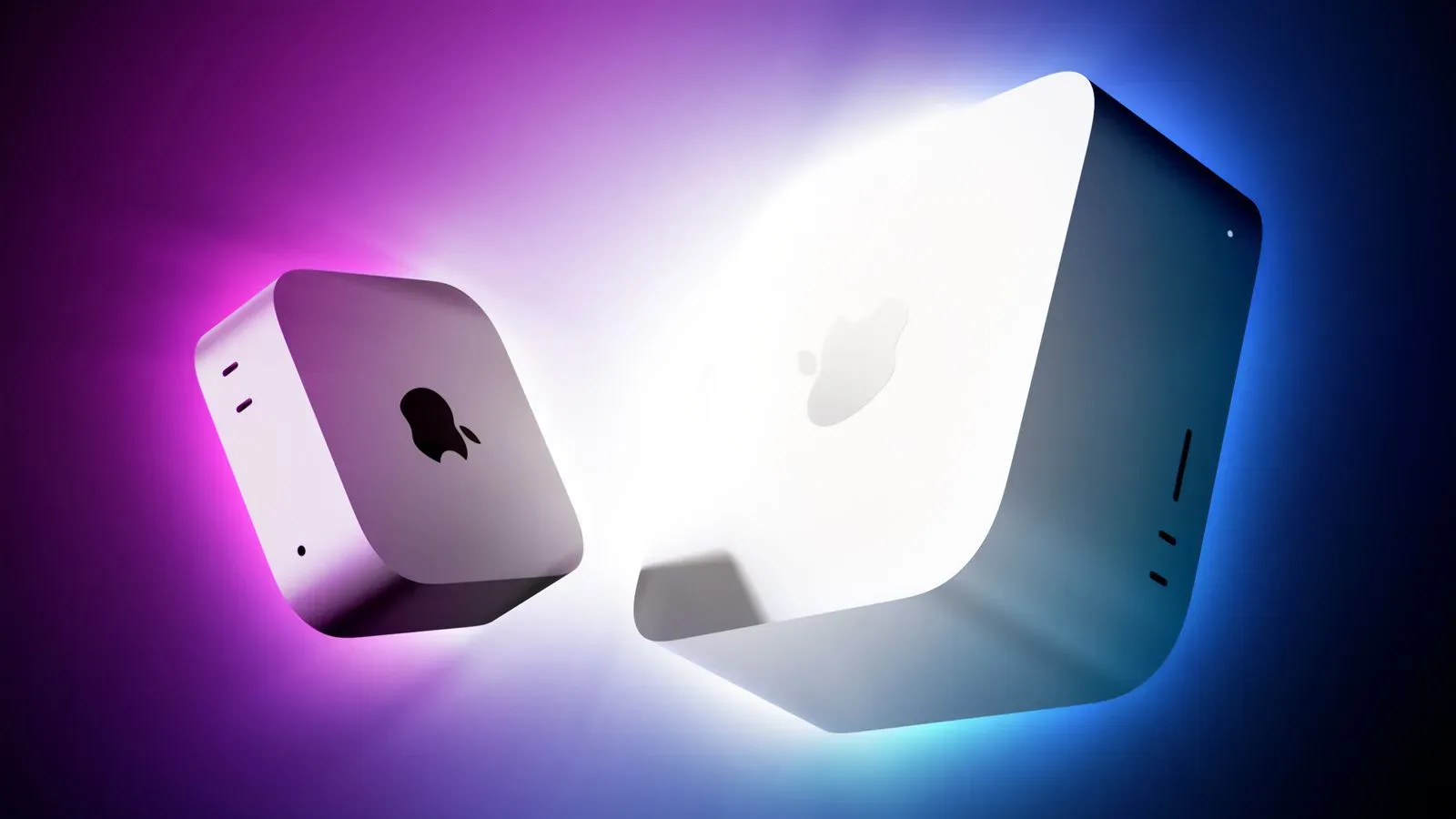
Amazon is listing notable price cuts on Apple desktop configurations centered on the M6 Mac mini and an M5 Max Mac Studio. The savings are straightforward but meaningful: two Mac mini options with 16GB of RAM are reduced by $119 and $149 respectively, while the specified Mac Studio configuration is discounted by $200.
The largest dollar reduction belongs to the M5 Max Mac Studio with 36GB of RAM and a 512GB SSD. It is listed at $2,299, down from $2,499. The two Mac mini listings are less expensive overall, with the 16GB RAM and 256GB SSD version at $779.99, a $119 reduction, and the 16GB RAM and 512GB SSD version at $949.99, a $149 reduction.
The discounted configurations at a glance
- M6 Mac mini, 16GB RAM, 256GB SSD: $779.99, reduced by $119.
- M6 Mac mini, 16GB RAM, 512GB SSD: $949.99, reduced by $149.
- M5 Max Mac Studio, 36GB RAM, 512GB SSD: $2,299, reduced by $200 from $2,499.
Those figures matter because the three offers should not be treated as interchangeable versions of the same purchase. They cover two different desktop lines, distinct memory capacities and different internal-storage capacities. A buyer comparing them should start with the exact configuration rather than the headline discount.
What the specifications actually distinguish
RAM, or memory, is the working space a computer has available while software is running. The listed Mac mini systems each have 16GB, while the listed Mac Studio has 36GB. That specification is one of the clearest dividing lines in these deals: the Studio configuration has more than twice the memory of either discounted mini.
SSD refers to solid-state storage: the internal capacity used for files, applications and other data. Here, the entry Mac mini has 256GB, while the other Mac mini and the Mac Studio each list 512GB. The $170 gap between the two discounted Mac mini prices is not solely a measure of the additional 256GB of storage; it is simply the difference between the prices of the two specific listings. Still, storage capacity is an immediately visible practical distinction.
The product names also signal separate tiers in the lineup. One is a Mac mini using an M6 chip, and the other is a Mac Studio using an M5 Max chip. The supplied listings establish those names and configurations, but do not provide performance benchmarks, port details, display support, dimensions or workload comparisons. It would therefore be a mistake to turn the sale prices into unsupported claims about which system is universally faster or best for a particular creative application.
Reading the discounts without overreading them
On the Mac mini side, the 256GB model’s $119 reduction brings its listed price to $779.99. The 512GB configuration’s $149 reduction brings it to $949.99. The bigger discount is attached to the pricier mini, but it is only $30 larger in absolute terms. The more consequential shopping question is whether the buyer wants the listed 512GB capacity enough to justify the $170 difference in sale price.
The Mac Studio deal is larger at $200, but it begins from a markedly higher $2,499 price point and remains a $2,299 purchase after the cut. It includes 36GB of RAM and a 512GB SSD, putting it in a materially different configuration class from the two 16GB Mac mini listings. The $200 saving is useful context for someone already considering that exact Studio, but it does not make it a like-for-like substitute for an M6 Mac mini.
That distinction is especially important when deal coverage compresses different machines into one headline. “Up to” savings language identifies the highest reduction in a group; it does not mean every model receives that reduction. In this case, the maximum $200 discount applies to the named Mac Studio configuration. The M6 Mac mini offers are discounted by $119 and $149.
A practical way to compare these listings
- Match the listing to the needed configuration. Check the model name, RAM amount and SSD capacity together. The two M6 Mac mini offers share 16GB of RAM but differ in storage, while the Mac Studio listing specifies both 36GB of RAM and 512GB of storage.
- Compare the final price, not just the amount saved. The discount tells part of the story; the out-of-pocket totals are $779.99, $949.99 and $2,299.
- Separate capacity from assumptions. The listings provide memory and storage figures, but not an exhaustive technical specification sheet or tested performance results. Buyers with a narrowly defined workload should verify the fuller product details before treating the sale as a fit.
- Confirm the offer at checkout. Retail pricing and stock can change. The useful number is the price shown for the exact configuration when the purchase is being made, rather than a deal headline detached from its listed model.
Why the Mac mini pair is the clearest comparison
The two M6 Mac mini offers create the most direct choice in the group because both list 16GB of RAM and differ visibly in SSD capacity and price. The 256GB version is the lower-cost entry at $779.99. The 512GB version costs $949.99 and has the larger advertised reduction, though the relevant decision is the $170 sale-price gap between those two configurations.
Neither listing supplies a reason to assume one capacity suits every buyer. Instead, they offer a simple fork: pay less for 256GB of SSD storage, or spend more for 512GB while keeping the stated 16GB RAM figure. The sale has value precisely because it makes that choice explicit rather than hiding it behind a single Mac mini price.
The Mac Studio offer is a separate buying decision
The M5 Max Mac Studio is best viewed independently. Its advertised 36GB RAM and 512GB SSD configuration is listed at $2,299 after the $200 reduction. That is $1,349.01 more than the 512GB M6 Mac mini at $949.99, and $1,519.01 more than the 256GB mini at $779.99.
Those differences do not establish which machine any individual should purchase. They do establish that the Studio is not merely a slightly upgraded version of the discounted minis in price terms. The sale groups several Apple desktop listings together, but the configuration details make clear that they occupy very different budgets.
For readers following the broader intersection of personal computing and games-industry technology, this report on decomp.dev’s shutdown and the collaborative game-decompilation community offers a separate look at how computing tools and game work can overlap.
What is known—and what is not
The available deal information is specific enough to identify three discounted Apple desktop configurations, their RAM and SSD capacities, and their advertised price reductions. It does not establish the duration of the offers, guarantee inventory, provide a complete feature comparison, or state that every Mac mini or Mac Studio configuration is discounted.
It also does not provide performance testing, so prospective buyers should resist filling in those gaps with assumptions. The disciplined takeaway is narrower: Amazon is listing an M6 Mac mini with 16GB RAM and 256GB storage for $779.99, another with 16GB RAM and 512GB storage for $949.99, and an M5 Max Mac Studio with 36GB RAM and 512GB storage for $2,299. For shoppers already targeting one of those exact configurations, the advertised reductions are $119, $149 and $200.
Shop the products
Check current price, model and availability at the retailer.