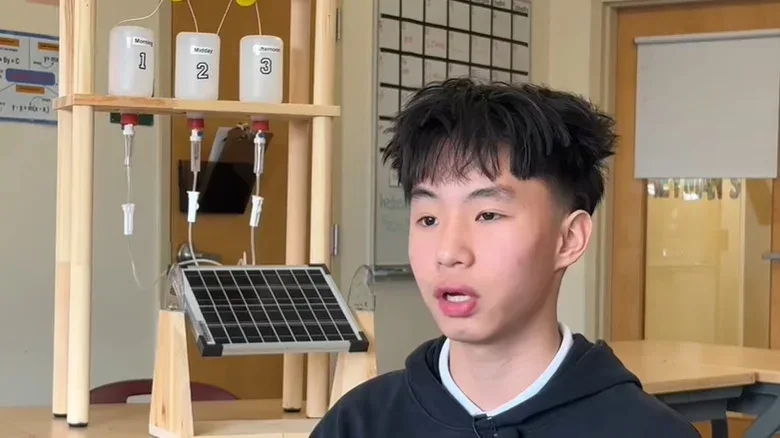
A small solar panel has one very ordinary enemy: the Sun refuses to stay put. Fixed panels are installed at a chosen angle, then remain there while sunlight shifts across the sky. Jason Chang, a 13-year-old seventh grader at Worcester Academy in Massachusetts, has built a strikingly simple response to that limitation: a solar tracker driven by dripping water and gravity rather than a motor, sensor, or electrical control system.
The project began with a household annoyance. Chang was repeatedly asked to reposition solar-powered Christmas lights so their panel could receive more sunlight. Instead of accepting the daily manual adjustment, he designed a mechanism intended to make the adjustment itself. The result is a low-cost prototype built largely from recycled materials, reported to cost less than $25.
Its central idea is accessible: let a steadily filling bucket become a clock. As water collects, the bucket grows heavier and changes the balance of a rotating wooden frame holding the panel. That gradual weight shift tilts the panel over the course of the day. In other words, the device tries to follow the Sun without electronically determining where the Sun is.
A seesaw becomes a solar tracker
Chang’s build operates on the same basic balance principle as a seesaw. A small solar panel sits on a wooden structure that can rotate. Water drips into a bucket attached to one side of the setup. As the mass of water rises, gravity increasingly pulls that side downward, changing the panel’s angle.
The clever part is not merely using a bucket as a counterweight. It is making the water flow at a rate that produces useful movement over a day. A tracker that pivots too quickly would point past the ideal direction early; one that moves too slowly would spend much of its time at an unhelpful angle. Chang adjusted the drip rate to make the panel tilt at approximately the right pace.
That approach eliminates several components commonly associated with automated movement:
- No motor: Gravity provides the force that changes the frame’s position.
- No sunlight sensor: The mechanism does not need to detect the Sun directly to begin moving.
- No electrical supply for the mechanism: The tracker itself is not dependent on the panel’s output to power a controller or motor.
The system is started by pulling a plug and allowing the water to flow. That apparent simplicity should not obscure the development behind it. Chang spent more than a year refining the prototype and documenting tests in a notebook. A gravity-powered mechanism may sound straightforward, but getting a physical system to move predictably on a schedule is an engineering challenge in its own right.
What the reported improvement does—and does not—show
In outdoor comparisons, the prototype reportedly generated about 20% more voltage than a stationary panel. That is a positive outcome for a student-built experimental design and an indication that changing the panel’s angle may help it capture sunlight more effectively.
Related coverage includes A 13-Year-Old Built a Water-Powered Solar Tracker With No Motor.
But voltage is not the same thing as electricity produced over time. This distinction matters, especially for anyone tempted to read “20% more voltage” as “20% lower electricity bills.” A panel’s useful electrical output involves voltage and current. Power is the rate at which electrical energy is delivered, while energy is the amount delivered across a period of time. A tracker’s practical performance would need measurements of current alongside voltage, plus energy readings gathered over time, to establish how much additional usable energy it actually produced.
The available results do not provide that full picture. They support a promising prototype result, not a verified 20% increase in power or total daily energy. They also do not establish what a comparable gain would look like with a larger panel, during different weather, or across seasons.
That is not a knock on the project. It is the difference between an early experiment and a deployment-ready energy claim. A well-designed next stage would compare a moving and fixed panel under the same outdoor conditions, record voltage and current at intervals, and total the energy produced over a meaningful period. It would also track how reliably the water system maintains its intended movement.
Why fixed rooftop panels are still the normal choice
Solar tracking is not a new concept. Commercial trackers can move panels as the Sun changes position, and tracking can raise energy yield for ground-mounted solar arrays. Yet movement has a price beyond the equipment itself: more complexity, more parts exposed to weather, and more maintenance to consider.
That trade-off helps explain why most home rooftop panels stay fixed. A small wooden frame with a lightweight panel is one thing. A roof-mounted moving assembly has to contend with rain, wind, structural mounting, and the long-term durability of every moving part. The extra energy produced must justify the added cost and upkeep. For many homeowners, adding another fixed panel may be less complicated than installing a tracker.
Chang’s design also depends on water, which replaces electrical complexity with practical questions of its own. Water needs to be available. The system must be reset or replenished at some interval. Its flow must remain consistent enough to keep the panel moving as intended. The information available does not state how often the device needs refilling or resetting, nor whether it has been tested with full-size panels in strong winds.
Winter presents another clear issue. Cold conditions can improve solar-panel efficiency, but a tracker that relies on flowing water faces the risk of ice. Chang is working on a winter version, an important step if the concept is to be useful beyond warmer conditions.
Where a motor-free design could matter most
The most plausible value of a small passive tracker is not necessarily as a universal replacement for rooftop solar hardware. It may be in compact, low-cost, or off-grid setups where even a modest improvement in collected energy could be useful and where avoiding motors, sensors, and their power needs is attractive.
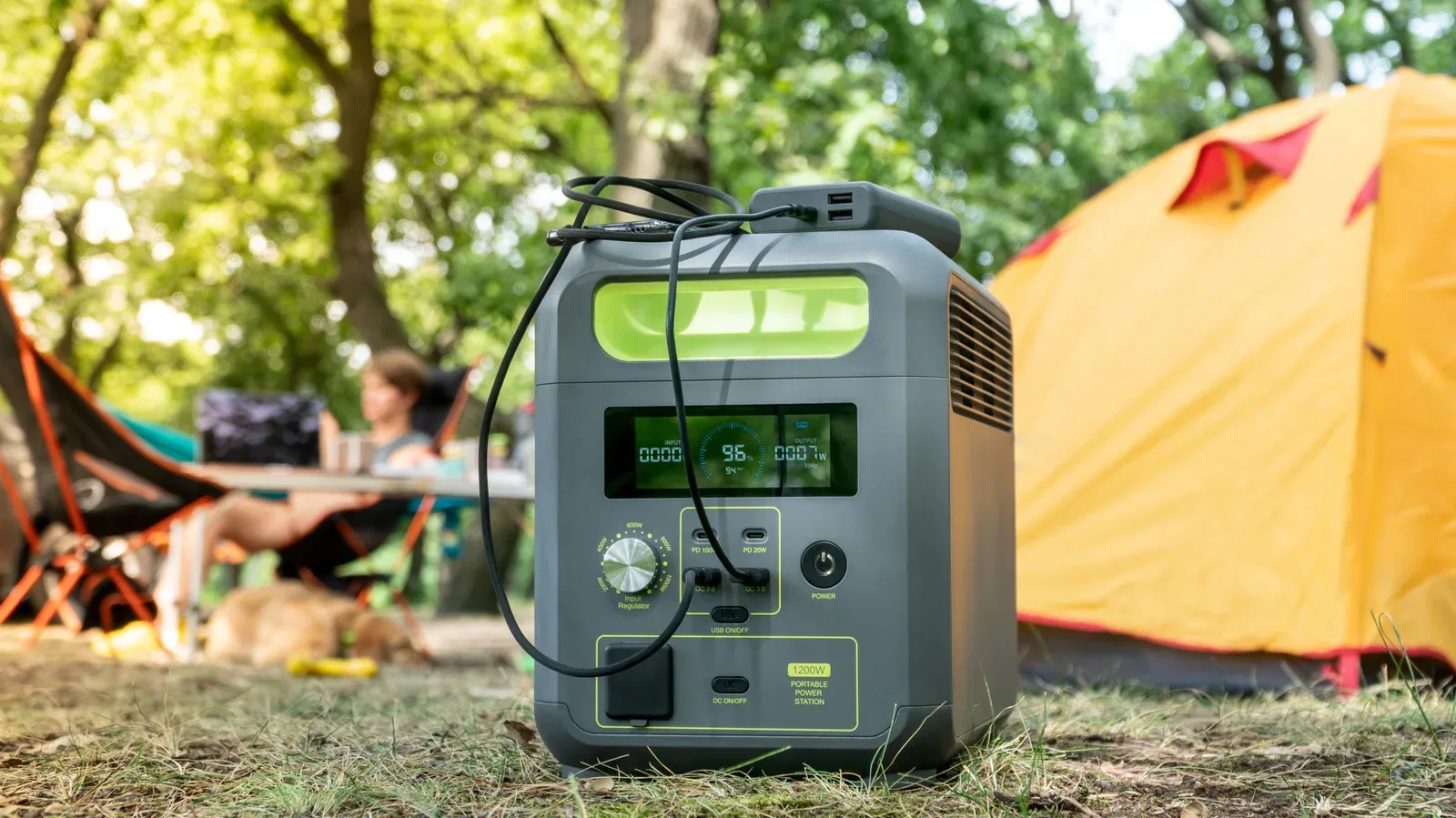
That framing also makes the prototype relevant to people thinking about small electronics, backup power, and portable setups. A solar panel does not automatically deliver every watt-hours figure attached to a battery or power station in real-world use; conversion and operating conditions matter. For a related practical breakdown, see why a 1,000Wh power station will not necessarily provide 1,000Wh to a gaming setup.
Chang’s tracker highlights a similarly useful point: collecting more favorable sunlight is only one part of an energy system. The panel’s electrical behavior, the battery, any charge controller, conversion losses, and the device being powered all affect the result. A higher voltage reading is valuable data, but it is not the final answer to how long a device can run.
An experiment with the right unanswered questions
What makes the project compelling is its combination of a familiar problem and a tangible mechanical answer. It takes a task that would otherwise require someone to manually move a panel and transforms it into a slow, gravity-driven process. The build also demonstrates that automation is not always synonymous with electronics: balance, mass, timing, and flow rate can form a control system of sorts.
Its limitations are equally instructive. Can the movement remain accurate as conditions change? Can the design withstand weather? How does it perform when temperatures fall below freezing? How much water does it consume, and how often does it require attention? Does it produce more total energy once current and time are measured? Those questions define the path from a promising small prototype to something that could be evaluated for broader use.
For now, Chang has shown an inventive way to tackle the fixed-angle problem with inexpensive materials and no motorized tracking hardware. In 2026, he was among 55 students recognized as National STEM Champions. The panel may be small, but the project’s lesson is not: a careful observation, persistent testing, and a deceptively simple physical mechanism can produce an idea worth examining closely.