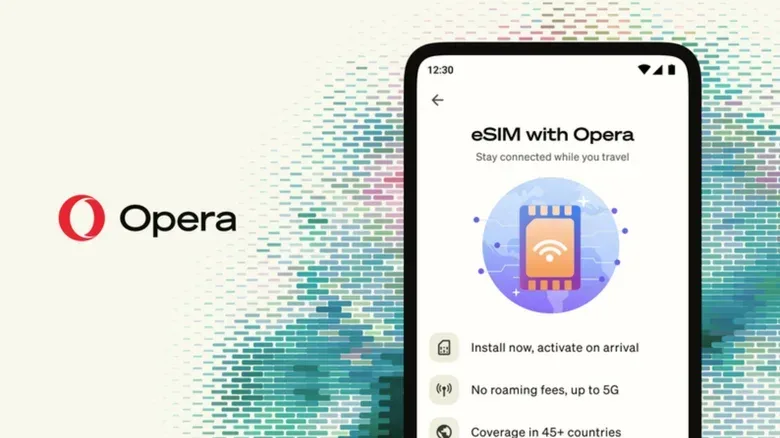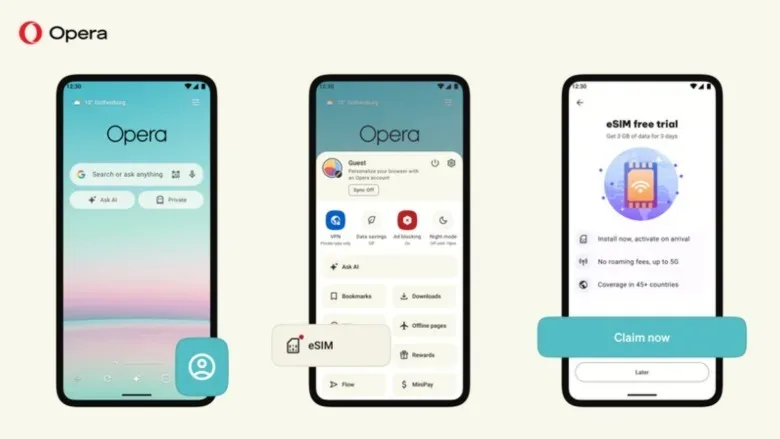
Opera has added a travel-minded connectivity feature to its Android browser: an eSIM accompanied by 3GB of free 5G data. The pitch is appealingly simple. Instead of swapping physical SIM cards after crossing a border, eligible travelers can use a digital SIM managed through the browser app and connect to local mobile networks in supported destinations.
The important wrinkle is that this is not merely data for web browsing inside Opera. Although the eSIM’s controls live in the browser, its connection is intended to provide internet access across the phone. That means other apps can use the connection too, rather than forcing a traveler to stay inside one browser while everything else remains stranded on costly roaming or hotel Wi-Fi.
For people traveling with a phone that doubles as a maps machine, chat client, authenticator, transit helper and handheld gaming device, that distinction matters. A browser-only data perk would be a novelty. System-wide connectivity can be practical. But the free portion has strict boundaries: the 3GB allotment expires three days after activation, and it is available only to people based in a specified group of countries.
What Opera is offering
An eSIM, or embedded SIM, is a digital alternative to the removable SIM card traditionally used to identify a subscriber on a mobile network. Rather than inserting a small physical card, a compatible phone can activate a digital plan. In Opera’s setup, the eSIM is built into the Android browser experience, with settings accessed from the app.
Opera says the same eSIM can work across 47 countries. The supplied examples include Thailand, Malaysia and Singapore. The convenience here is not simply avoiding the fiddly little tray-and-pin ritual associated with a physical SIM. It is also the prospect of keeping one travel eSIM in place instead of digitally swapping between separate country-specific eSIMs while moving from destination to destination.
The offer starts with 3GB of 5G data and does not require users to enter payment details to receive that initial allocation. After the free data has been used or its limited validity period has passed, paid options are available in 3GB, 5GB and 10GB sizes. Pricing varies by destination, so the headline free allowance should not be read as a promise that later top-ups will cost the same everywhere.
There is no commitment attached to claiming the initial eSIM and data, based on the details provided. That lowers the barrier for a traveler who wants a backup connection without creating a new account-and-billing chore before they have even reached the airport gate.
The three-day timer is the real boss fight
Three gigabytes can be useful, but it is not an unlimited holiday pass. The bigger limitation may be timing: the free data expires three days after activation. For a short trip, a stopover or the first stretch of a longer journey, that could be enough to get oriented. For trips that run beyond a long weekend, it is better understood as a starter pack than a complete connectivity plan.
How long 3GB lasts depends entirely on what a phone is asked to do. Lightweight tasks such as messaging, checking directions, looking up reservations and reading text-based pages generally make a smaller demand than video streaming. A long video session while sitting on a train can burn through an allowance very quickly. Automatic photo backups, app updates and cloud synchronization can also matter, even when the user feels like they are barely using the phone.
That is particularly relevant to mobile players. Downloading or updating a large game over the travel eSIM would be an aggressive use of a limited allowance, and streaming gameplay or watching extensive video guides can consume it rapidly. On the other hand, the connection could be genuinely useful for smaller but crucial tasks: receiving sign-in codes, checking a server status page, messaging a co-op group, using cloud saves cautiously, or finding a safe Wi-Fi connection before a longer download.
The practical lesson is not that 3GB is worthless. It is that travelers should decide what the data is for before activating it. Treating it as a connectivity reserve—especially for arrival, transit and emergencies—makes more sense than treating it as an invitation to make the phone behave as though it has a limitless home plan.
A simple data-preservation checklist
- Activate the free allotment when its three-day window will be most useful, rather than automatically before a trip begins.
- Avoid major game downloads, operating-system updates and app updates on the limited connection.
- Be cautious with high-resolution video, livestreams and automatic cloud photo uploads.
- Use Wi-Fi for large installs and keep the eSIM data for maps, messages, authentication and essential app access.
- Check destination-specific pricing before deciding whether a 3GB, 5GB or 10GB paid top-up is the sensible next step.
Those are general usage choices, not special Opera requirements. The value of a system-wide data connection is that users can decide which apps deserve the allowance. The downside is that every app can potentially spend it.
Who can get the free allowance
The eSIM is described as usable in 47 countries, but the free 3GB offer has a separate eligibility restriction. It is available to people based in the US, UK, Germany, France, UAE, Brazil, the Netherlands, Sweden, Norway and Poland.
That separation is worth reading carefully. Where the eSIM works and who can receive the free data offer are not the same question. A destination may be among the 47 supported countries while a prospective user may still fall outside the listed group eligible for the complimentary 3GB. Travelers should therefore verify both their home-base eligibility and destination coverage in the browser’s eSIM setup before relying on it.
Hardware and software requirements also apply. The feature is for Android 10 or newer, and the phone must support eSIM technology. It must also be carrier-unlocked. A carrier-locked handset may prevent the intended use of another mobile plan, even if the device has eSIM hardware and runs a sufficiently recent Android version.
That makes compatibility a three-part check:
- The device runs Android 10 or later.
- The specific phone supports eSIM.
- The phone is not locked to a carrier.
Users who pass only one or two of those checks should not assume the feature will work. “eSIM-compatible” is not automatically synonymous with “able to activate any travel eSIM,” because carrier status remains part of the equation.
A browser becoming a travel utility
The unusual part of this feature is its home. eSIM plans are often thought of as a phone-setting or carrier-app matter, while Opera is placing management inside a browser. That does not change the fact that the resulting connection serves the device more broadly; it changes where the user starts and administers the process.
Opera’s Android browser already includes a VPN, and the company has also been adding features including a soccer-focused hub. Separately, it has introduced Neon, an AI-driven agentic browser. The eSIM move fits a wider pattern of browsers trying to be more than page viewers: a single app can increasingly become a dashboard for privacy tools, information, AI features and now travel connectivity.
It is still useful to keep the concepts separate. A VPN is a privacy and routing tool that can change how internet traffic is tunneled; it is not a replacement for a mobile data connection. An eSIM data plan is the mechanism that supplies cellular connectivity. Opera offering both in its browser may make its travel toolkit more convenient, but one feature does not erase the constraints of the other. The supplied information does not establish any special relationship between the browser’s VPN and the eSIM data service.
What it means for gaming travelers
This is not a new gaming service and it does not turn 3GB into an all-you-can-download buffet. Its relevance to players is more basic: reliable mobile data can keep the many small support systems around games functioning while away from home. That can mean account verification, group messages, patch notes, companion apps, maps, voice-text coordination or a quick check of a game’s online status.
For travelers weighing an Android phone partly as a gaming device, connectivity remains one piece of a larger equation involving hardware, storage, battery health and game support. Our look at why a refurbished Pixel 8 can be a smart 2026 gaming phone buy—with clear limits offers related perspective on balancing those trade-offs.
Opera has not shared plans for an iOS version. For now, the feature is limited to qualifying Android devices. For eligible users headed abroad, it could be a low-friction safety net: an eSIM controlled through a familiar app, with no payment information required for the initial 3GB. Just make sure to save that small data bar for the moments it actually needs to carry the party.