A long gaming session away from a socket has a familiar villain: the tiny battery icon. The OHOVIV 50,000mAh Portable Charger Power Bank is positioned as a large-capacity answer to that problem, particularly for people carrying a phone, tablet, earbuds, smartwatch, or older accessories with mixed connector types. The model is listed at $31 for Amazon Prime members, reduced from $52. That is a stated $21 reduction, or 40%.
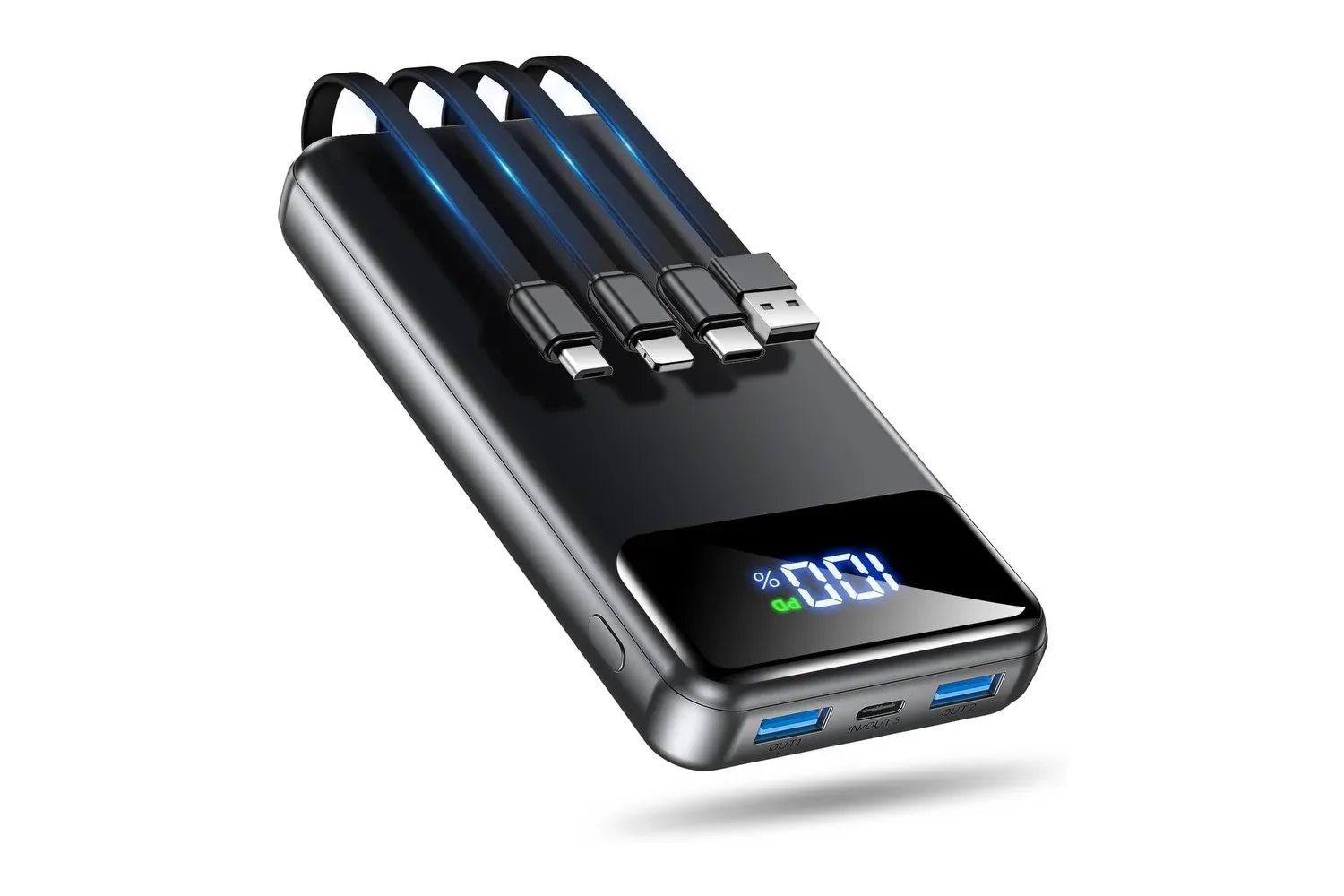
The headline specification is its 50,000mAh capacity, but the more immediately practical feature may be cable consolidation. OHOVIV includes four cables permanently attached to the pack: Lightning, USB-C, Micro USB, and USB-A. Two further USB-A ports and one USB-C port are also available, with the company saying the combined arrangement can charge as many as six devices at once.
For a player packing a handheld setup, a phone used for multiplayer coordination, a wireless headset case, and a tablet for travel entertainment, that combination is more relevant than capacity alone. It is designed to replace the small collection of cables that can otherwise disappear into a backpack at precisely the wrong time. There is an important caveat, though: “up to six devices” describes the number of connections available, not a guarantee that every connected device receives the same charging speed.
What the $31 listing includes
OHOVIV describes the package as a 50,000mAh battery pack with a USB-C cable for recharging the pack itself. The integrated leads cover several generations of portable gear:
- Lightning: intended for compatible older iPhone models and other Apple devices using that connector.
- USB-C: the current common connector for newer iPhones, Android phones, tablets, and many accessories.
- Micro USB: useful for older Bluetooth speakers and accessories still built around the legacy connection.
- USB-A: a traditional USB connector included as an attached lead, alongside the two USB-A ports on the power bank.
The USB-C port on the unit has a dual role. It can send power out to a connected device, and it is the port used to replenish the power bank. That is a convenient layout on paper because the same general connector family handles both input and output, although prospective buyers should still think about the wall adapter they already own. The included cable is not the wall charger itself.
An LED digital display shows remaining capacity. That is a small feature with a large practical benefit on a high-capacity pack: rather than interpreting a few vague indicator lights, users can check the displayed remaining charge and decide whether the power bank belongs in a bag, car, emergency kit, or by an outlet for a recharge.
Capacity needs context, not just a large number
mAh, short for milliampere-hours, is a commonly used measurement of battery capacity. A larger mAh figure generally signals a larger stored-energy reserve, but it should not be treated as a precise promise of a particular number of full charges for every device. The result changes with the device being charged, its battery size, charging losses, background use, battery condition, and the voltage conversion that happens as power moves from a battery pack to a phone or tablet.
OHOVIV says this model can charge an Apple iPhone 15 up to 10 times. That is a manufacturer claim rather than a universal result. It is best understood as an estimate that illustrates the scale of the pack: it is meant for repeated phone recharges or for sharing power across several portable devices, rather than merely rescuing one phone late in the day.
Related coverage includes OHOVIV 50,000mAh Power Bank Deal Drops to $31 for Prime Members.
This distinction matters for gaming travel. Someone charging a single phone intermittently has very different needs from a group using multiple phones while also topping up earbuds and a tablet. Capacity will be consumed by the total demand across everything connected. A 50,000mAh pack could be sensible for extended travel, camping, a car kit, or a household backup arrangement; it may be more capacity than necessary for an ordinary commute where a smaller unit is easier to carry.
There is also a practical inverse relationship worth keeping in mind: a power bank advertised with this much capacity is intended for endurance, but it also has to be recharged eventually. Prospective buyers should plan for that charging task, not just the device-charging side. The digital readout can at least make that maintenance easier to track.
22.5W charging: what PD and QC 4.0 mean
OHOVIV lists a maximum 22.5W output and support for PD and QC 4.0. In straightforward terms, watts measure power: higher wattage can allow compatible hardware to charge more quickly. PD means USB Power Delivery, while QC 4.0 refers to Qualcomm Quick Charge 4.0. They are charging standards that allow compatible devices and chargers to negotiate an appropriate power level.
The key word is compatible. A power bank’s stated maximum does not mean every phone, tablet, cable, or port will take power at that rate. The connected device decides what it can accept, and charging can slow as a battery fills. Charging several devices at once can also change how the available output is shared. These are normal limits of multi-device charging, not necessarily a defect in the product.
OHOVIV’s stated example is an iPhone reaching about 55% in roughly 30 minutes. As with the 10-charge estimate, that is a company-provided figure and should be treated as an indication, not a promise for every model or use case. A phone actively running a game, downloading updates, navigating, or operating at high screen brightness may not behave like an idle phone while it charges.
For players, fast charging can be most helpful during short breaks rather than as a substitute for a wall outlet in every circumstance. A partial recharge while waiting for transport or taking a meal break may be enough to preserve a phone’s hotspot, chat, authentication, maps, or companion-app duties for the rest of an outing. Those mundane jobs can become surprisingly important when a console, handheld, or PC relies on the phone around it.
The integrated-cable advantage, and the questions to ask
Built-in leads solve an uncomplicated but recurring problem: no cable means no charge, even when the battery pack is full. The attached Lightning, USB-C, Micro USB, and USB-A options make this unit particularly adaptable for a household or travel group with devices from different periods. OHOVIV says each integrated cable has been tested for more than 10,000 bend cycles.
Permanent cables do introduce a purchasing consideration. Their convenience is greatest if the attached connector types match the devices a buyer expects to carry. The availability of two USB-A ports and one USB-C port provides flexibility for separate cables when needed, but it is still worth inventorying a typical travel setup first: phone connector, tablet connector, earbuds case, smartwatch lead, and any handheld or controller accessories.
That check can prevent buying on the basis of a large capacity figure alone. A power bank is most useful when its ports, leads, and charging standards match actual equipment. For example, USB-C may be the everyday connector for newer phones, while Micro USB’s value lies in supporting an older speaker or accessory that has not yet left the gear drawer.
People setting up a travel-ready gaming bag may also find it helpful to pair battery planning with the rest of their portable equipment. A recent PC gaming upgrade consideration is a reminder that portable accessories and core hardware solve very different problems: a power bank can sustain compatible small devices, but it is not a replacement for mains power for every gaming system.
Safety features and sensible use
The unit is described as using intelligent protection chips for overcharging, overvoltage, overcurrent, and short-circuit protection. Those terms refer to conditions that can place unwanted electrical stress on connected devices or the power pack. Protection systems are a valuable part of a charging product, especially one intended to connect to several devices at once.
They do not remove the need for basic care. Use the pack and its connectors as intended, inspect cables and ports for damage, and recharge the battery pack through its USB-C port with suitable equipment. The LED display is useful here as well: knowing the remaining level makes it easier to recharge before a trip, rather than discovering the pack is depleted when a phone is already at its last few percent.
The proposed use cases are broad: vehicle storage, camping supplies, travel, emergency kits, and backup power during an outage. In each case, the core appeal is less about a single dramatic fast charge than about having a substantial portable reserve available to multiple people. It supports smartphones from brands including Apple, Samsung, and Google, provided the device can use one of the available connector options or a suitable cable through its ports.
Who this power bank suits
The OHOVIV pack makes the strongest case for people who regularly have several small devices in circulation and value connector variety. Its $31 Prime-member listing is especially straightforward for someone who needs a phone-and-accessory backup for a multi-day trip, camping, car storage, or a shared household charging station.
Its biggest differentiators are not merely the advertised 50,000mAh capacity and 22.5W maximum. They are the four attached cable types, three additional ports, a remaining-charge display, and support for charging up to six connected devices. Buyers should view the manufacturer’s phone-charge and speed figures as estimates, check their own connectors and charging needs, and remember that several simultaneous devices will share the available power.
For that right user, the setup aims to turn one battery pack into a flexible support item for phones, tablets, earbuds, watches, and older accessories—without requiring an extra handful of cables to be remembered before leaving home.
Shop the products
Check current price, model and availability at the retailer.