In an industry where a game’s name is often treated as a precious, defensible piece of its identity, two developers have taken a more unusual route: they are putting two entirely different games called Piece by Piece on Nintendo Switch on the very same day.
The shared-name releases arrive November 25 under the No More Robots publishing label. One Piece by Piece comes from Gamekat, while the other was developed and originally published by Neon Polygons. They are not alternate editions, companion games, or two halves of a single project. They are separate games with separate developers, distinct premises, and sharply different genres that happen to share an exceptionally fitting title.
It is a silly situation on its face, but it also says something positive about a business where developers are routinely competing for discoverability, attention, and a clear identity in crowded digital storefronts. Rather than escalating an accidental collision into a dispute, the teams embraced the coincidence—and then went further by working together on the Switch release.
Same title, very different games
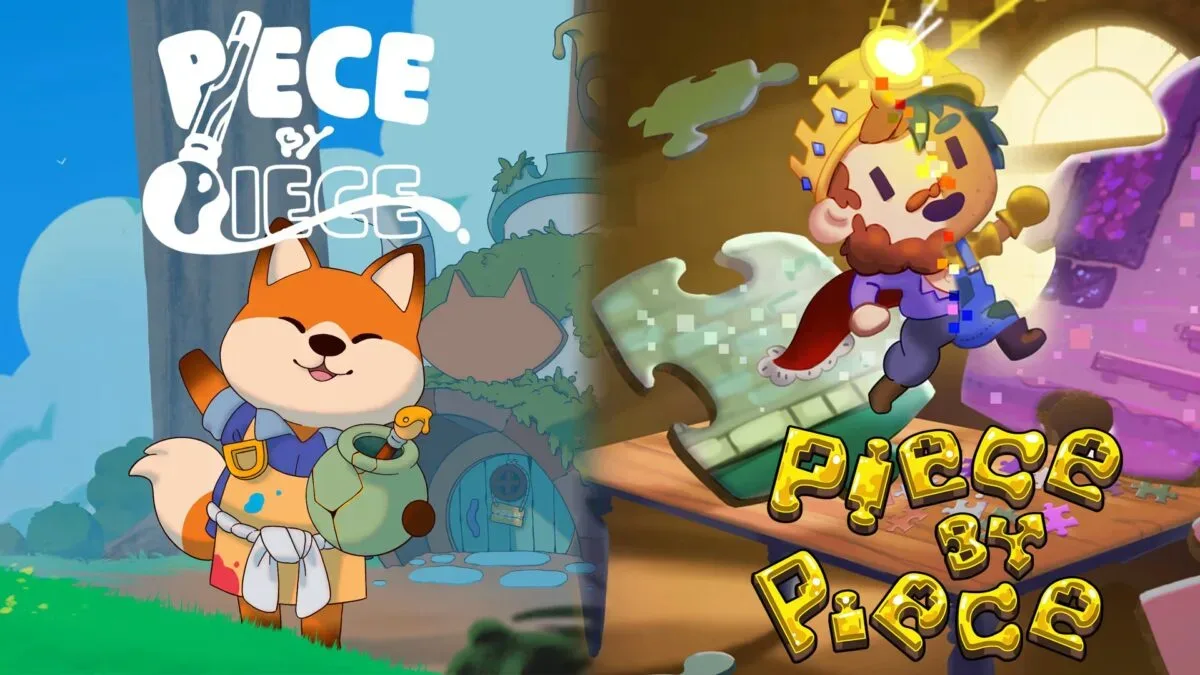
Gamekat’s Piece by Piece is a cozy life simulation game centered on a fox tinkerer. Its premise is rooted in restoration: the protagonist repairs the broken treasures belonging to neighbors. A life sim, short for life simulation, generally focuses on daily routines, relationships, personal projects, and a player-driven pace rather than on tightly structured combat or constant fail states. Here, fixing objects for a community appears to be the central fantasy suggested by the game’s description.
Neon Polygons’ Piece by Piece takes the title in a much more literal mechanical direction. It is a puzzle platformer in which players assemble the levels themselves in a jigsaw-like fashion. A puzzle platformer mixes movement challenges—such as navigating a stage—with problem-solving. In this case, the problem-solving is not merely about finding the right route through a completed environment. The environment is itself something to be pieced together.
That difference matters for anyone browsing the Switch storefront. The shared title may create an immediate double take, but prospective players should use the developer name and genre description to make sure they are looking at the intended game. One offers a gentler repair-and-community loop starring a fox; the other makes level construction part of its platforming puzzle design.
The coincidence did not begin on Switch. Both games had already launched on Steam earlier in the year. The developers became aware of the overlap after each team announced its Steam release date. No More Robots co-founder Mike Rose said his company announced its date in March, only for Neon Polygons to announce a date a day later that fell two days after No More Robots’ game.
A nervous email became a bundle proposal
Neon Polygons reportedly contacted No More Robots with understandable concern. From a smaller developer’s perspective, finding out that another game with the same name is about to launch close to yours can raise difficult questions quickly: whether the other party will object, whether players will confuse the listings, and whether the title will become a costly problem at the moment a project needs momentum.
Rose’s response was not a demand to change the name. Instead, he found the timing funny and proposed bundling the games on Steam. A bundle is a storefront offering that groups more than one product together, typically so customers can purchase the set as a package. The reported exchange turned the shared name from a liability into an angle that could make both releases more memorable.
That is not the same thing as suggesting naming confusion never matters. Titles remain a major discovery tool, particularly when players search digital stores, talk about games with friends, or try to remember a project they saw in a trailer. But the games’ genre split gives the situation an important practical distinction: this is not two similar-looking products racing to occupy the same niche. Their premises make it possible to identify them by more than their identical names.
For players, the most reliable shorthand is simple:
- Gamekat’s Piece by Piece: a cozy life sim about a fox tinkerer restoring neighbors’ broken treasures.
- Neon Polygons’ Piece by Piece: a jigsaw-inspired puzzle platformer where putting the level together is part of play.
From a Steam coincidence to a Switch collaboration
The story could have ended with the Steam bundle, but it grew when Neon Polygons wanted to bring its game to Switch. Rose learned that the team was constrained by the time and financial demands involved in making that port, then offered assistance.
A port is a version of a game adapted for another platform. It can involve much more than simply placing the same game on another digital store. Developers may need to ensure a game works within the target platform’s technical requirements, integrate platform-specific functions, prepare builds for submission, and navigate the approval process. The available information does not detail the technical work performed for Neon Polygons’ game, so it would be wrong to assume particular changes or features. What is clear is that the practical barriers to a Switch version were significant enough that outside help made a difference.
The result is that both games are now being released on Switch together, and both are associated with No More Robots for that launch. That arrangement is a material change from the earlier Steam situation, where Neon Polygons had published its own game. It also makes the double-title premise more visible: two products with the same name, arriving on the same console, on the same day, through the same publishing label.
Rose described the decision as partly a nice and fun gesture, while also admitting an affection for the chaos of it all. The humor is clearly intentional. Still, it is not chaos for its own sake if it gives a smaller team a path to a platform release it otherwise could not manage.
Why Nintendo needed repeated clarification
The trickiest part of the plan was apparently explaining it to Nintendo’s regional organizations. Rose said the teams had to repeatedly confirm to Nintendo groups in Europe, Japan, and America that these were indeed two separate games, that they had the same title, and that they would share a release date.
That reaction is easy to understand. Publishing systems are designed to prevent accidental duplication, misleading product records, and consumer confusion. Two separate submissions that match on title and date could resemble an error in a database or an attempt to create misleadingly similar storefront entries. In this instance, the apparent duplication was the intended joke—and the developers had to make that intention legible across multiple regional organizations.
It is worth separating the reported facts from the interpretation. The reported fact is that Nintendo required repeated explanation. The reasonable interpretation is that the situation did not fit normal expectations for product submissions. There is no indication here of a technical failure, a rejected release, or a policy violation. The story instead highlights the administrative oddity of trying to formalize a gag that relies on two listings looking, at first glance, like they should not coexist.
There is a broader lesson for storefront browsing, too. A game title is useful, but it is not a complete identifier. Developer name, publisher, genre description, and artwork all help distinguish one product from another. That normally sounds like basic shopping advice; in the case of these two releases, it becomes unusually important.
A cooperative answer to a crowded market
The collaboration lands at a moment when standing out is difficult for game developers. New games arrive constantly, and even a distinctive project can struggle to reach the people most likely to enjoy it. The source material also notes a related concern around developers pulling demos because they fear AI-made clones may further cloud discovery.
Nothing about this story resolves those larger pressures. A clever pairing cannot guarantee visibility, nor does it eliminate the importance of clear communication around each product. Yet it offers a notably different response to competition. The teams treated their overlap as a shared promotional opportunity and, later, as a reason to help make a console release possible.
There is also an important limit to the feel-good framing: the two games are not interchangeable. Anyone interested in the releases should choose based on their preferred type of experience, not merely on the joke. Players looking for cozy repair work and a neighborhood-focused life sim should seek out Gamekat’s game. Players drawn to constructing routes and stages as part of platforming challenges should look for Neon Polygons’ game.
For more on the pressures and technology discussions surrounding game development, see this report on AI tools moving through the games industry conversation.
What to watch for on November 25
The headline is straightforward: Switch will receive two separate titles named Piece by Piece on November 25. The amusing part is that this is not an accidental storefront collision that slipped through unnoticed. The developers and publisher knowingly built the launch around it, while Nintendo’s regional teams had to be reassured that the duplication was deliberate.
The useful takeaway is equally straightforward. Check which Piece by Piece you are selecting. One is made by Gamekat and centers on a fox tinkerer repairing treasured possessions; the other is made by Neon Polygons and turns jigsaw assembly into a puzzle-platforming mechanic. Their identical names are the setup. Their very different play concepts are the point.