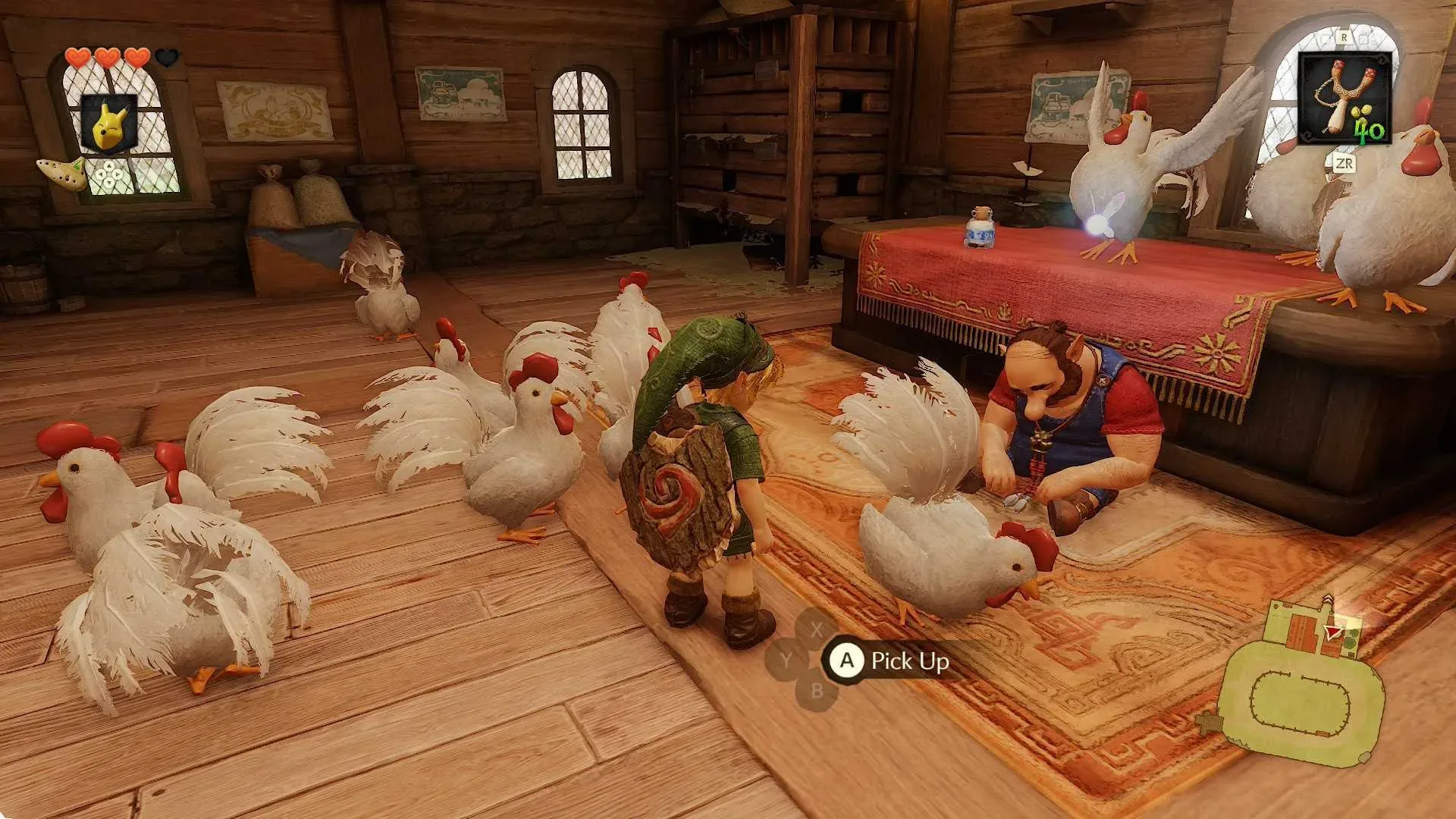
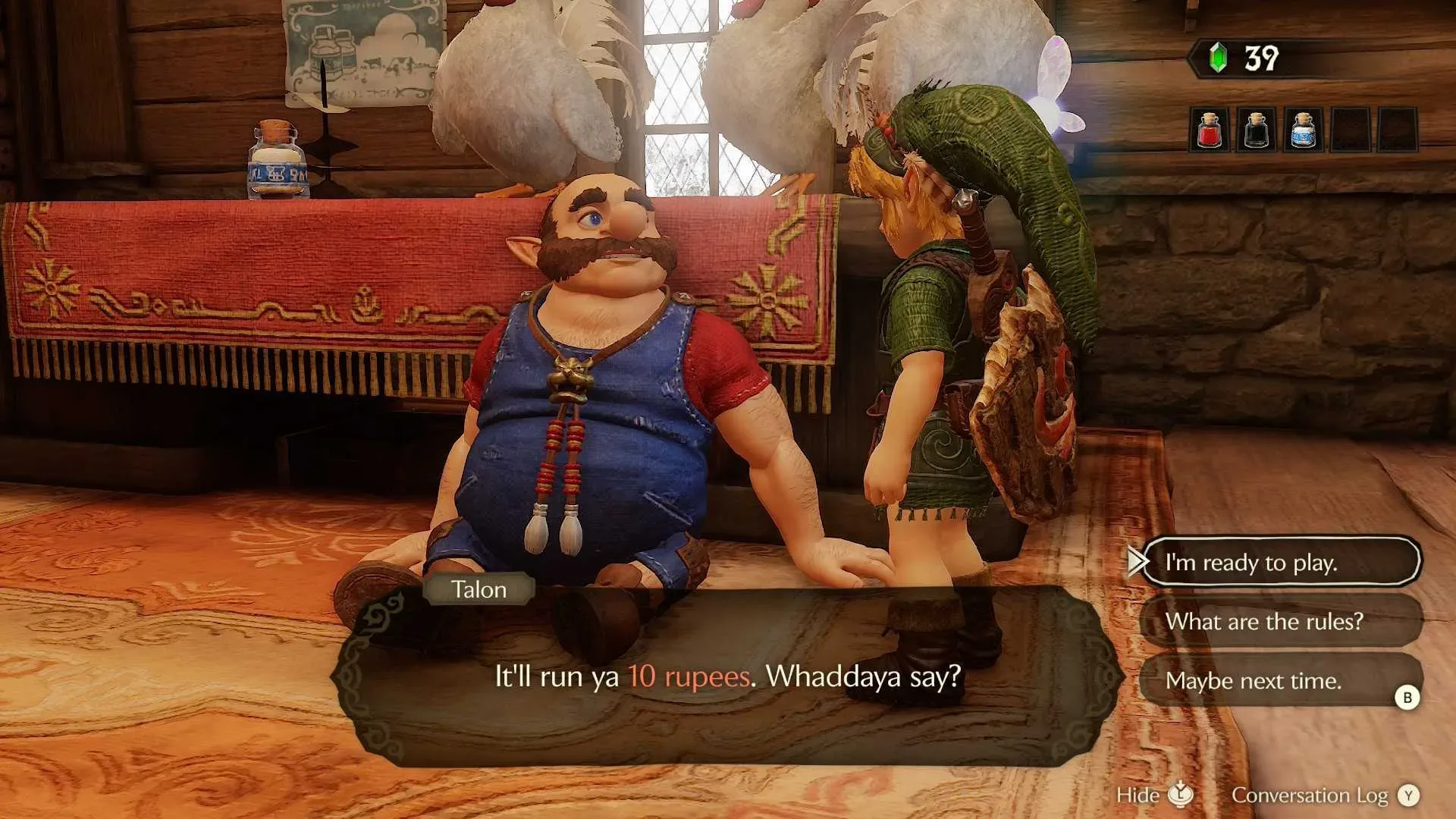
The humble Cucco challenge at Lon Lon Ranch has long been one of The Legend of Zelda: Ocarina of Time’s most easily outwitted diversions. Its premise is simple: identify three particular Cuccos within a larger flock inside Talon’s house, all while a timer runs down. The reward is a bottle containing Lon Lon Milk, an especially useful prize when Link’s inventory and funds are still limited.
Yet the old version’s small-room physics created a wonderfully low-tech solution. Before starting the minigame, players could pick up the ordinary Cuccos and pile them into the corner behind Talon, near the stairs. When the challenge began, the three target Cuccos were released into a largely empty floor. Instead of hunting through a moving knot of identical birds, players could immediately identify the only three birds not parked in poultry jail.
That route now appears to be closed in the reported Switch 2 remake. Cuccos cannot be left trapped behind Talon or held upstairs; attempts to place them there result in the birds sliding back down. More decisively, Talon reportedly shuffles and redistributes the room’s Cuccos once the player chooses to begin. Any pre-game sorting is undone before the clock starts.
The chicken game is now a chicken game
That sounds like a very minor adjustment, and mechanically it is. It does not rewrite a dungeon, alter a major boss encounter, or remove an important item. But it changes the character of a memorable little activity. The original tactic was not a hidden command or a difficult speedrunning maneuver. It was a piece of player improvisation built around object placement and the fact that the minigame did not fully reset its play space.
In game-design terms, an exploit is an unintended advantage produced by systems interacting in a useful way. It differs from an ordinary strategy because the designer may not have meant for it to exist, even if it requires no external tools and is available to every player. The Lon Lon Ranch trick fits that description neatly: players used the game’s normal carry-and-drop interactions, but did so before the activity’s intended random search could begin.
The remake’s change removes the exploit at its source. It is not merely that Cuccos are harder to wedge into a corner. The pre-game board state is reset, so the player enters the challenge on the terms Talon intended: a flock occupies the room, three birds are selected as targets, and the task is to find them under time pressure.
For players who remember paying repeatedly for attempts early in the adventure, the old setup had obvious appeal. The challenge charges money per play, while the early game does not exactly encourage reckless spending. A failed attempt meant another fee for another shot at what could otherwise be a frustratingly opaque guessing exercise. The bottle reward makes persistence worthwhile, but the exploit made persistence unnecessary.
A reset does not necessarily mean a harsher challenge
Importantly, the removal of the setup trick does not automatically make the Cucco game more punishing. Reports indicate that picking up and putting down Cuccos feels faster with the remake’s smoother controls. That can materially affect a timed task even when its rules are unchanged. Faster, more responsive interaction means less time lost simply wrestling with positioning or waiting for an action to register.
In practice, that suggests a different trade-off than a blunt difficulty increase. Players lose a way to make the answer visually obvious, but may gain a cleaner ability to inspect the flock and react during the actual round. The result is closer to a traditional minigame: less pre-arrangement, more direct execution.
It is also a useful reminder that remakes do not only preserve old behavior. Small technical and collision changes can reshape routines that veteran players treat as part of a game’s identity. A room reset, altered movement on stairs, or a changed collision surface can quietly retire a trick that was passed between players for years.
Another old rupee route also appears to be gone
The Cucco reset is not the only reported change to a familiar workaround. Players apparently can no longer climb the chains on Hyrule Castle’s drawbridge to collect rupees. Where the older route allowed Link to use the chains as climbable geometry, the remake has him fall through instead.
This is a different kind of adjustment from Talon shuffling birds. The ranch change explicitly restores the minigame’s starting conditions. The drawbridge case is more about collision: the invisible rules that determine whether a character can stand on, climb, pass through, or fall from part of the environment. If the chain no longer supports Link, that route disappears regardless of whether its removal was a targeted balance decision or a consequence of revised environmental behavior.
Either way, the practical result is the same for returning players: old mental maps need a quick audit. A remembered shortcut is no longer necessarily a shortcut.
Not every odd interaction has been cleaned up
The remake does not appear to be pursuing a complete purge of every unusual interaction, however. One reported trick remains particularly charming: striking butterflies with a Deku Stick can turn them into fairies. A fairy is valuable because it can provide recovery, making the butterfly interaction much more than a cosmetic curiosity when it is available.
That distinction matters. Some quirks reduce or bypass the intended challenge of a paid minigame; others reward experimentation with the game’s world. The reported butterfly behavior belongs more naturally to the latter category. It encourages players to test what happens when a basic item meets a common creature, which is exactly the sort of playful discovery that can make an older adventure world feel unusually alive.
There are also reports that at least some dungeon progression can still be tackled out of the usual order, though the precise cases are not established here. Sequence breaking, as it is often called, means reaching areas or completing objectives in an order the main progression path does not normally expect. It can range from a harmless alternative route to a run-altering shortcut, so each claim needs to be considered separately rather than treated as proof that every old skip survived.
The Chest Minigame may remain another point of interest. The Lens of Truth—apparently called Goggles in this version—has historically been associated with revealing the correct choice in that challenge. Its status has not been confirmed here, so players should regard it as an open question rather than a guaranteed surviving shortcut.
What returning players should take from the changes
For anyone revisiting Hyrule with a memory full of schoolyard solutions, the safest approach is simple: test the trick, but do not plan an early route around it. The Cucco corral strategy is specifically undermined by Talon’s reset, and the drawbridge-chain rupees are reportedly unavailable. Those are concrete examples of old knowledge no longer transferring perfectly.
- At Lon Lon Ranch: expect to identify the target birds during the timed challenge instead of separating the flock beforehand.
- With movement tricks: do not assume old scenery retains the same collision behavior.
- With environmental experimentation: keep trying item-and-creature interactions; the Deku Stick butterfly behavior appears to remain.
- With route planning: distinguish confirmed behavior from player reports, particularly around dungeon order and the Chest Minigame.
That mixture is arguably the most interesting outcome for a remake. It preserves the instinct to poke at the edges of the world while refusing to guarantee that every old loophole will still pay out. The chicken game’s notorious answer has changed from “rearrange the room first” to “actually find the chickens,” but Hyrule may still have enough strange interactions left to reward curiosity.
For more on how familiar games can change when long-standing player habits collide with newer versions and platform behavior, see our coverage of changing player-facing systems in Dead by Daylight.